

What Is Private Label Sunscreen?
Private label sunscreen uses a manufacturer’s existing or near-ready SPF formula as the base for your brand. It is not just “putting your logo on a bottle.” A sunscreen still needs the right testing path, compliant claims, stable packaging, and a formula that fits your target market.
The main trade-off is less formula ownership and less freedom to create something fully unique. For many brands, that is acceptable when the goal is to validate demand before investing in deeper SPF development.
Common private label options may include:
- Ready or near-ready SPF formulas
- Mineral, chemical, hybrid, or tinted sunscreen directions
- Tube, bottle, pump, stick, or airless packaging choices
- Fragrance-free, lightweight, moisturizing, or sensitive-skin positioning
- Label and artwork customization
- Small adjustments to texture, finish, color, or product concept when the formula allows
What Is Custom Sunscreen?
Custom sunscreen is developed or deeply adjusted around a brand’s specific product goals instead of relying mainly on a ready formula. This path gives a brand more control, but it also brings more technical risk.
A small change in the formula or packaging can affect SPF performance, UVA protection, water resistance, stability, or user feel.
Custom sunscreen may involve:
- A unique mineral, chemical, hybrid, or tinted SPF system
- Specific texture goals, such as lightweight, silky, rich, matte, or invisible finish
- Added skincare benefits, such as hydration, barrier support, brightening, or oil control
- Custom packaging compatibility checks
- More sample rounds, testing coordination, and documentation review
- Higher development cost and longer lead time than private label
Custom sunscreen works best when differentiation matters more than speed and the brand already has clear positioning, budget, target market, and testing plans.
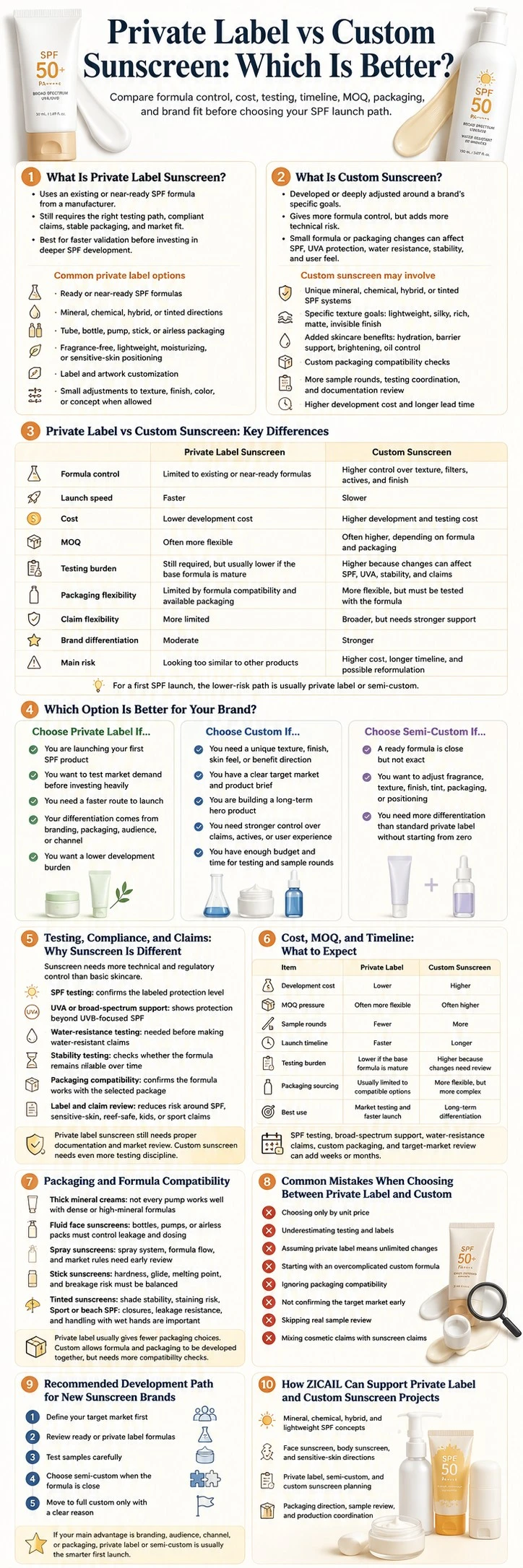
Private Label vs Custom Sunscreen: Key Differences
Private label and custom sunscreen solve different business problems. One reduces development pressure; the other gives more control but adds more testing, cost, and formulation risk.
| Factor | Private Label Sunscreen | Custom Sunscreen |
|---|---|---|
| Formula control | Limited to existing or near-ready formulas | Higher control over texture, filters, actives, and finish |
| Launch speed | Faster | Slower |
| Cost | Lower development cost | Higher development and testing cost |
| MOQ | Often more flexible | Often higher, depending on formula and packaging |
| Testing burden | Still required, but usually lower if the base formula is mature | Higher because changes can affect SPF, UVA, stability, and claims |
| Packaging flexibility | Limited by formula compatibility and available packaging | More flexible, but must be tested with the formula |
| Claim flexibility | More limited | Broader, but needs stronger support |
| Brand differentiation | Moderate | Stronger |
| Main risk | Looking too similar to other products | Higher cost, longer timeline, and possible reformulation |
For a first SPF launch, the lower-risk path is usually private label or semi-custom. Full custom makes more sense when formula uniqueness is central to the brand strategy.
Which Option Is Better for Your Brand?
Choose based on your brand stage, sales channel, and how much formula differentiation you truly need.
Choose private label sunscreen if:
- You are launching your first SPF product.
- You want to test market demand before investing heavily.
- You need a faster route to launch.
- Your main differentiation comes from branding, packaging, audience, or channel.
- You want a lower development burden.
Choose custom sunscreen if:
- You need a unique texture, finish, skin feel, or benefit direction.
- You have a clear target market and product brief.
- You are building a long-term hero product.
- You need stronger control over claims, actives, or product experience.
- You have enough budget and time for testing and sample rounds.
Choose semi-custom sunscreen if:
- A ready formula is close but not exact.
- You want to adjust fragrance, texture, finish, tint, packaging, or positioning.
- You need more differentiation than standard private label without starting from zero.
Testing, Compliance, and Claims: Why Sunscreen Is Different
Sunscreen needs more technical and regulatory control than a cleanser, toner, or basic moisturizer. In many markets, SPF products are treated as OTC drug products, regulated cosmetics, or special-function products, so formula choices, claims, labels, and testing require closer review.
In the United States, OTC sunscreen products are subject to FDA sunscreen rules, including labeling and effectiveness testing requirements for SPF, broad-spectrum, and water-resistance claims.[1][2] Other markets have their own pathways, so brands should confirm requirements for each target region before launch.
Key areas to review include:
- SPF testing: Confirms the labeled sun protection level.[2]
- UVA or broad-spectrum support: Helps show protection beyond UVB-focused SPF.[3]
- Water-resistance testing: Needed before making water-resistant claims.[1][3]
- Stability testing: Checks whether the formula remains reliable over time.
- Packaging compatibility: Confirms the formula works with the selected tube, bottle, pump, stick, or spray system.
- Label and claim review: Reduces the risk of unsupported SPF, sensitive-skin, reef-safe, kids, or sport claims.
Do not skip this: Private label sunscreen still needs proper documentation and market review. Custom sunscreen needs even more testing discipline because formulation changes can affect performance.
Cost, MOQ, and Timeline: What to Expect
Private label sunscreen usually has a lower development cost, shorter timeline, and lighter MOQ pressure. Custom sunscreen often needs a larger budget because the formula, samples, testing, packaging, and documentation may all require more work.
Exact costs and lead times vary by supplier, target market, SPF level, formula type, claims, packaging, and order size. Avoid choosing only by the lowest unit price. A low-cost formula can become expensive if it fails testing, needs packaging changes, or cannot support required claims.
| Item | Private Label | Custom Sunscreen |
|---|---|---|
| Development cost | Lower | Higher |
| MOQ pressure | Often more flexible | Often higher |
| Sample rounds | Fewer | More |
| Launch timeline | Faster | Longer |
| Testing burden | Lower if the base formula is mature | Higher because changes need review |
| Packaging sourcing | Usually limited to compatible options | More flexible, but more complex |
| Best use | Market testing and faster launch | Long-term differentiation |
SPF testing, broad-spectrum support, water-resistance claims, custom packaging, and target-market review can add weeks or months. Build extra time into the project instead of planning around the fastest possible supplier promise.
Packaging and Formula Compatibility
Sunscreen packaging is not only about appearance. It must match formula thickness, flow, UV filter system, user scenario, filling method, and stability needs. A good package should protect the formula, dispense the right amount, and feel practical for the way customers use the product.
Key packaging checks include:
- Thick mineral creams: Not every pump works well with dense or high-mineral formulas.
- Fluid face sunscreens: Bottles, pumps, or airless packaging must control leakage and dosing.
- Spray sunscreens: The spray system, formula flow, and market rules need early review.
- Stick sunscreens: Hardness, glide, melting point, and breakage risk must be balanced.
- Tinted sunscreens: Shade stability, staining risk, and package cleanliness matter.
- Sport or beach SPF: Closures, leakage resistance, and handling with wet hands are important.
Private label projects usually have fewer packaging choices because the formula is already built. Custom sunscreen allows formula and packaging to be developed together, but that also means more compatibility checks before approval.
Common Mistakes When Choosing Between Private Label and Custom Sunscreen
Avoid these mistakes before choosing your sunscreen development path:
- Choosing only by unit price: Low price is not useful if the formula fails testing, feels poor, or cannot support your claims.
- Underestimating testing and labels: SPF, broad-spectrum, water-resistance, kids, sensitive-skin, and reef-safe claims need careful review.
- Assuming private label means unlimited changes: Too many changes can turn a simple private label project into a custom development project.
- Starting with an overcomplicated custom formula: New brands often create too many texture, active, claim, and packaging demands at once.
- Ignoring packaging compatibility: The wrong pump, tube, stick, or spray system can create leakage, poor dispensing, instability, or bad user experience.
- Not confirming the target market early: UV filters, claims, and label wording can vary by region.
- Skipping real sample review: Test texture, white cast, smell, spreadability, packaging feel, and user feedback before bulk production.
- Mixing cosmetic claims with sunscreen claims: Hydration or brightening claims are different from SPF, broad-spectrum, or water-resistance claims.
Recommended Development Path for New Sunscreen Brands
New sunscreen brands should not start with the most complex formula unless they already have a clear sales channel, budget, and testing plan. A simpler launch path gives better control over risk, timeline, and user feedback.
- Define your target market first. Confirm where the product will be sold and what SPF, broad-spectrum, water-resistance, or positioning claims matter for that market.
- Review ready or private label formulas. Start by checking existing SPF options. This helps you understand texture, white cast, finish, packaging fit, and realistic launch direction.
- Test samples carefully. Review spreadability, smell, skin feel, white cast, finish, leakage, packaging usability, and feedback from real users.
- Choose semi-custom when the formula is close. If a formula works well but needs small adjustments, semi-custom can improve brand fit without starting from zero.
- Move to full custom only with a clear reason. Custom development makes sense when your brand needs a unique texture, claim direction, active system, or long-term hero product.
If your main advantage is branding, audience, channel, or packaging, private label or semi-custom is the smarter first launch. Move to full custom when formula uniqueness becomes a core business advantage.
How ZICAIL Can Support Private Label and Custom Sunscreen Projects
ZICAIL helps skincare brands compare private label, semi-custom, and custom sunscreen development paths before moving into production. The goal is to choose a practical route based on your target market, formula direction, packaging needs, and launch plan.
ZICAIL can help with:
- Mineral, chemical, hybrid, and lightweight SPF concepts
- Face sunscreen, body sunscreen, and sensitive-skin directions
- Private label, semi-custom, and custom sunscreen planning
- Packaging direction, sample review, and production coordination


