

Why Sunscreen Packaging Matters More Than Regular Skincare Packaging
Sunscreen packaging is not just a design choice. Because sunscreen is a functional product, the package must protect the formula, support correct use, and leave enough space for product and compliance information.
Good sunscreen packaging should support:
- Formula protection: Reduce exposure to heat, light, air, leakage, and contamination.
- User application: Make squeezing, pumping, spraying, or spreading easy enough for regular use.
- Outdoor durability: Handle beach bags, pool use, gym bags, travel, and outdoor sports better than a typical face cream jar.
- Label space: Leave room for SPF, PA/UVA information, directions, warnings, expiry date, PAO symbol, batch code, ingredients, and claims.
- Market requirements: In the United States, sunscreen labeling may involve OTC Drug Facts requirements. Other markets may also require cosmetic, sunscreen, recycling, packaging, and language information.
A good-looking package is not enough. For sunscreen, packaging must work with the formula, the user, and the target market.
Main Types of Sunscreen Packaging
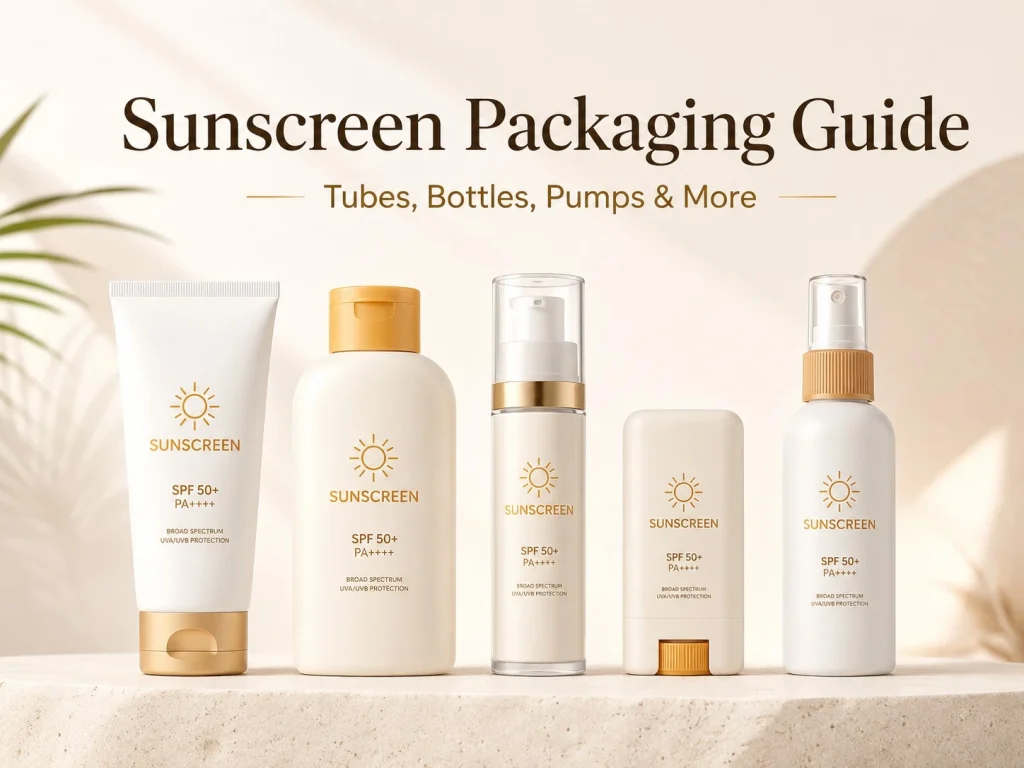
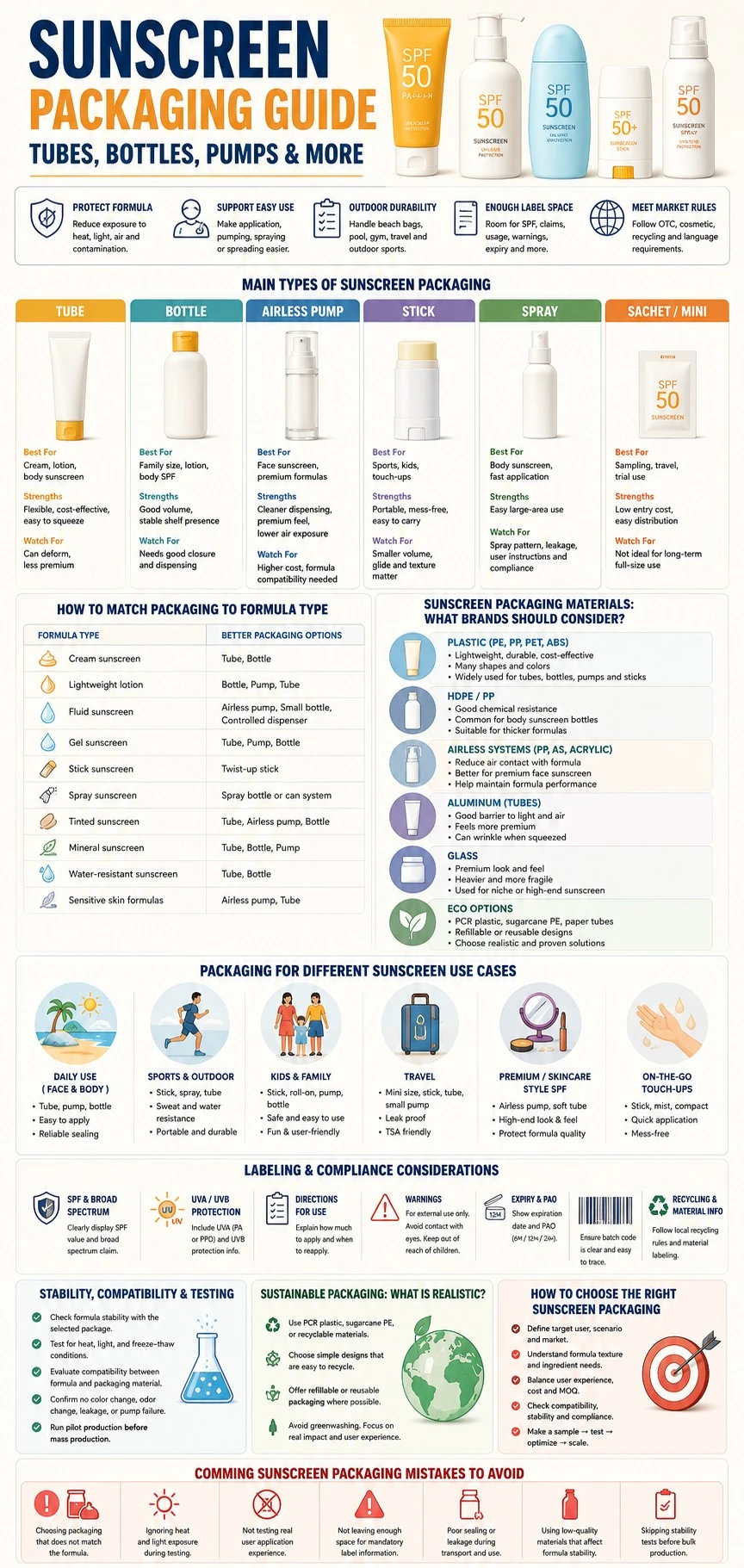
Most sunscreen projects start with one practical question: which format makes the product easy to use, stable, and suitable for the target market? The table below compares the main options.
Packaging Type | Best For | Strengths | Watch For |
|---|---|---|---|
Tube | Cream, lotion, body sunscreen | Flexible, cost-effective, easy to squeeze | Can deform, less premium |
Bottle | Family size, lotion, body SPF | Good volume, stable shelf presence | Needs good closure and dispensing |
Airless pump | Face sunscreen, premium formulas | Cleaner dispensing, premium feel, lower air exposure | Higher cost, formula compatibility needed |
Jar | Balm-like or niche formats | Wide opening, easy to fill | Not ideal for most sunscreen because of air and finger contact |
Stick | Sports, kids, touch-ups | Portable, mess-free, easy to carry | Smaller volume, glide and texture matter |
Spray | Body sunscreen, fast application | Easy large-area use | Spray pattern, leakage, user instructions, and compliance need review |
Roll-on | Kids, travel, face/body touch-up | Controlled application, easy to apply | Ball system must suit the formula |
Sachet / trial pack | Sampling, travel, trial use | Low entry cost, easy distribution | Not ideal for long-term full-size use |
For most sunscreen projects, tubes and bottles are the practical starting point. Airless pumps, sticks, and sprays work best when the formula texture, price point, user habit, and target market support them.
How to Match Sunscreen Packaging to Formula Type
In sunscreen projects, packaging cannot be chosen by appearance alone. A package may fail if the formula is too thick, too fluid, too pigmented, or difficult to dispense evenly. I usually review formula texture before confirming packaging, because changing it late can affect cost, timing, and testing.
Formula Type | Better Packaging Options | Main Reason |
|---|---|---|
Cream sunscreen | Tube, bottle | Handles thicker texture and daily use |
Lightweight lotion | Bottle, pump, tube | Easy to dispense and apply |
Fluid sunscreen | Airless pump, small bottle, controlled dispenser | Helps control runny textures |
Gel sunscreen | Tube, pump, bottle | Depends on viscosity and flow |
Stick sunscreen | Twist-up stick | Fits solid sunscreen format |
Spray sunscreen | Spray bottle or can system | Must match viscosity and spray behavior |
Tinted sunscreen | Tube, airless pump, bottle | Better control and cleaner use |
Mineral sunscreen | Tube, bottle, pump | Needs smooth dispensing and even dispersion |
Chemical or hybrid sunscreen | Tube, bottle, pump, airless pump | Needs compatibility and stability review |
Tinted and mineral sunscreens need extra attention because pigments and mineral filters must stay evenly dispersed. For chemical and hybrid formulas, packaging should also be checked for compatibility, light exposure, heat exposure, and long-term stability.
Sunscreen Packaging Materials: What Should Brands Consider?

Sunscreen packaging materials should be selected for formula protection, usability, and market fit. Common options include PE, PP, PET, PCR plastic, aluminum, and laminated tubes. The best material is not always the most premium-looking one; it is the one that works with the formula and target market.
Brands should consider:
- Formula compatibility: The package should not react with the sunscreen, change odor, affect color, or weaken texture.
- Barrier needs: Some formulas need better protection from light, air, heat, or moisture.
- Squeeze and dispensing feel: Tubes and bottles should release product smoothly without cracking, leaking, or becoming messy.
- Decoration method: Printing, labeling, coating, and color matching should fit the brand position and production budget.
- Cost and MOQ: Custom packaging may not suit an early-stage product if the MOQ or tooling cost is too high.
- Recyclability and PCR options: Recyclable or PCR packaging is valuable, but it should not reduce stability or user experience.
- Target market rules: International brands may need to consider recycling labels, language space, and packaging waste requirements.
The EU Packaging and Packaging Waste Regulation also makes recyclability, clear labeling, and reduced packaging waste more important for brands selling internationally. Still, sunscreen packaging should first protect the formula and help users apply the product properly.
Packaging for Different Sunscreen Use Cases
Sunscreen packaging should match how the product will actually be used. A daily face SPF, a family beach sunscreen, and a kids’ touch-up product need different packaging. In OEM projects, use case is one of the fastest ways to narrow the options.
Use Case | Better Packaging | Why It Works |
|---|---|---|
Daily face sunscreen | Airless pump, small tube | Cleaner, controlled dispensing with a more skincare-like feel |
Body sunscreen | Tube, bottle, pump bottle | Easier to apply in larger amounts |
Kids sunscreen | Stick, roll-on, tube | Cleaner use and easier control for parents |
Sports / outdoor sunscreen | Tube, stick, durable bottle | Portable, less messy, and easier to carry |
Travel sunscreen | Small tube, sachet, mini bottle | Lightweight and easy to pack |
Beach / family sunscreen | Larger bottle, pump bottle, tube | Better for repeated use and larger application areas |
Premium skincare sunscreen | Airless pump, decorated tube | Supports a more refined product image |
Dermatology / sensitive skin positioning | Airless pump, simple tube, controlled bottle | Cleaner dispensing and a more clinical feel |
The best packaging supports the user’s real habit. A premium face sunscreen needs cleaner, controlled dispensing, while a family body sunscreen needs enough volume for repeated use.
Labeling and Compliance Considerations for Sunscreen Packaging
Sunscreen packaging is also label space. A package may look attractive, but if it cannot carry the required information clearly, it can create problems before launch.
Label needs vary by market, but brands should plan for:
- Product identity: SPF level, sunscreen format, skin type, and main positioning.
- Directions and warnings: Application amount, reapplication, water resistance, sun exposure warnings, and age-related guidance where required.
- Market-specific fields: In the United States, sunscreen products may need OTC Drug Facts, directions, and warnings. Other markets may require a UVA logo, PAO symbol, batch number, responsible person, INCI list, nominal content, recycling information, or local-language labeling.
- Claims review: Terms such as broad spectrum, water resistant, reef-safe, mineral, kids, sensitive skin, dermatologist tested, and hypoallergenic should be reviewed carefully.
- Label size: Very small bottles, sachets, sticks, and mini tubes may not leave enough room for complex market requirements.
Do not design the package first and “fit the compliance later.” For sunscreen, label space should be reviewed early with the target market, claims, and packaging size. Requirements vary by market, so brands should confirm final artwork with regulatory or compliance support before production.
Stability, Compatibility, and Testing Before Bulk Production
Sunscreen packaging should be tested with the actual formula, not chosen only from a catalog. A tube, pump, bottle, or spray system may look suitable, but the real test is how it performs with the final sunscreen texture over time.
Before confirming sunscreen packaging, check:
- Formula compatibility: The package should not affect odor, color, texture, separation, or product feel.
- Leakage risk: Caps, pumps, tubes, and bottles should seal well during storage, shipping, and use.
- Heat and light exposure: Sunscreen containers may face beach bags, cars, outdoor use, and transport conditions. FDA consumer guidance also notes that sunscreen containers should be protected from excessive heat and direct sun.
- Dispensing performance: Thick mineral formulas need smooth dispensing, while fluid formulas need controlled output.
- Tinted formula behavior: Pigments can stain caps, pumps, labels, or outer packaging if compatibility is poor.
- Drop and transport durability: Packaging should handle shipping pressure, vibration, and normal user handling.
- Label and printing resistance: Printing, labels, coatings, and decoration should resist rubbing, leakage, and sunscreen residue.
- User application experience: If the package makes the product messy or hard to use, customers may apply less than they need.
Stability and compatibility checks should happen before bulk packaging confirmation. Fixing packaging after production starts is slower, more expensive, and more damaging to launch timing.
Sustainable Sunscreen Packaging: What Is Realistic?
Sustainable sunscreen packaging matters, but formula protection comes first. A package is not better if it looks eco-friendly but leaks, deforms, affects stability, or makes the product harder to use.
Realistic options include recyclable mono-material tubes or bottles, PCR plastic where suitable, reduced outer packaging, FSC paper boxes, aluminum options, and refill concepts for selected formats. Brands should avoid vague claims like “eco-friendly” unless the material choice, recycling path, or packaging reduction can be clearly supported.
Reef-safe and sustainable packaging claims should not be mixed together. Reef-safe usually refers to formula positioning or ingredient choices, while sustainable packaging refers to the container, material, recyclability, and waste impact.
The EU Packaging and Packaging Waste Regulation also points toward stronger requirements for recyclability, labeling, and packaging waste reduction, so international brands should think about design for recyclability earlier in the project.
Better Direction | Be Careful With |
|---|---|
Recyclable mono-material packaging | Packaging that cannot protect the formula |
PCR plastic where suitable | Weak bottles that deform or leak |
Reduced outer packaging | Removing needed label space |
Clear recycling labels | Vague eco claims |
FSC paper boxes | Extra packaging that adds little value |
Refill concepts for suitable formats | Refill systems that create leakage or hygiene issues |
Sustainable sunscreen packaging still needs to pass compatibility, stability, leakage, transport, and user-experience checks.
How to Choose the Right Sunscreen Packaging for Your Brand
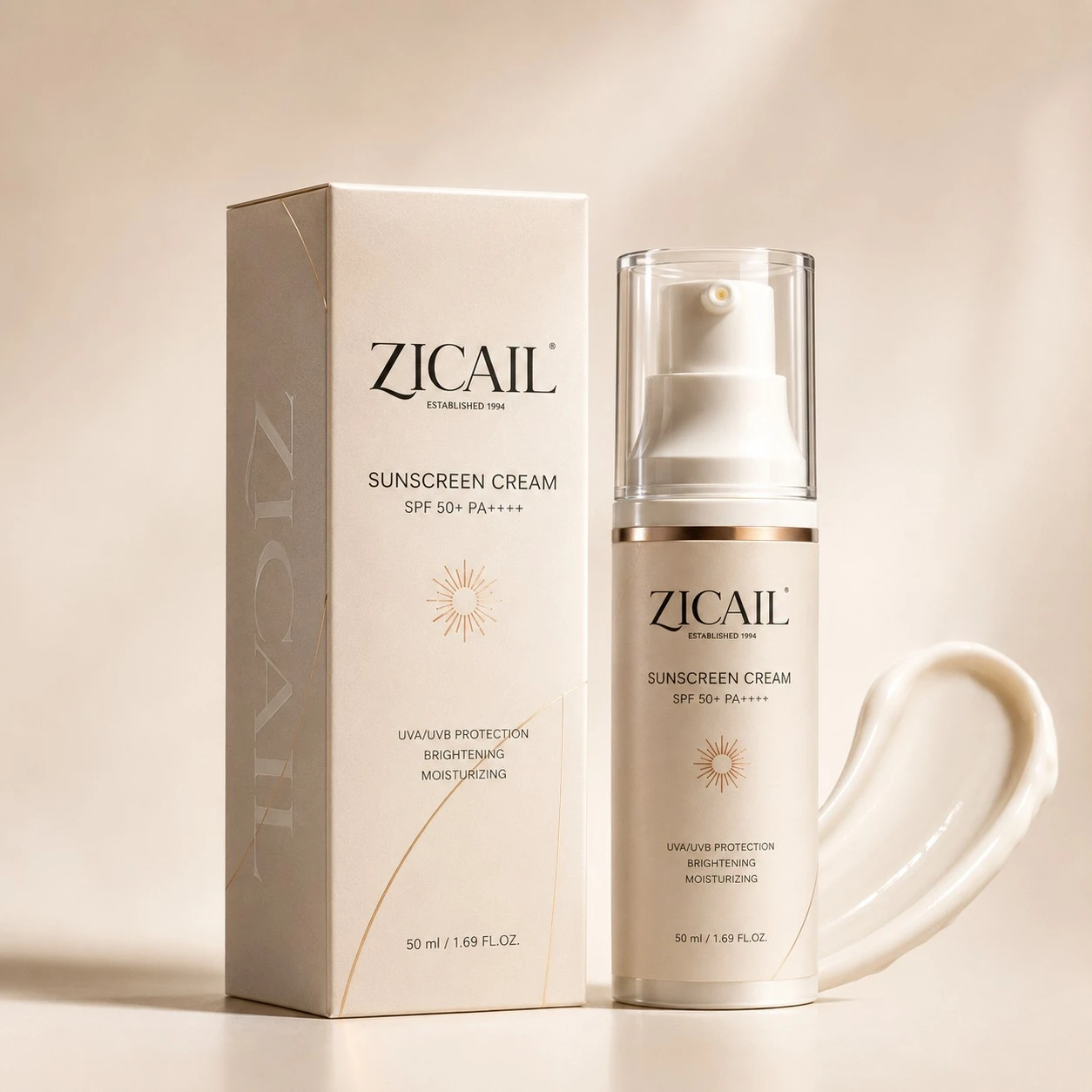
In real sunscreen projects, packaging should not be decided after the formula is finished. Formula, packaging, claims, and target market should be reviewed together from the beginning. This helps avoid good-looking packaging that does not fit the final texture, label needs, or market positioning.
Use this process:
- Define the formula type.
Start with the texture and format: cream, lotion, fluid, gel, stick, spray, tinted, mineral, chemical, or hybrid. - Define the target user and use case.
Daily face sunscreen, body sunscreen, kids sunscreen, sports sunscreen, and family beach sunscreen need different packaging logic. - Decide the market positioning.
A mass-market body sunscreen may need a practical tube or bottle. A premium face SPF may need a cleaner pump or decorated tube. - Check required label space.
Leave room for SPF, directions, warnings, batch code, expiry date, PAO, claims, ingredients, and market-specific fields. - Match packaging with viscosity and dispensing.
Thick formulas need easy output. Fluid formulas need controlled dispensing. Tinted formulas need cleaner handling. - Review cost, MOQ, and decoration options.
Custom packaging can support brand value, but it must fit the launch stage, budget, order quantity, and timeline. - Run compatibility and stability checks.
Test leakage, odor, color, texture, separation, pump performance, cap sealing, transport durability, and label resistance. - Confirm samples before bulk production.
Do not approve packaging only from photos or catalog images. Check filled samples with the real formula.
The right sunscreen packaging is not always the most expensive choice. It is the option that protects the formula, supports correct use, fits the brand position, and can be produced reliably.
Common Sunscreen Packaging Mistakes to Avoid
Small packaging mistakes can become large production or customer-experience problems. These are the issues I would check early before confirming a sunscreen package.
- Choosing packaging only by appearance.
A beautiful package can still fail if it leaks, dispenses poorly, lacks label space, or does not match the formula. - Using a dispenser that does not match viscosity.
Thick sunscreen can clog or become hard to squeeze. Fluid sunscreen can pour out too quickly if the opening is too large. - Choosing packaging that is too small for the required label.
Sunscreen often needs directions, warnings, claims, batch code, expiry date, PAO, and market-specific information. - Ignoring heat, leakage, and transport testing.
Sunscreen is often carried outdoors, in beach bags, and through warm shipping conditions. Packaging must handle real use. - Overusing sustainability claims without proof.
Words like “eco-friendly” or “green” need clear support. Vague claims can reduce trust instead of building it. - Choosing premium packaging that the price point cannot support.
Airless pumps, custom colors, metallic finishes, or special decoration may not fit every launch budget or MOQ. - Not testing tinted or mineral formulas carefully.
Pigments and mineral filters can affect dispensing, staining, separation, and user experience. - Copying competitor packaging without checking formula differences.
Two sunscreens can look similar online but behave very differently in the same tube, bottle, pump, or stick.
Final Thoughts
Sunscreen packaging should protect product performance and support real use. The best option is not always the most expensive, most beautiful, or most popular format. It should match the formula texture, user scenario, target market, label requirements, and brand position.
For OEM/ODM sunscreen projects, formula and packaging should be developed together from the beginning. When packaging is chosen too late, brands may face problems with dispensing, leakage, label space, stability, or final product cost. A practical package that works reliably is usually better than a package that only looks good in photos.


