


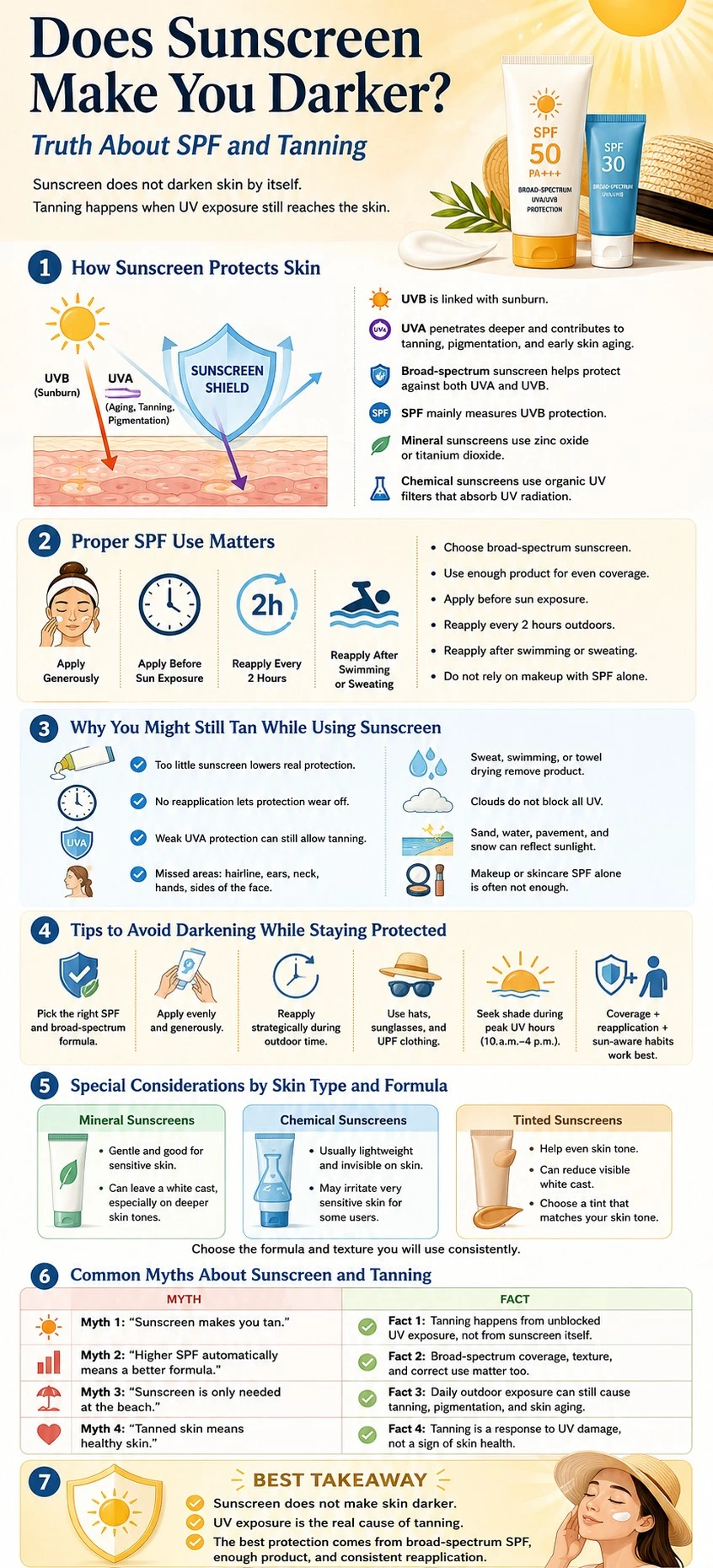
How Sunscreen Works to Protect Skin
Sunscreen protects skin by reducing how much ultraviolet radiation reaches the skin. UVB is strongly linked with sunburn, while UVA penetrates more deeply and contributes to tanning, pigmentation, and early skin aging. A broad-spectrum sunscreen helps protect against both UVA and UVB.
SPF mainly tells you how well a sunscreen protects against sunburn caused by UVB. It does not mean you can stay in the sun all day without reapplying. Broad-spectrum protection is important because someone can still tan or darken from UVA exposure even if they do not burn easily.
Mineral sunscreens use filters such as zinc oxide or titanium dioxide to sit on the skin and help reflect and scatter UV rays. Chemical sunscreens use organic UV filters that absorb UV radiation and convert it into lower-energy heat. Both types can work well when the formula is broad-spectrum and used correctly.
Key points for proper SPF use:[2]
- Choose broad-spectrum sunscreen for UVA and UVB protection.
- Use enough product to cover the skin evenly.
- Apply before sun exposure, not after you already feel hot.
- Reapply at least every two hours outdoors, and after swimming or sweating.
- Do not rely on makeup with SPF as your only protection during strong sun.
Why You Might Still Tan While Using Sunscreen
If your skin gets darker while using sunscreen, the sunscreen is usually not the cause. More often, the issue is that enough UV still reached the skin. This can happen even with a good product if the real-life use does not match the label conditions.
Common reasons sunscreen users still tan:
- You applied too little. Thin application lowers real protection and leaves gaps on the skin.
- You did not reapply often enough. Sunscreen can wear off from sweat, water, rubbing, and time outdoors. Reapply at least every two hours when outside.
- Your sunscreen does not protect enough against UVA. UVA can contribute to tanning and dark spots, so broad-spectrum protection matters.
- You missed common areas. Hairline, ears, neck, hands, and the sides of the face are easy to skip.
- Sweat, swimming, or towel drying removed product. Water-resistant sunscreen still needs reapplication after swimming or heavy sweating.
- Your environment increased exposure. Clouds do not block all UV. Sand, water, pavement, and snow can reflect sunlight and increase exposure.
- You relied on makeup or skincare SPF alone. Foundation or moisturizer with SPF may not be applied thickly or evenly enough for outdoor protection.
Tips to Avoid Darkening While Staying Protected
Even with sunscreen, tanning can occur if protection is incomplete. Choosing the right SPF and broad-spectrum protection is only the first step. How you apply and maintain coverage matters just as much. I always focus on real-world use: coverage, reapplication, and sun-aware habits.
Key tips to stay protected without darkening:
- Pick the right SPF and broad-spectrum sunscreen. Match SPF to your planned exposure and skin sensitivity.
- Apply evenly and generously. Don’t miss ears, neck, hands, or the back of the legs.
- Reapply strategically. Every two hours outdoors, after swimming or heavy sweating.
- Use additional barriers. Hats, sunglasses, and UPF clothing can reduce sun exposure.
- Plan your outdoor activity. Seek shade during peak UV hours (10 a.m.–4 p.m.) when possible.
Real-life practice shows that combining proper SPF, complete coverage, and thoughtful reapplication dramatically lowers unwanted darkening while still letting skin stay safe.
Special Considerations by Skin Type and Formula
Not all skin reacts the same to UV exposure or sunscreen. Lighter, sensitive, or reactive skin may show redness or burn, while darker skin may tan more visibly. Formula type also affects coverage, white cast, and finish.
- Mineral sunscreens (zinc oxide, titanium dioxide)
- Pros: Gentle, good for sensitive skin, broad protection
- Cons: Can leave a white cast, more noticeable on darker skin
- Chemical sunscreens
- Pros: Lightweight, invisible finish, easier layering under makeup
- Cons: Some may irritate very sensitive skin
- Tinted sunscreens
- Pros: Evens skin tone, reduces visible white cast
- Tips: Match tint to skin tone; apply in thin layers and blend edges
Tips for all users: ensure even coverage on high-risk areas, choose formula and texture that match daily routines, and reapply consistently. Personal testing on small areas helps identify the best match for both protection and aesthetic finish.
See also: What is My Skin Type
Common Myths About Sunscreen and Tanning
Many misconceptions confuse users about tanning and sun protection. Clarifying them helps people apply sunscreen correctly and avoid unintended darkening.
- Myth: Sunscreen makes you tan.
Fact: Sunscreen blocks UV; tanning occurs from unblocked UV exposure or insufficient application. - Myth: Higher SPF automatically means white, heavy formula is better.
Fact: SPF only measures UVB protection; texture and broad-spectrum coverage matter more. - Myth: Sunscreen is only needed at the beach.
Fact: Daily sun exposure contributes to tanning, pigmentation, and skin aging; use sunscreen outdoors year-round. - Myth: Tanned skin = healthy skin.
Fact: Tanning is a skin response to UV damage and may indicate cumulative harm, not health.[3]
Final Recommendations
Correct sunscreen use is the most effective way to prevent tanning and long-term skin damage. Choose an SPF that matches your sun exposure, apply evenly, and reapply as needed—especially after swimming, sweating, or towel use.
Combine sunscreen with hats, sunglasses, and protective clothing for maximum protection. For further guidance on formulation, application, and sun care routines, see our related sunscreen and skincare articles.
Sources
[1] U.S. Food and Drug Administration. “The Risks of Tanning.”
[2] American Academy of Dermatology Association. “How to Apply Sunscreen.”
[3] Skin Cancer Foundation. “Tanning & Your Skin.”


