

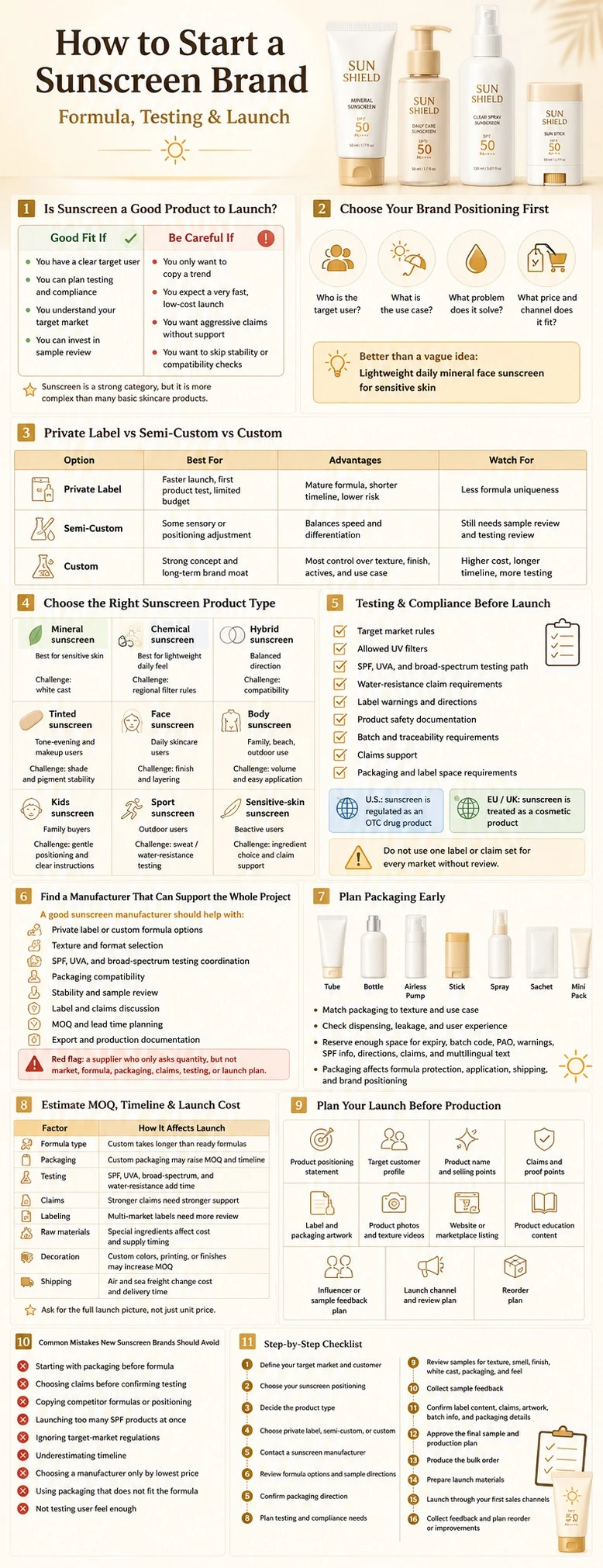
Is Sunscreen a Good Product to Launch?
Sunscreen can be a strong product to launch because sun care is no longer limited to beach use. Daily SPF, skincare-style sunscreen, tinted sunscreen, mineral sunscreen, body sunscreen, kids sunscreen, sport sunscreen, and sensitive-skin sunscreen all give brands different entry points.
Still, sunscreen is not the easiest beginner product. It involves claim review, testing, labeling, stability, packaging, and market-specific requirements. For a new brand, the best first sunscreen is usually not the highest SPF, the most complex claim, or the most unusual format. A better path is a focused product with a defined user, realistic claims, suitable packaging, and a manageable testing route.
| Good Fit If | Be Careful If |
|---|---|
| You have a clear target user | You only want to copy a trending product |
| You can plan testing and compliance | You expect a very fast, low-cost launch |
| You understand your target market | You want aggressive claims without support |
| You can invest in sample review | You want to skip stability or compatibility checks |
Sunscreen is worth launching when the product concept is specific enough to guide formula, packaging, testing, and marketing decisions.
Choose Your Sunscreen Brand Positioning First
Before choosing a formula, define who the sunscreen is for. In real sunscreen projects, unclear positioning causes more delays than formula development. If the brand cannot define the user, every later decision becomes harder, from SPF level and texture to packaging and claims.
A clear positioning should answer:
- Who is the target user? Daily skincare users, outdoor users, kids, sensitive-skin users, makeup wearers, athletes, families, and deeper skin tones may need different product directions.
- What is the use case? Daily face SPF, body SPF, kids SPF, sport SPF, tinted SPF, mineral sunscreen, and premium skincare sunscreen need different textures and packaging.
- What problem does the product solve? Common pain points include white cast, greasy feel, heavy texture, eye stinging, makeup pilling, sweat, outdoor wear, and poor fit for deeper skin tones.
- What price and channel does it fit? A premium DTC face sunscreen, a family body sunscreen, and a distributor-focused product should not use the same claims, packaging, or cost structure.
Avoid vague positioning like “for all skin types” or “the best sunscreen.” A sharper direction, such as “lightweight daily mineral face sunscreen for sensitive skin,” gives the manufacturer a clearer target and gives buyers a better reason to choose the product.
Decide Between Private Label and Custom Sunscreen
One of the first business decisions is whether to start with private label sunscreen, semi-custom sunscreen, or a fully custom formula. This choice affects cost, timing, testing, sample rounds, and how different your product can be.
| Option | Best For | Advantages | Watch For |
|---|---|---|---|
| Private label sunscreen | Faster launch, first product test, limited budget | Uses an existing mature formula; shorter timeline and lower development risk | Less formula uniqueness; packaging, label, and positioning still need careful planning |
| Semi-custom sunscreen | Brands needing some formula or sensory adjustment | Balances speed and differentiation; useful for texture, fragrance, finish, or positioning changes | Still needs sample review, testing review, and clear change limits |
| Custom sunscreen | Clear product concept, stronger brand moat | More control over texture, active system, finish, color, skin feel, and use case | Higher cost, longer timeline, more testing, and more sample adjustment |
For a first sunscreen product, I usually suggest being realistic. If your budget and timeline are limited, private label or semi-custom is often the smarter starting point. If your brand already has a strong concept and clear market gap, custom development can create stronger long-term differentiation.
See also: Private Label vs Custom Sunscreen: Which Is Better?
Choose the Right Sunscreen Product Type
Choosing the right sunscreen type is more important than chasing the most popular format. The better choice depends on the target market, texture goal, regulatory market, claim direction, and user expectation.
| Product Type | Best For | Key Challenge |
|---|---|---|
| Mineral sunscreen | Sensitive skin, clean-positioned brands | White cast, texture, dispersion |
| Chemical sunscreen | Lightweight daily feel | Market-specific filter rules |
| Hybrid sunscreen | Balanced texture and protection | Formula compatibility |
| Tinted sunscreen | Tone-evening, makeup users, deeper skin tones | Shade range and pigment stability |
| Face sunscreen | Daily skincare users | Finish, layering, eye comfort |
| Body sunscreen | Family, beach, outdoor use | Larger volume and easy application |
| Kids sunscreen | Family buyers | Gentle positioning and clear instructions |
| Sport sunscreen | Outdoor users | Sweat/water-resistance testing and claims |
| Sensitive-skin sunscreen | Reactive or delicate skin users | Ingredient choice and claim support |
| Lightweight daily SPF | City use and skincare routines | Elegant texture without weak positioning |
Do not frame mineral sunscreen as always better than chemical sunscreen. Mineral formulas may fit sensitive-skin or clean-positioned brands, but they can be harder to make elegant. Chemical and hybrid formulas may support lighter textures in some markets, but UV filter rules vary by region.
For a new brand, the best product type is one you can explain clearly, test properly, package well, and sell to a specific customer group.
Understand Testing and Compliance Before You Launch
Sunscreen is not like a basic moisturizer. It is a performance product, so claims, testing, labeling, formula stability, packaging, and market rules need to be reviewed before launch. This is one area where new brands should not guess.
Claims such as SPF, broad spectrum, UVA protection, water resistance, kids, sensitive skin, reef-safe, mineral, dermatologist tested, and hypoallergenic should be used carefully. Each claim may require different testing, label support, or market review.
In the United States, sunscreen products are regulated as OTC drug products and may need to follow specific labeling and testing requirements, including Drug Facts, directions, warnings, and broad-spectrum SPF conditions. In the EU and UK, sunscreen is treated as a cosmetic product, but brands still need to consider safety assessment, permitted UV filters, efficacy support, and labeling rules.
Before launch, confirm:
- Target market rules
- Allowed UV filters
- SPF, UVA, and broad-spectrum testing path
- Water-resistance claim requirements
- Label warnings and directions
- Product safety documentation
- Batch and traceability requirements
- Claims support
- Packaging and label space requirements
Do not use one label or claim set for every market without review. A sunscreen that is suitable for one region may need changes before it can be sold elsewhere.
Requirements vary by country, so brands should confirm final testing and label requirements with qualified regulatory support before production.
Find a Sunscreen Manufacturer That Can Support the Whole Project
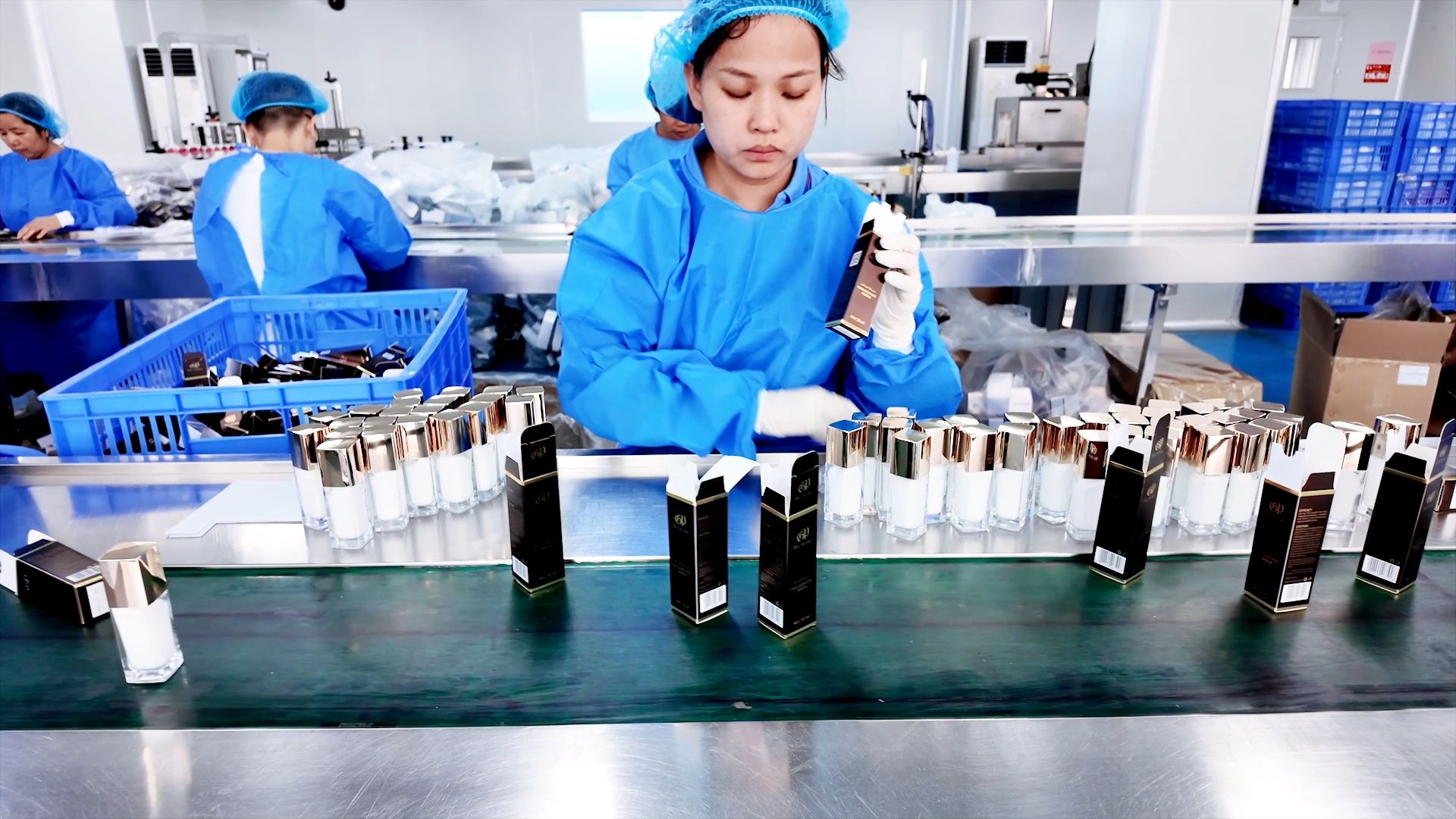
Starting a sunscreen brand is not only about finding a factory that can fill sunscreen into a tube or bottle. You need a manufacturer that understands the full project: formula, samples, packaging, testing, labels, production, and export preparation.
For a first sunscreen product, the right manufacturer is not always the cheapest one. It is the one that helps you avoid formula, testing, packaging, and compliance mistakes before bulk production.
A good sunscreen manufacturer should help with:
- Private label or custom formula options: They should explain which path fits your budget, timeline, and product goal.
- Texture and format selection: Face sunscreen, body sunscreen, mineral sunscreen, tinted sunscreen, and sport sunscreen all need different development logic.
- SPF, UVA, and broad-spectrum testing coordination: They should understand what testing may be needed for your target market and claims.
- Packaging compatibility: The package should match the formula texture, dispensing needs, label space, and shipping conditions.
- Stability and sample review: Samples should be checked for texture, smell, color, separation, leakage, and user feel.
- Label and claims discussion: A good supplier should warn you when claims are too aggressive or need stronger support.
- MOQ and lead time planning: They should give realistic production planning instead of only quoting a unit price.
- Export and production documentation: Documents, batch records, certificates, and shipping support matter for international brands.
Be careful if a manufacturer only asks, “How many pieces do you want?” but does not ask about your market, formula type, packaging, claims, testing, or launch plan.
See also:
Questions to Ask a Sunscreen Manufacturer Before You Start
How to Choose a Sunscreen Manufacturer for Your Brand
Plan Your Sunscreen Packaging Early

Sunscreen packaging affects formula protection, dispensing, label space, user application, shipping, and brand positioning. It should be planned while the formula is still being reviewed, not after everything else is finished.
Common options include tubes, bottles, airless pumps, sticks, sprays, sachets, and mini packs. Each format works better for different formulas and use cases.
For example:
- Thick mineral sunscreen needs packaging that supports smooth dispensing and even use.
- Fluid face SPF needs controlled output so the product does not run or spill.
- Tinted sunscreen needs cleaner dispensing and packaging that reduces staining issues.
- Body lotion sunscreen usually needs a tube, bottle, or pump for larger application amounts.
- Travel sunscreen needs compact packaging that is light, clean, and easy to carry.
For global brands, packaging also needs enough label space for PAO, expiry date, batch code, recycling information, local language, SPF information, directions, warnings, and claims.
For a deeper breakdown, see our sunscreen packaging guide.
Estimate MOQ, Timeline, and Launch Cost
Sunscreen launch planning should include MOQ, timeline, and total cost—not just unit price. A low unit price does not help if testing, packaging, sample changes, shipping, or compliance review delay the launch.
Private label sunscreen is usually faster than custom sunscreen because the formula path is already clearer. Custom sunscreen takes longer because it may involve formula development, sample rounds, stability or compatibility checks, SPF-related testing, packaging confirmation, and label review.
| Factor | How It Affects Launch |
|---|---|
| Formula type | Custom formulas take longer than ready formulas |
| Packaging | Custom packaging may raise MOQ and timeline |
| Testing | SPF, UVA, broad spectrum, or water-resistance tests add time |
| Claims | Stronger claims need stronger support |
| Labeling | Multi-market labels need more review |
| Raw materials | Special ingredients may affect cost and supply timing |
| Decoration | Custom colors, printing, or finishes may increase MOQ |
| Shipping | Air and sea freight change cost and delivery time |
Launch cost can include sample fees, packaging cost, testing cost, label design, regulatory review, unit price, shipping, duties, product photography, and marketing content.
Instead of only asking, “What is your price per unit?” ask for the full launch picture: formula path, MOQ, sample process, testing needs, packaging timeline, production schedule, and shipping plan.
See also: How Much Does It Cost to Launch a Sunscreen Brand?
Plan Your Launch and Marketing Channels Before Production
Do not wait until bulk production is finished to decide how you will sell the sunscreen. Your launch channel affects product size, packaging design, key claims, photos, content, sample plan, and reorder timing.
Before bulk launch, prepare:
- Product positioning statement: Define the product in one clear sentence.
- Target customer profile: Know whether you are selling to daily skincare users, families, outdoor users, sensitive-skin buyers, or another group.
- Product name and main selling points: Keep them specific and easy to understand.
- Key claims and proof points: Make sure claims match testing, formula direction, and target market rules.
- Label and packaging artwork: Prepare final packaging before production.
- Product photos and texture videos: Show texture, finish, white cast, makeup compatibility, and outdoor use.
- Website page or marketplace listing: Prepare product descriptions, FAQs, directions, and claim explanations.
- Product education content: Explain how much to apply, when to reapply, skin type fit, water resistance, and daily use.
- Influencer or sample feedback plan: Collect feedback on texture, smell, white cast, packaging convenience, and application feel.
- Launch channel and review plan: Decide where you will sell first and how you will collect early customer feedback.
- Reorder plan: Plan stock so your launch does not stop after the first batch.
For global brands, prepare multilingual labels, product pages, FAQs, usage instructions, and market-specific compliance information early. In real sunscreen projects, brands that collect sample feedback before bulk production usually make better decisions on texture, packaging, claims, and launch content.
Common Mistakes New Sunscreen Brands Should Avoid
The biggest mistake I see is treating sunscreen like a normal cream. Sunscreen is a performance product, so formula, testing, packaging, and claims must be planned together.
Avoid these common mistakes:
- Starting with packaging before formula. A beautiful tube or bottle may not work with the final texture, dispensing needs, or label space.
- Choosing claims before confirming testing. SPF, broad spectrum, water resistance, sensitive skin, kids, mineral, and reef-safe claims need proper review and support.
- Copying competitor formulas or positioning. A product that works for one brand may not fit your target market, budget, packaging, or regulatory path.
- Trying to launch too many SPF products at once. New brands usually do better with one clear sunscreen direction before expanding the line.
- Ignoring target market regulations. Sunscreen rules vary by country, so one formula, label, or claim set may not work everywhere.
- Underestimating timeline. Sample rounds, packaging confirmation, testing, label review, and shipping can all extend launch time.
- Choosing a manufacturer only by lowest price. Cheap production can become expensive if testing, packaging, claims, or documentation are weak.
- Using packaging that does not fit the formula. Thick, fluid, tinted, mineral, and spray formulas all need different packaging checks.
- Not testing user feel enough. Sunscreen must feel good enough for daily use. Texture, white cast, smell, eye comfort, and makeup layering matter.
Step-by-Step Checklist for Starting a Sunscreen Brand
Use this checklist as a practical path from idea to launch:
- Define your target market and customer.
- Choose your sunscreen positioning.
- Decide the product type: mineral, chemical, hybrid, tinted, face, body, kids, sport, or sensitive-skin sunscreen.
- Choose private label, semi-custom, or custom development.
- Contact a sunscreen manufacturer with your target market, product idea, budget range, and launch goal.
- Review formula options and sample directions.
- Confirm packaging direction based on texture, use case, label space, and market position.
- Plan testing and compliance needs for your target market.
- Review samples for texture, smell, finish, white cast, packaging, and user feel.
- Collect sample feedback before bulk production.
- Confirm label content, claims, artwork, batch information, and packaging details.
- Approve the final sample and production plan.
- Produce the bulk order.
- Prepare launch materials, including product photos, videos, FAQs, product pages, listings, and education content.
- Launch through your first sales channels.
- Collect customer feedback and plan reorder or product improvements.
A clear process helps new sunscreen brands avoid rushed decisions. The goal is not to launch the most complicated product first; it is to launch a focused sunscreen that can be tested, produced, explained, and sold with confidence.
Final Thoughts
Starting a sunscreen brand is easier when formula, packaging, testing, claims, and target market are planned together from the beginning. A clear and realistic first product is usually stronger than an overcomplicated sunscreen that is difficult to test, produce, explain, or sell.
If you are preparing to launch a private label or custom sunscreen product, ZICAIL can help you review formula direction, packaging options, sample development, testing needs, and production planning. Contact us to discuss your sunscreen project and find a practical path from concept to launch.


