


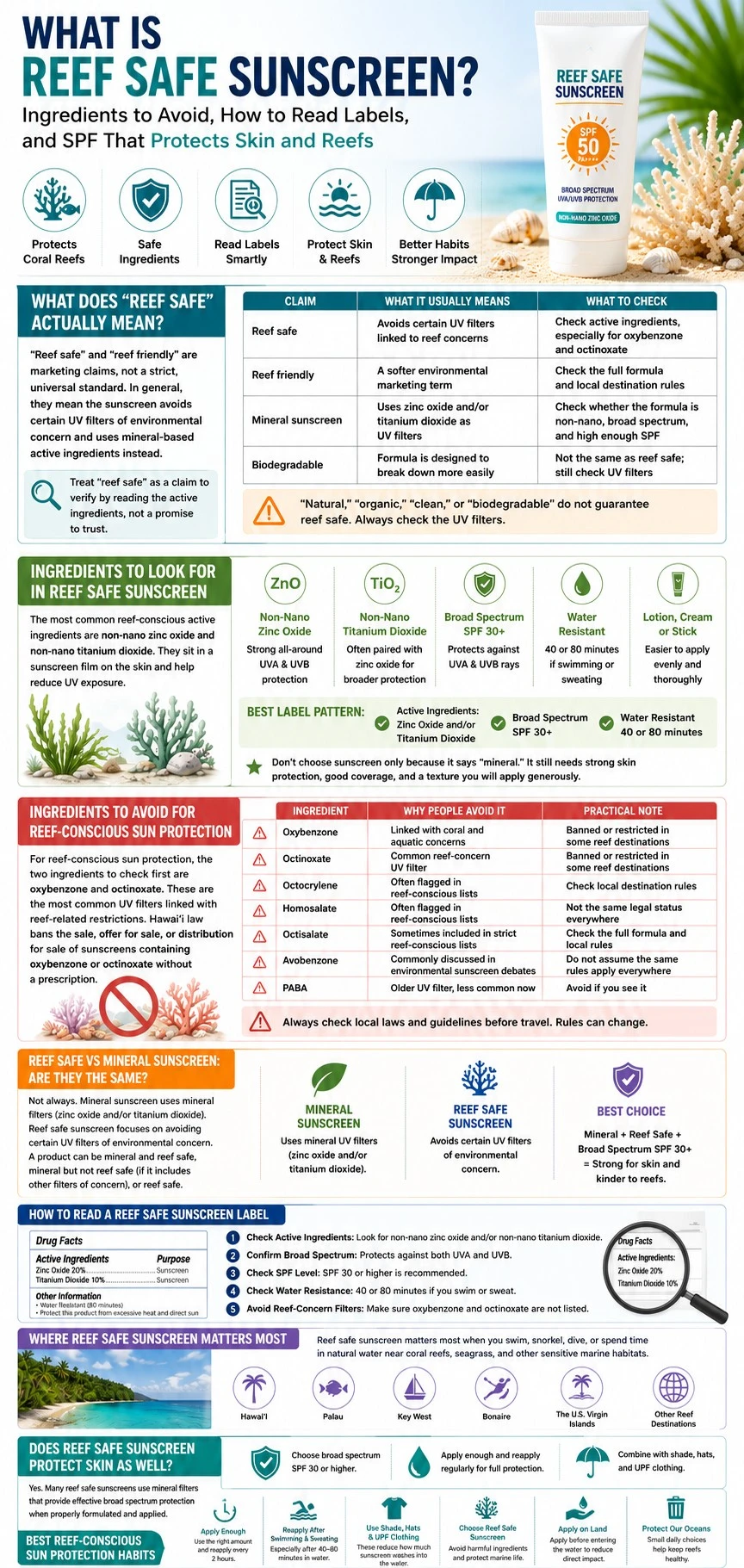
What Does “Reef Safe” Actually Mean?
“Reef safe” and “reef friendly” are common sunscreen label claims, but they do not have one strict definition across all brands, countries, or retailers.[4] In real shopping terms, reef safe sunscreen usually means a product avoids certain UV filters of environmental concern and uses mineral-based active ingredients instead.
Treat “reef safe” as a claim to verify, not a promise to trust. The best place to check is the active ingredients section, not the front of the bottle.
| Claim | What It Usually Means | What to Check |
|---|---|---|
| Reef safe | Avoids certain UV filters linked to reef concerns | Check active ingredients, especially for oxybenzone and octinoxate |
| Reef friendly | A softer environmental marketing term | Check the full formula and local destination rules |
| Mineral sunscreen | Uses zinc oxide and/or titanium dioxide as UV filters | Check whether the formula is non-nano, broad spectrum, and high enough SPF |
| Biodegradable | Formula is designed to break down more easily | Not the same as reef safe; still check UV filters |
Do not treat “natural,” “organic,” “clean,” or “biodegradable” as automatic proof that a sunscreen is reef safe. Those words may describe part of the formula, but they do not replace checking the UV filters.
Ingredients to Look For in Reef Safe Sunscreen
The most common reef-conscious active ingredients are non-nano zinc oxide and non-nano titanium dioxide. These are mineral UV filters that sit in a sunscreen film on the skin and help reduce UV exposure.[1][2]
Zinc oxide is often the stronger all-around choice because it can support broad UVA and UVB coverage. Titanium dioxide is also widely used, but it is often paired with zinc oxide for broader protection. The “non-nano” claim matters because larger mineral particles are generally preferred for reef-conscious formulas, though it is not a promise of zero environmental impact.
Look for labels that include:
- Non-nano zinc oxide as a main active ingredient.
- Non-nano titanium dioxide, often paired with zinc oxide.
- Broad Spectrum SPF 30 or higher for practical daily and beach protection.
- Water Resistant 40 minutes or 80 minutes if you swim or sweat.
- A lotion, cream, or stick format when possible, since these are easier to apply directly and evenly.
Best label pattern:
Active Ingredients: Zinc Oxide and/or Titanium Dioxide
Broad Spectrum SPF 30+
Water Resistant 40 or 80 minutes
Do not choose sunscreen only because it says “mineral.” A reef-conscious sunscreen still needs strong skin protection, good coverage, and a texture you will apply generously.
Ingredients to Avoid for Reef-Conscious Sun Protection
For reef-conscious sun protection, the two ingredients to check first are oxybenzone and octinoxate. These are the most common UV filters linked with reef-related restrictions.[1][3] Hawaiʻi law bans the sale, offer for sale, or distribution for sale of sunscreens containing oxybenzone or octinoxate without a prescription.[3]
Some reef-conscious lists also flag other UV filters or supporting ingredients, but not every ingredient has the same evidence level or legal status. Avoid the highest-profile reef-concern filters first, then check local rules before reef travel.
| Ingredient | Why People Avoid It | Practical Note |
|---|---|---|
| Oxybenzone | Linked with coral and aquatic concerns | Banned or restricted in some reef destinations |
| Octinoxate | Common reef-concern UV filter | Banned or restricted in some reef destinations |
| Octocrylene | Often flagged in reef-conscious lists | Check local destination rules |
| Homosalate | Often flagged in reef-conscious lists | Not the same legal status everywhere |
| Octisalate | Sometimes included in strict reef-conscious lists | Check the full formula and local rules |
| Avobenzone | Commonly discussed in environmental sunscreen debates | Do not assume the same rules apply everywhere |
| PABA | Older sunscreen ingredient often avoided in modern formulas | Avoid if following strict reef-conscious standards |
| Parabens | Preservative concern | Not a UV filter, but sometimes avoided in ocean-use products |
| Triclosan | Environmental concern | Avoid in ocean-use products |
The goal is not to fear every chemical name. It is to choose sunscreen more carefully near reefs while still protecting your skin from UV damage.
Reef Safe vs Mineral Sunscreen: Are They the Same?
Reef safe sunscreen and mineral sunscreen are related, but they are not the same thing. Mineral sunscreen describes the UV filters used in the formula, usually zinc oxide and/or titanium dioxide.[2] Reef safe sunscreen is an environmental label claim that should be checked, not accepted at face value.[4]
| Term | Main Meaning | What to Check |
|---|---|---|
| Mineral sunscreen | UV filter type | Zinc oxide, titanium dioxide |
| Reef safe sunscreen | Environmental claim | Active ingredients and local rules |
| Non-nano sunscreen | Particle size claim | Whether the mineral actives are non-nano |
| Water-resistant sunscreen | Wear claim | 40 or 80 minutes; not waterproof |
Many reef safe sunscreens are mineral sunscreens, but a mineral formula is not automatically ideal for every reef-conscious shopper. Check non-nano claims, water resistance, spray format, supporting ingredients, and travel rules.
The safest buying habit is simple: read the Drug Facts or active ingredients box. The front label can help you narrow choices, but it should not be your final proof.
How to Read a Reef Safe Sunscreen Label
The easiest way to judge reef safe sunscreen is to read the label in order: active ingredients first, skin protection second, and destination rules last.[4][5] This keeps you from relying only on marketing words like “natural,” “ocean friendly,” or “reef safe.”
- Find the Drug Facts or Active Ingredients box: This tells you what UV filters the sunscreen actually uses.
- Look for non-nano zinc oxide and/or titanium dioxide: These are the most common reef-conscious mineral filters.
- Avoid oxybenzone and octinoxate at minimum: These are the two highest-profile reef-concern filters.
- Check for broad-spectrum SPF 30 or higher: Reef-conscious sunscreen still needs strong skin protection.
- Check water resistance if you swim or sweat: Look for 40 minutes or 80 minutes on the label.
- Do not rely only on front-label claims: “Clean,” “natural,” “biodegradable,” and “reef friendly” do not replace the active ingredients list.
- Check local rules before travel: Reef destinations, marine parks, resorts, and tour operators may have stricter sunscreen rules.
Quick label rule: If the front says reef safe but the active ingredients are hard to verify, do not treat the claim as enough.
Where Reef Safe Sunscreen Matters Most
Reef safe sunscreen matters most when your sunscreen can wash directly into ocean water, especially near coral reefs or protected marine areas.[1][2] It also matters when a destination has local sunscreen rules, because those rules may be stricter than what you see on a product label.
Use extra care in places and activities such as:
- Coral reef destinations, especially tropical islands and reef parks.
- Snorkeling and diving trips, where sunscreen can enter the water directly.
- Swimming in marine parks, protected bays, or conservation areas.
- Beach resorts with sunscreen rules, especially those near reefs.
- Destinations such as Hawaii, the U.S. Virgin Islands, Palau, and some reef-focused tour areas.
Do not treat this as a fixed global legal list. Sunscreen rules can change by country, island, county, park, resort, or tour operator. Some local rules may be stricter than national or state-level rules, especially in reef-protection areas.
For travel, check official tourism, park, resort, or government guidance before packing sunscreen.
Does Reef Safe Sunscreen Protect Skin as Well?
Yes, reef safe sunscreen can protect skin well, but only if the formula gives real UV protection and you use enough.[5][6] The label still needs to support skin health, not just environmental claims.
A good reef-conscious sunscreen should be:
- Broad spectrum, so it helps protect against both UVA and UVB.
- SPF 30 or higher for practical outdoor and beach use.
- Water resistant if you swim, sweat, or spend long periods outside.
- Comfortable enough to apply generously, not just in a thin layer.
- Suitable for your skin tone and sensitivity, especially if you dislike white cast or heavy texture.
Mineral sunscreen often makes sense for sensitive skin, children, and reef-focused travel, but texture still matters. A reef-conscious sunscreen that you apply too thinly is not good skin protection.
Best Reef-Conscious Sun Protection Habits
Reef-conscious sun protection is not only about choosing a better sunscreen. It is also about reducing how much product washes into the ocean. Clothing, shade, and smarter beach habits can lower runoff while still protecting your skin.[1][2]
- Wear UPF clothing, rash guards, hats, and sunglasses to cover more skin with less sunscreen.
- Apply sunscreen before reaching the beach so it has time to form an even film.
- Let sunscreen dry or set before entering the water instead of applying it right at the shoreline.
- Avoid aerosol sprays near sand or water because overspray can scatter into the environment.
- Reapply on land and avoid rinsing freshly applied sunscreen directly into the ocean.
- Use shade during peak sun hours when possible, especially on long beach days.
These habits do not replace sunscreen. They make sunscreen use more controlled, more effective, and less likely to wash off immediately in reef areas.


