Understand PA sunscreen rating, UVA protection levels, PA+, PA++, PA+++, and how it compares with SPF. Learn how to choose better broad-spectrum sunscreen.
Table of Contents
Quick Answer: What Is PA Rating in Sunscreen?
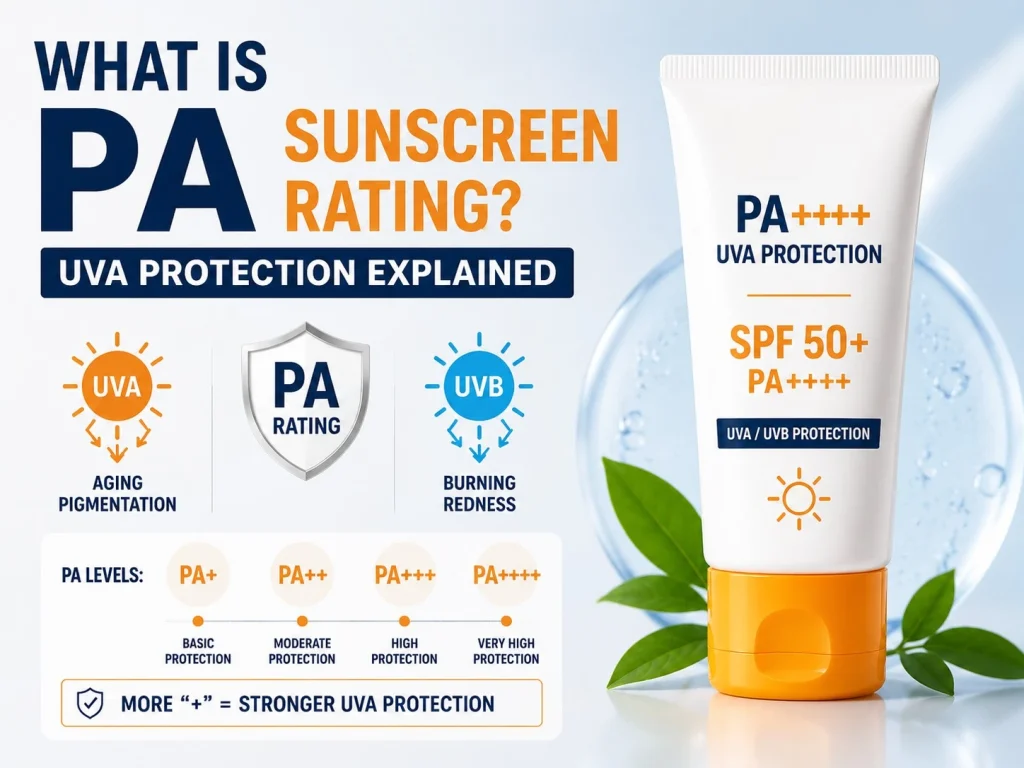
PA rating is a UVA protection grading system mainly used in Asia-Pacific sunscreen labeling. It indicates how well a sunscreen reduces UVA exposure, which is linked to long-term skin damage such as aging and pigmentation. [2]
It is based on the PPD (Persistent Pigment Darkening) test, which measures how effectively a product reduces UVA-induced skin darkening. PA levels range from PA+ to PA++++, with more “+” signs indicating stronger UVA protection.
SPF and PA measure different UV ranges and are not interchangeable. UVA exposure is a key driver of premature aging and pigmentation. [1]
PA+ = low UVA protection
PA++ = moderate UVA protection
PA+++ = high UVA protection
PA++++ = very high UVA protection
Higher PA = stronger UVA defense, not higher SPF
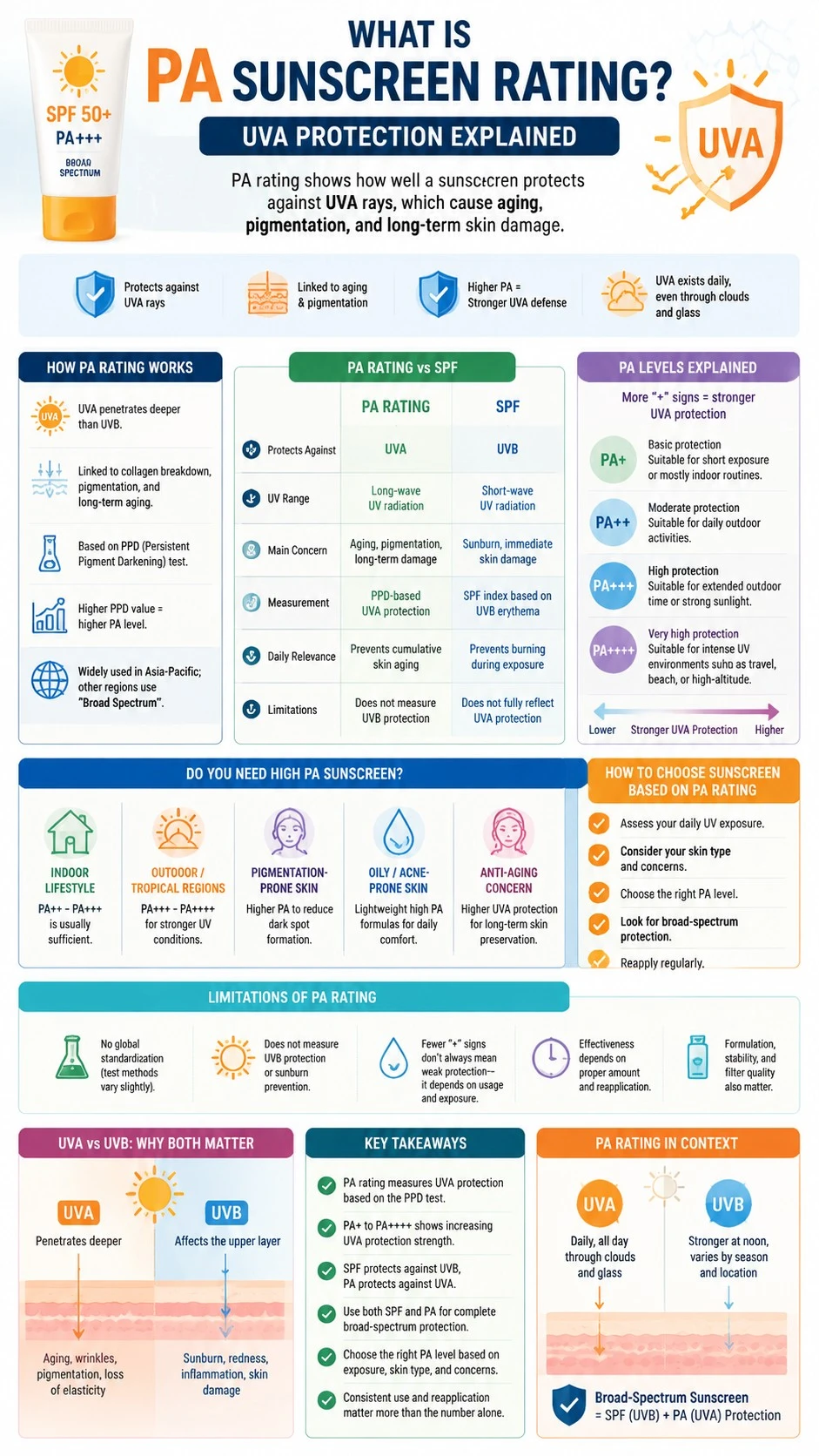
Detailed vertical sunscreen PA rating infographic
How PA Rating Works (UVA Protection System)
PA rating is based on UVA skin response rather than sunburn. UVA penetrates deeper than UVB and is linked to collagen breakdown, pigmentation, and long-term aging. [2]
It is linked to the PPD (Persistent Pigment Darkening) method, which measures the level of UVA exposure required to trigger visible skin darkening. Higher PPD values correspond to stronger UVA protection and higher PA grades. [3]
The system was created to address SPF limitations, which only measure UVB. Because UVA is present daily—even through clouds and glass—PA labeling is widely used in Asia, while other regions often use “Broad Spectrum” labeling instead. [1][4]
UVA penetrates deeper than UVB
UVA is linked to pigmentation and photoaging
PA system measures UVA protection strength
Higher PA = higher PPD value
Not all countries use PA labeling
PA Rating vs SPF: What’s the Difference?
SPF and PA measure different parts of UV protection. SPF reflects UVB protection, while PA reflects UVA protection, which is linked to long-term skin changes such as aging and pigmentation. [1]
They are complementary rather than interchangeable. A high SPF does not guarantee strong UVA protection, and a high PA rating does not indicate UVB protection strength.
Full photoprotection requires both UVA and UVB coverage, which is why broad-spectrum sunscreens combine SPF with UVA protection systems such as PA or equivalent regional standards. [4]
Feature
SPF
PA Rating
Protection type
UVB protection
UVA protection
UV range
Short-wave UV radiation
Long-wave UV radiation
Main concern
Sunburn and immediate damage
Aging, pigmentation, long-term damage
Measurement system
SPF index based on UVB erythema response
PPD-based UVA protection grading
Daily relevance
Prevents burning during exposure
Prevents cumulative skin aging
Limitations
Does not fully reflect UVA protection
Does not measure UVB protection or burning risk
Key takeaway: SPF alone does not provide full-spectrum protection. PA completes the UVA side of sun defense, and only the combination of both provides a more complete photoprotection profile.
PA Levels Explained (PA+, PA++, PA+++, PA++++)
PA levels represent increasing UVA protection strength, with more “+” signs indicating higher protection against UVA-induced skin stress and pigmentation.
Each level corresponds to real-world exposure intensity rather than different protection categories. Lower levels work for limited exposure, while higher levels are designed for stronger or prolonged sunlight conditions.
PA+ → Basic protection for short exposure or mostly indoor routines
PA++ → Moderate protection for typical daily outdoor activity
PA+++ → High protection for extended outdoor time or strong sunlight
PA++++ → Very high protection for intense UV environments such as travel, beach, or high-altitude exposure
Higher PA is not always necessary. The appropriate level depends on exposure duration and UV intensity.
Do You Need High PA Sunscreen?
High PA sunscreen is not necessary for everyone. The right level depends on UV exposure, skin sensitivity, and long-term aging concerns. Moderate PA is often sufficient for low exposure, while higher levels are better suited for stronger or prolonged sunlight.
The goal is to match PA level with real exposure rather than choosing the highest rating by default.
Oily / acne-prone skin: lightweight high PA formulas for daily comfort
Pigmentation-prone skin: higher PA to reduce dark spot formation
Indoor lifestyle: PA++–PA+++ is usually sufficient
Outdoor / tropical regions: PA+++–PA++++ for stronger UV conditions
Anti-aging concern: higher UVA protection for long-term skin preservation
How to Choose Sunscreen Based on PA Rating
Choosing sunscreen based on PA rating should follow exposure patterns rather than assuming higher is always better. The correct PA level depends on outdoor time, UV intensity, and sensitivity to pigmentation or aging. [1]
User Type
Recommended PA Level
Reason
Office workers
PA++–PA+++
Moderate UVA exposure through windows and short outdoor periods
Reduced risk of UVA-triggered dark spots and uneven tone
Travelers / beach users
PA++++
High-intensity UV environments with prolonged exposure
Consistency matters more than switching products frequently. Choose a PA level that matches your daily exposure pattern and use it regularly.
Limitations of PA Rating
PA rating is a useful indicator of UVA protection strength, but it does not represent full real-world sunscreen performance under all conditions. [3] Controlled testing environments cannot fully reflect how sunscreen behaves under heat, sweat, friction, or uneven application. In practice, application amount and reapplication frequency have a greater impact on actual protection than the PA value itself.
Another limitation is the lack of global standardization. Different regions use different UVA labeling systems, such as PA or Broad Spectrum, which reduces cross-market consistency. [4] In addition, PA does not evaluate full UVA wavelength coverage, as performance depends on the specific UV filter system used in formulation.
Key limitations include differences between laboratory testing and real-world use, lack of global labeling consistency, and incomplete representation of UVA filter performance.
Based on controlled laboratory testing, not real-world usage conditions
Does not account for texture, feel, or application behavior on skin
Cannot replace broad-spectrum UVA/UVB labeling systems
Does not guarantee water resistance or durability in wet conditions
Final Takeaway: What PA Rating Really Means
PA rating is a practical indicator of UVA protection strength, while SPF represents UVB protection. [1] Together, they describe two different but equally important parts of sun protection. Neither system alone is sufficient for full photoprotection.
Higher PA levels provide stronger defense against UVA-related skin changes, but real effectiveness still depends on correct application, adequate amount, and regular reapplication during exposure. For complete protection, both SPF and PA need to be considered as a combined system rather than separate labels.
FAQs About PA Sunscreen Rating
What does PA+ mean in sunscreen?
PA+ indicates the lowest level of UVA protection in the PA system. It is generally suitable for limited sun exposure or short periods outdoors where UVA exposure is relatively low. [3]
Is PA rating important?
Yes. PA rating helps measure UVA protection, which is linked to long-term skin changes such as pigmentation and aging. It is an important factor when choosing daily sunscreen.
Is PA++++ better than SPF 50?
They measure different things, so they are not directly comparable. SPF 50 refers to UVB protection strength, while PA++++ refers to high UVA protection. Both are needed together.
Does PA measure UVA protection?
Yes. PA is specifically designed to indicate the level of UVA protection based on standardized testing methods used in sunscreen evaluation systems.
Do US sunscreens use PA rating?
No. Most US sunscreens do not use PA labeling. Instead, they use “Broad Spectrum” labeling to indicate UVA and UVB coverage. [4]
Can low PA sunscreen still protect?
Yes, but protection is limited for UVA exposure. Lower PA levels may still be suitable for indoor or short-duration use, depending on UV intensity.
What PA rating is best for daily use?
For most daily urban use, PA++ to PA+++ is generally sufficient. Higher levels are more suitable for prolonged outdoor exposure or higher UV environments.
Zoe has 5 years of skincare industry experience in customer support, product communication, and practical manufacturing understanding. Her writing is based on industry knowledge, real-life product use, and market-focused experience.