


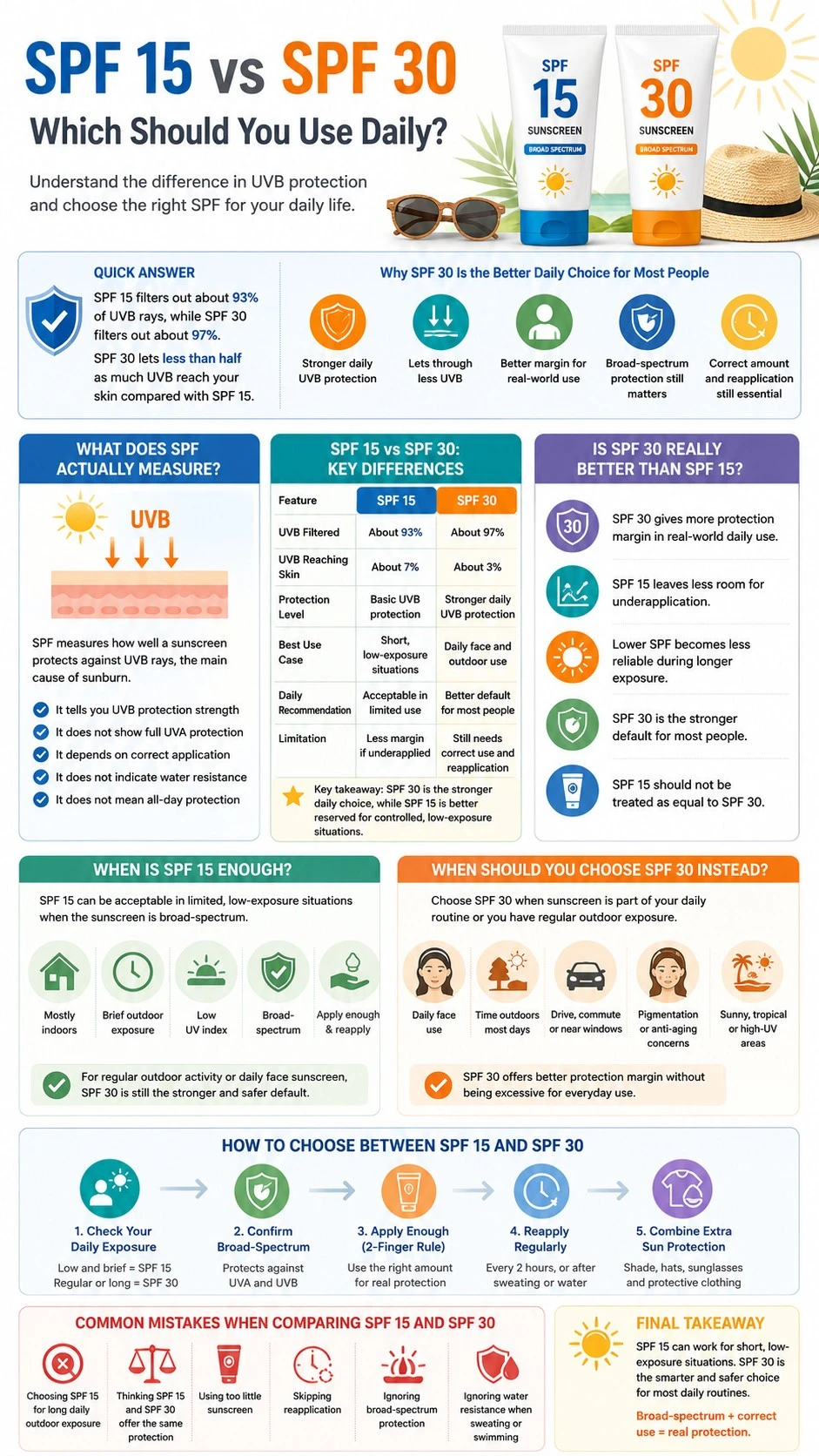
What Does SPF Actually Measure?
SPF stands for Sun Protection Factor. It measures how well a sunscreen protects against UVB rays under controlled testing conditions. UVB is closely linked to sunburn, so SPF is the main number people use to judge sunburn protection. [2]
SPF does not fully describe UVA protection, which is why broad-spectrum labeling still matters. The labeled SPF also assumes the product is applied in the right amount and spread evenly. When people use too little, real protection drops. [1][3]
SPF tells you:
- UVB protection strength
- Sunburn protection level
- The tested protection level under proper application conditions
SPF does not tell you:
- Full UVA protection strength
- Whether the product is broad-spectrum
- Whether the sunscreen is water-resistant
- How long you can stay in the sun without reapplying
SPF 15 vs SPF 30: Key Differences
The main difference between SPF 15 and SPF 30 is easier to understand by looking at both filtered UVB and UVB that still reaches the skin. The filtered percentage may look close, but the remaining exposure is meaningfully different. [2]
That difference matters most in daily life, where sunscreen is rarely applied as evenly or as thickly as in testing. SPF 15 can work for limited exposure, while SPF 30 gives a stronger margin for face, outdoor, and repeated daily use.
| Feature | SPF 15 | SPF 30 |
|---|---|---|
| UVB Filtered | About 93% | About 97% |
| UVB reaching skin | About 7% | About 3% |
| Protection level | Basic UVB protection | Stronger daily UVB protection |
| Best use case | Short, low-exposure situations | Daily face and outdoor use |
| Daily recommendation | Acceptable in limited use | Better default for most people |
| Limitation | Less margin if underapplied | Still needs correct use and reapplication |
Key takeaway: SPF 30 is the stronger daily choice, while SPF 15 is better reserved for controlled, low-exposure situations.
Is SPF 30 Really Better Than SPF 15?
Yes. SPF 30 is better for most real-world daily use because it gives more protection margin when sunscreen is not applied perfectly. The key difference is not just the labeled number, but how reliable protection remains during normal use. [2][3]
SPF 15 can protect well in controlled, low-exposure settings. It becomes less dependable when sunscreen is applied too thinly, exposure lasts longer than expected, or skin is exposed repeatedly throughout the day.
SPF 30 is the stronger default because it reduces UVB exposure more effectively without being excessive for everyday use.
- SPF 15 protects, but leaves less room for underapplication
- SPF 30 gives a better daily safety margin
- Lower SPF becomes less reliable during longer exposure
- SPF 15 should not be treated as equal to SPF 30
When Is SPF 15 Enough?
SPF 15 can be acceptable in limited, low-exposure situations, but it should not be treated as the best daily standard for most people. It works best when sun exposure is brief, the UV index is low, and the product is broad-spectrum. [1]
SPF 15 may be enough when:
- You spend most of the day indoors
- Outdoor exposure is brief and incidental
- The UV index is low
- The sunscreen is broad-spectrum
- You apply enough and reapply when needed
For regular outdoor activity or daily face sunscreen, SPF 30 is still the stronger and safer default.
When Should You Choose SPF 30 Instead?
Choose SPF 30 when sunscreen is part of your daily face routine or regular outdoor life. It is not excessive for daily use; it gives better protection margin in the way people actually apply sunscreen. [3][4]
SPF 30 is most useful when exposure is regular, indirect, or easy to underestimate. For pigmentation, dark spots, or anti-aging concerns, choose broad-spectrum SPF 30 so both UVB and UVA protection are considered.
Choose SPF 30 when:
- You use sunscreen on your face daily
- You spend time outdoors most days
- You drive, commute, or sit near windows often
- You have pigmentation, dark spots, or anti-aging concerns
- You live in a sunny, tropical, or high-UV area
- You want better protection margin for real-world use
How to Choose Between SPF 15 and SPF 30
Choosing between SPF 15 and SPF 30 should depend on exposure. SPF 15 can work for controlled, low-exposure situations, while SPF 30 is the better choice when exposure is regular, direct, or easy to underestimate.
| Use Case | Better Choice | Why |
|---|---|---|
| Daily face sunscreen | SPF 30 | The face gets frequent incidental exposure and needs a stronger daily margin. |
| Office / mostly indoor routine | SPF 15 may be acceptable; SPF 30 is safer | Indoor exposure is lower, but windows and short outdoor periods still matter. |
| Driving or window exposure | SPF 30 | UVA exposure through windows can add up during daily routines. |
| Short errands | SPF 30 | Brief exposure can still be repeated throughout the day. |
| Outdoor work | SPF 30 minimum | Longer exposure needs stronger and more reliable protection. |
| Beach / swimming / travel | SPF 30 minimum; higher may be better | Intense sun, water, sweat, and reflection increase exposure. |
| Children or very sun-sensitive skin | SPF 30 or higher | More sensitive skin needs a stronger protection buffer. |
| Body sunscreen for low exposure | SPF 15 may be acceptable | Low-exposure body areas have less direct UV contact. |
| Body sunscreen for outdoor exposure | SPF 30 | Exposed arms, shoulders, neck, and legs need stronger daily protection. |
The simplest rule: choose SPF 30 for regular daily use, and reserve SPF 15 for controlled, low-exposure situations. [3][4]
See also: How to Choose the Right Sunscreen for Your Skin
Common Mistakes When Comparing SPF 15 and SPF 30
SPF works best when the product is broad-spectrum, applied in the right amount, and reapplied during continued exposure. These mistakes matter more with SPF 15 because it gives less margin when use is imperfect. [1][2]
- Mistake: Thinking SPF 30 is only slightly better
- Correction: SPF 30 allows meaningfully less UVB to reach the skin than SPF 15.
- Mistake: Choosing SPF 15 for long outdoor exposure
- Correction: SPF 30 or higher is more appropriate for prolonged sunlight. [3][4]
- Mistake: Ignoring broad-spectrum labeling
- Correction: SPF measures UVB protection, so broad-spectrum coverage matters.
- Mistake: Applying less because the SPF is higher
- Correction: Labeled SPF depends on using enough product on exposed skin.
- Mistake: Forgetting to reapply
- Correction: Reapply during sun exposure, especially after sweating, swimming, wiping, or towel drying. [1][2]
- Mistake: Treating sunscreen as the only protection
- Correction: Use shade, hats, sunglasses, and protective clothing when the sun is strong. [1]
Final Takeaway: SPF 15 vs SPF 30
SPF 15 provides basic UVB protection and can be acceptable for limited, low-exposure use. SPF 30 provides stronger and more practical daily protection, making it the better default for most people. [2][3]
Regular face use, outdoor routines, driving, travel, and high-UV conditions all point toward SPF 30. For better daily protection, choose broad-spectrum sunscreen, apply enough, and reapply when exposure continues. [1][4]


