


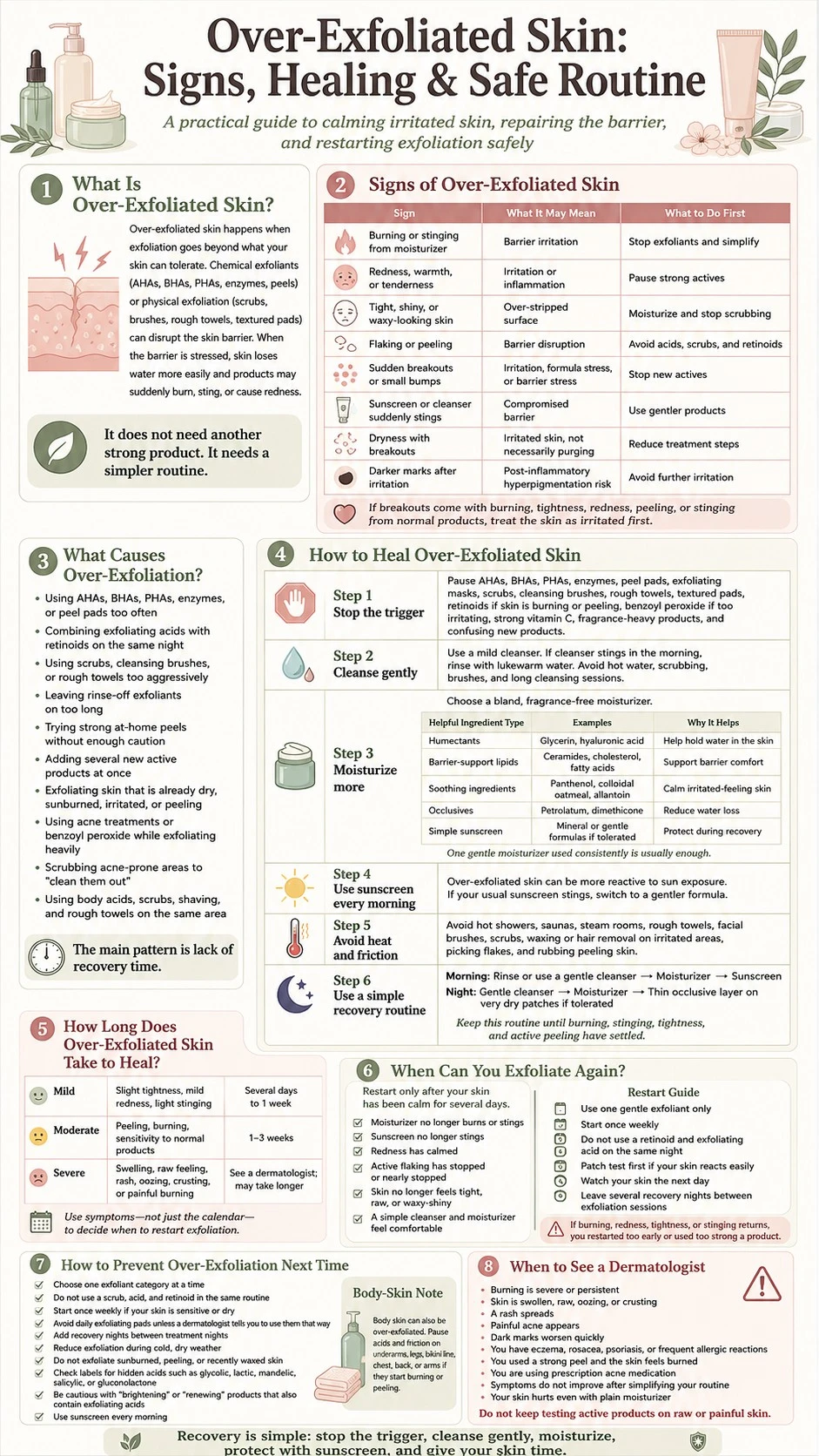
What Is Over-Exfoliated Skin?
Over-exfoliated skin happens when exfoliation goes beyond what your skin can tolerate. Exfoliation can be chemical, using ingredients such as AHAs, BHAs, PHAs, enzymes, or peels. It can also be physical, using scrubs, brushes, towels, sponges, or textured pads.
Healthy exfoliation removes some dead surface cells. Over-exfoliation disrupts the skin barrier, which helps hold water in and keeps irritants out. When the barrier is stressed, products that normally feel fine may suddenly burn, sting, or make the skin red.
Exfoliation should match your skin type because the wrong method can damage skin and lead to redness or acne breakouts. [1] Skin also needs recovery time between exfoliation sessions, so daily exfoliation is not a good default for most routines. [2]
In plain English, over-exfoliated skin is skin that has been pushed too hard. It does not need another strong product. It needs a simpler routine.
Signs of Over-Exfoliated Skin
Over-exfoliation can show up as burning, redness, tight or overly shiny skin, peeling, breakouts, or sudden sensitivity to products that used to feel fine. [3]
| Sign | What It May Mean | What to Do First |
|---|---|---|
| Burning or stinging from moisturizer | Barrier irritation | Stop exfoliants and simplify |
| Redness, warmth, or tenderness | Irritation or inflammation | Pause strong actives |
| Tight, shiny, or waxy-looking skin | Over-stripped surface | Moisturize and stop scrubbing |
| Flaking or peeling | Barrier disruption | Avoid acids, scrubs, and retinoids |
| Sudden breakouts or small bumps | Irritation, formula stress, or barrier stress | Stop new actives |
| Sunscreen or cleanser suddenly stings | Compromised barrier | Use gentler products |
| Dryness with breakouts | Irritated skin, not necessarily “purging” | Reduce treatment steps |
| Darker marks after irritation | Post-inflammatory hyperpigmentation risk | Avoid further irritation |
Breakouts alone do not always mean over-exfoliation. If they appear with burning, tightness, redness, peeling, or stinging from normal products, treat the skin as irritated first.
What Causes Over-Exfoliation?

Over-exfoliation is usually caused by frequency, strength, friction, or stacking too many active products together.
Common causes include:
- Using AHAs, BHAs, PHAs, or enzymes too often.
- Using peel pads every day before the skin has built tolerance.
- Combining exfoliating acids with retinoids on the same night.
- Using scrubs too aggressively.
- Using cleansing brushes, rough towels, or textured pads too often.
- Leaving rinse-off exfoliants on too long.
- Trying strong at-home peels without enough caution.
- Adding several new active products at once.
- Exfoliating skin that is already dry, sunburned, irritated, or peeling.
- Using acne treatments, retinoids, or benzoyl peroxide while also exfoliating heavily.
- Scrubbing acne-prone areas to “clean them out.”
- Using body acids, scrubs, shaving, and rough towels on the same area.
The main pattern is lack of recovery time. Even a gentle exfoliant can become too much when used too often or layered with other irritating steps.
How to Heal Over-Exfoliated Skin
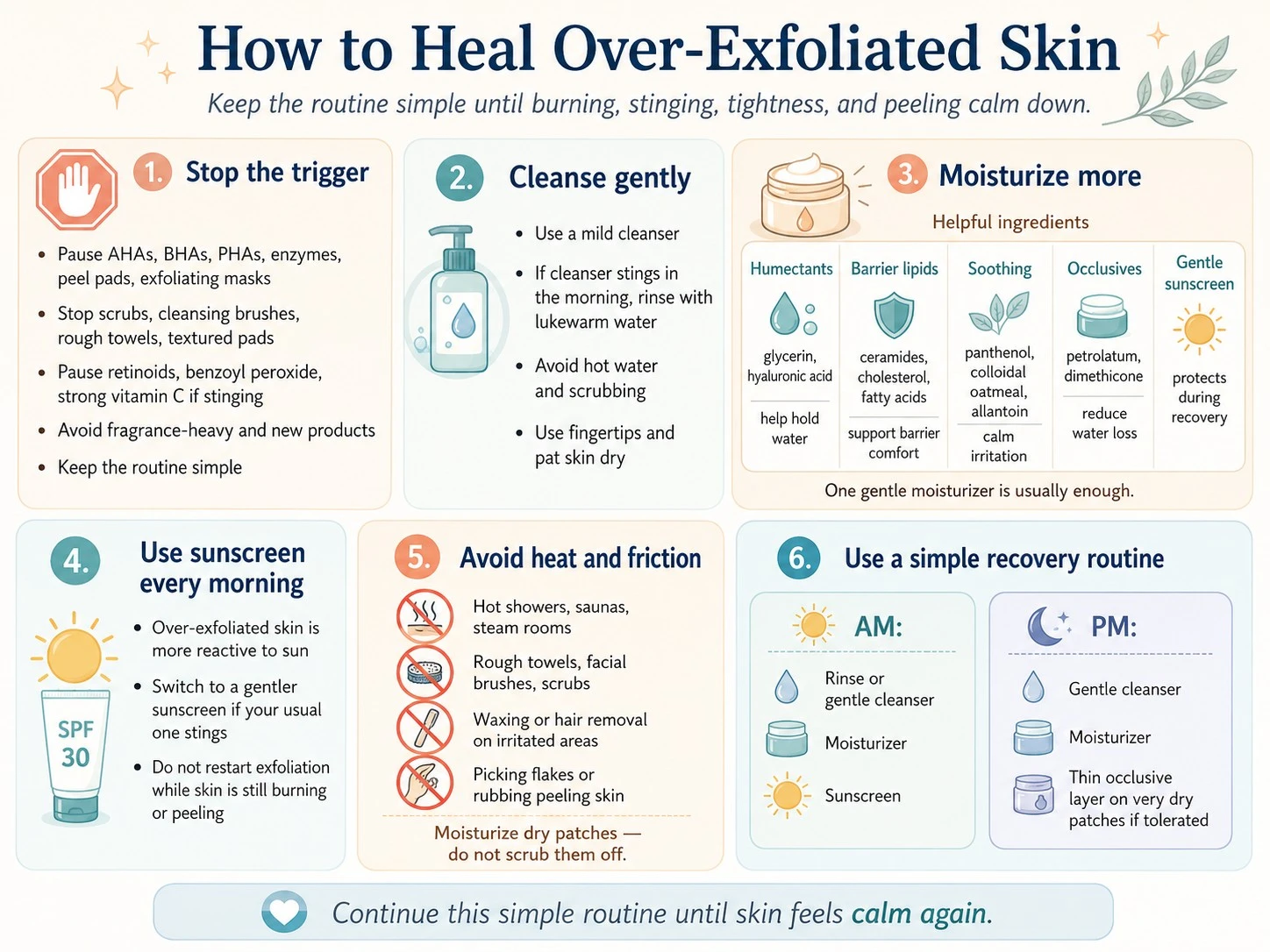
When skin is over-exfoliated, remove the triggers and keep the routine simple until the skin feels normal again.
Step 1: Stop the trigger
Do not keep exfoliating to “smooth out” peeling skin. That usually makes the problem worse.
Pause these products for now:
- AHAs, BHAs, PHAs, enzymes, peel pads, and exfoliating masks.
- Scrubs, cleansing brushes, rough towels, and textured pads.
- Retinoids if your skin is dry, peeling, burning, or stinging.
- Benzoyl peroxide if it feels too drying or irritating.
- Strong vitamin C, especially low-pH formulas that sting.
- Fragrance-heavy products.
- New products that make reactions harder to read.
Keep the routine simple until your skin is calm.
Step 2: Cleanse gently
Use a mild cleanser that does not leave your face tight, squeaky, or dry. If even cleanser stings in the morning, rinse with lukewarm water and save cleanser for night.
Avoid hot water, washcloth scrubbing, cleansing brushes, and long cleansing sessions. Use your fingertips, rinse gently, and pat the skin dry instead of rubbing.
Step 3: Moisturize more than usual
Moisturizer is the main support step while skin calms down. Choose a bland, fragrance-free formula with barrier-support ingredients such as glycerin, hyaluronic acid, dimethicone, petrolatum, or ceramides. [4][5]
| Helpful Ingredient Type | Examples | Why It Helps |
|---|---|---|
| Humectants | Glycerin, hyaluronic acid | Help hold water in the skin |
| Barrier-support lipids | Ceramides, cholesterol, fatty acids | Support barrier comfort |
| Soothing ingredients | Panthenol, colloidal oatmeal, allantoin | Calm irritated-feeling skin |
| Occlusives | Petrolatum, dimethicone | Reduce water loss |
| Simple sunscreen | Mineral or gentle formulas if tolerated | Protect during recovery |
Do not layer multiple “barrier repair” serums at once. One gentle moisturizer used consistently is usually enough during recovery.
Step 4: Use sunscreen every morning
Over-exfoliated skin can feel more reactive to sun exposure, so use sunscreen while it calms down.
If your usual sunscreen stings, switch to a gentler formula and keep the rest of the routine simple. Do not restart exfoliation while the skin is still burning or peeling.
Step 5: Avoid heat and friction
Heat and friction can keep irritated skin uncomfortable.
Avoid:
- Hot showers.
- Saunas.
- Steam rooms.
- Rough towels.
- Facial brushes.
- Scrubs.
- Waxing or hair removal on irritated areas.
- Picking flakes.
- Rubbing peeling skin.
Pat skin dry instead of rubbing. If dry patches feel rough, moisturize them. Do not scrub them off.
Step 6: Use a simple recovery routine
Morning:
- Rinse or use a gentle cleanser.
- Apply moisturizer.
- Apply sunscreen.
Night:
- Use a gentle cleanser.
- Apply moisturizer.
- Add a thin occlusive layer on very dry patches if your skin tolerates it.
Keep this routine until burning, stinging, tightness, and active peeling have settled.
How Long Does Over-Exfoliated Skin Take to Heal?
Recovery time depends on how irritated the skin is and whether the trigger has truly stopped. Mild cases can settle quickly. Moderate irritation can take longer.
| Severity | What It Looks Like | Possible Timeline |
|---|---|---|
| Mild | Slight tightness, mild redness, light stinging | Several days to 1 week |
| Moderate | Peeling, burning, sensitivity to normal products | 1–3 weeks |
| Severe | Swelling, raw feeling, rash, oozing, crusting, or painful burning | See a dermatologist; may take longer |
These timelines are not guarantees. Skin type, weather, medications, active ingredients, and underlying conditions all affect recovery.
Do not use the timeline alone to decide when to exfoliate again. Use the restart signs in the next section.
When Can You Exfoliate Again?
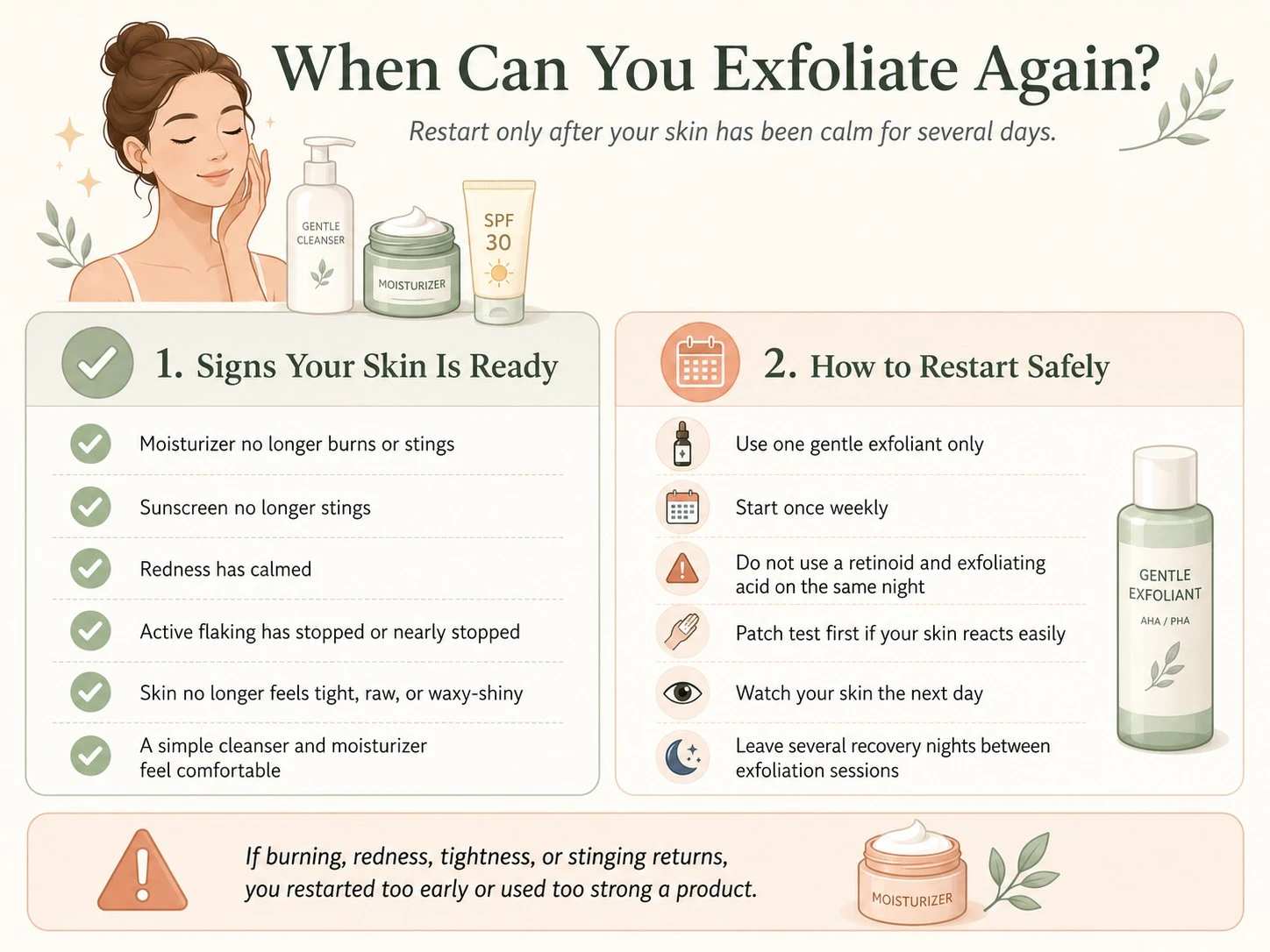
Do not restart exfoliation just because peeling has slowed or a few days have passed. Restart only after your skin has been calm for several days.
Your skin should meet these signs first:
- Moisturizer no longer burns or stings.
- Sunscreen no longer stings.
- Redness has calmed.
- Active flaking has stopped or nearly stopped.
- Skin no longer feels tight, raw, or waxy-shiny.
- A simple cleanser and moisturizer feel comfortable.
When you restart, keep it simple:
- Use one gentle exfoliant only.
- Start once weekly.
- Do not use a retinoid and exfoliating acid on the same night.
- Patch test first if your skin reacts easily.
- Watch your skin the next day.
- Leave several recovery nights between exfoliation sessions.
If burning, redness, tightness, or stinging returns, you restarted too early or used too strong a product.
How to Prevent Over-Exfoliation Next Time

Preventing over-exfoliation does not mean avoiding exfoliation forever. It means exfoliating in a way your skin can handle.
Use these rules:
- Choose one exfoliant category at a time.
- Do not use a scrub, acid, and retinoid in the same routine.
- Start once weekly if your skin is sensitive or dry.
- Avoid daily exfoliating pads unless a dermatologist tells you to use them that way.
- Add recovery nights between treatment nights.
- Reduce exfoliation during cold, dry weather.
- Do not exfoliate sunburned, peeling, or recently waxed skin.
- Check labels for hidden acids such as glycolic, lactic, mandelic, salicylic, or gluconolactone.
- Be cautious with “brightening” or “renewing” products that also contain exfoliating acids.
- Use sunscreen every morning.
Choose exfoliation based on skin type. Dry, sensitive, or acne-prone skin may need gentler methods, and skin needs recovery time between exfoliation sessions. [1][2]
Body skin can also be over-exfoliated. Be careful with glycolic acid body products, body scrubs, rough towels, shaving, KP treatments, and ingrown-hair products used on the same area. If your underarms, legs, bikini line, chest, back, or arms start burning or peeling, pause acids and friction just as you would on the face.
When to See a Dermatologist
Mild over-exfoliation can often improve with a simpler routine, but some symptoms need medical support.
See a dermatologist if:
- Burning is severe or persistent.
- Skin is swollen, raw, oozing, or crusting.
- A rash spreads.
- Painful acne appears.
- Dark marks worsen quickly.
- You have eczema, rosacea, psoriasis, or frequent allergic reactions.
- You used a strong peel and the skin feels burned.
- You are using prescription acne medication.
- Symptoms do not improve after simplifying your routine.
- Your skin hurts even with plain moisturizer.
Do not keep testing active products on raw or painful skin. If the reaction is more than mild irritation, get professional guidance.
Final Thoughts
Over-exfoliated skin needs less, not more. Stop exfoliating, pause strong actives, use a gentle cleanser, moisturize well, and protect your skin with sunscreen.
Restart only after your skin has been calm for several days. Use one gentle exfoliant once weekly, and stop again if burning, redness, or tightness returns.
FAQs About Over-Exfoliated Skin
What does over-exfoliated skin look like?
Over-exfoliated skin may look red, shiny, tight, flaky, or irritated. It may burn when you apply moisturizer or sunscreen. Some people also get small bumps, breakouts, or darker marks after irritation. A tight, waxy shine can be mistaken for glow, but it often means the skin surface has been over-stripped.
How do I heal over-exfoliated skin fast?
Stop exfoliating and pause strong actives first. Use a gentle cleanser, moisturizer, and sunscreen. Avoid scrubs, hot water, peeling masks, retinoids, strong vitamin C, and new products until your skin calms. Mild irritation may improve in several days, but more irritated skin can take one to three weeks or longer.
Should I moisturize over-exfoliated skin?
Yes. Moisturizer is one of the most useful steps for over-exfoliated skin. Choose a bland formula with ingredients such as glycerin, ceramides, panthenol, hyaluronic acid, colloidal oatmeal, dimethicone, or petrolatum if tolerated. If your skin is acne-prone, use a lighter moisturizer and apply heavier occlusives only on dry patches.
Can I use retinol on over-exfoliated skin?
No. Pause retinol and other retinoids until your skin is calm. Retinoids can worsen dryness, peeling, and stinging when the barrier is already irritated. When you restart, do not use retinol and exfoliating acids on the same night.
Can over-exfoliation cause breakouts?
Yes. Over-exfoliation can lead to irritation, dryness, and barrier stress that may look like breakouts. These bumps are not always true purging. If breakouts happen with burning, stinging, tightness, redness, or peeling, stop exfoliants and simplify your routine first.
When can I exfoliate again?
Restart only after your skin has been calm for several days. Moisturizer and sunscreen should no longer sting, and your skin should not feel tight, raw, or actively peeling. Start with one gentle exfoliant once weekly. Stop again if burning, redness, or tightness returns.
What should I avoid after over-exfoliating?
Avoid exfoliating acids, scrubs, peel pads, cleansing brushes, retinoids, strong vitamin C, strong acne treatments that sting, fragrance-heavy products, hot water, rough towels, and new products. Keep the routine simple until the skin feels normal again.
Is over-exfoliated skin the same as a damaged skin barrier?
Over-exfoliation can damage or stress the skin barrier, but not every damaged barrier is caused by exfoliation. A barrier can also become irritated from harsh cleansers, weather, medication, eczema, rosacea, acne treatments, or allergic reactions. The first step is still similar: remove triggers, moisturize, and reduce irritation.
Sources
[1] American Academy of Dermatology. How to Safely Exfoliate at Home
[2] Harvard Health Publishing. Have You Exfoliated Lately?
[3] Westlake Dermatology. Over-Exfoliation: Warning Signs, Causes, and Prevention
[4] American Academy of Dermatology. Dermatologists’ Top Tips for Relieving Dry Skin
[5] Cleveland Clinic. What Do Ceramides Do for Your Skin?


