


A dark mark left after a pimple is often called an “acne scar,” but that label can send you toward the wrong treatment. A flat brown mark and a deep rolling depression may both appear after acne, yet they represent different changes in the skin.
The distinction matters because brightening serums can help some forms of post-acne discoloration but cannot rebuild a deep scar. Likewise, a procedure designed to remodel scar tissue may be unnecessary for a flat mark that would gradually fade with appropriate acne control, sun protection, and pigment management.
How to Tell Acne Scars From Dark Spots
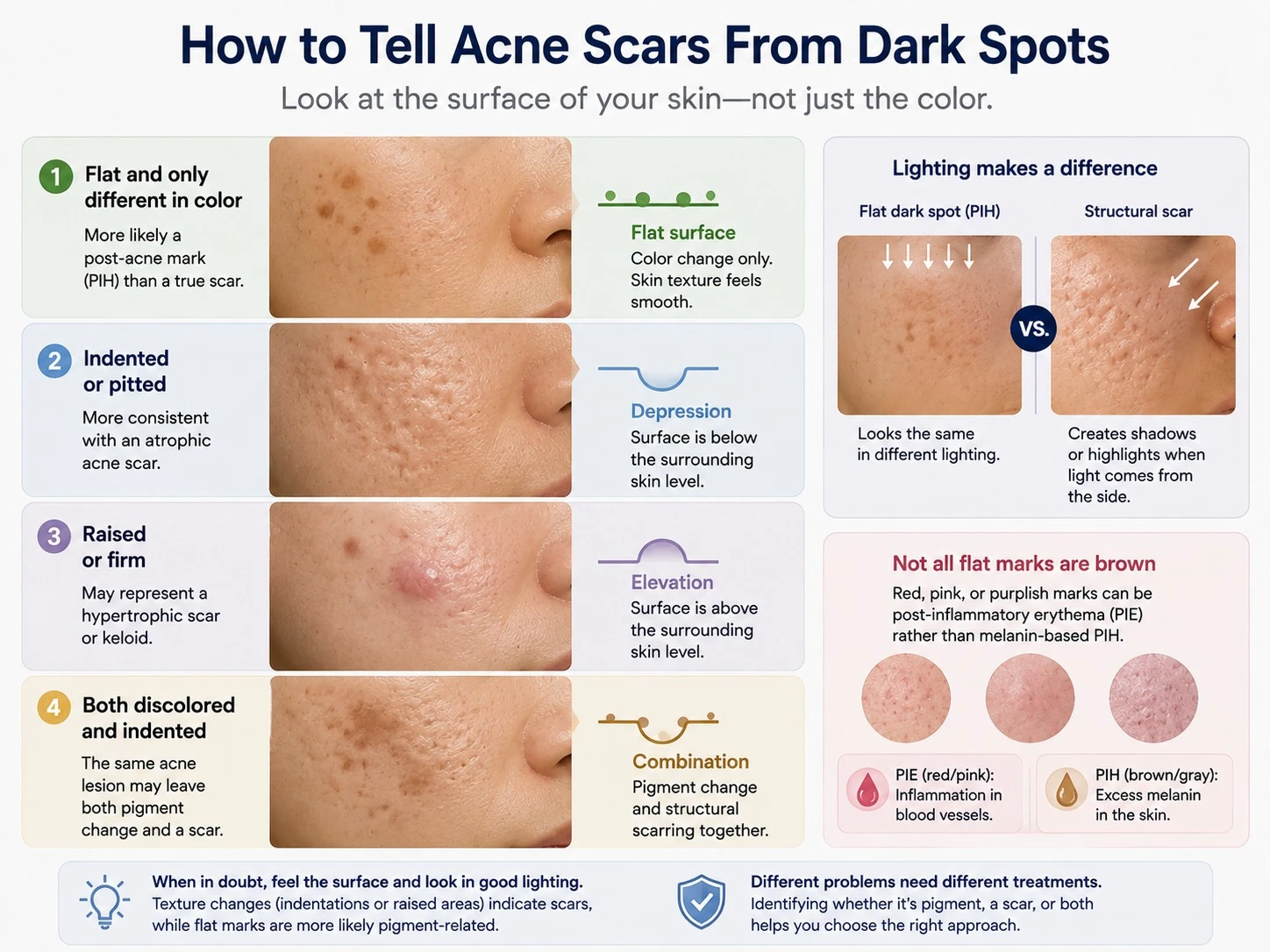
Start by looking at the surface of the skin rather than the color alone. Post-inflammatory hyperpigmentation, or PIH, is a flat area of excess pigment left after inflammation. True acne scars involve a structural change, such as tissue loss that creates a depression or excess scar tissue that creates a raised area.[1]
- Flat and only different in color: more likely a post-acne mark than a true scar.
- Indented or pitted: more consistent with an atrophic acne scar.
- Raised or firm: may represent a hypertrophic scar or keloid.
- Both discolored and indented: the same acne lesion may have left both pigment change and structural scarring.
Lighting can make the distinction easier. Structural scars often create shadows or highlights when light comes from the side, while a flat pigment mark changes color without creating the same contour.
Not every flat post-acne mark is brown. Red, pink, or purplish marks can reflect post-inflammatory erythema rather than melanin-based PIH. Both are different from true structural acne scars, but their biology and treatment are not identical.[6]
What Are Post-Acne Dark Spots?
Post-inflammatory hyperpigmentation develops when inflammation stimulates excess pigment production and deposition after the original acne lesion begins to heal. It can occur in any skin tone but is particularly common, more noticeable, and often more persistent in darker skin tones.[3][4]
PIH is one form of hyperpigmentation. Acne is a common trigger, but inflammation from eczema, injury, irritation, picking, or other skin problems can produce a similar pigment response.
Because the surface remains flat, a dark spot can fade as pigment is gradually cleared. That does not mean every mark disappears quickly. Superficial discoloration may take months to fade, while deeper pigment can remain visible much longer.[1][3]
Continued acne also creates new inflammation while older spots are fading. Treating only the marks while allowing new breakouts to continue can therefore make progress look much slower than it really is.
What Are the Main Types of Acne Scars?
True acne scars are classified mainly by whether the skin has lost tissue and become depressed or produced excess scar tissue and become raised. The specific pattern matters because different scars respond to different procedures.[1][2][5]
| Scar Type | Typical Appearance | Why the Type Matters |
|---|---|---|
| Ice pick scar | Deep, narrow depression extending into the skin | Its depth and narrow opening often require a more focal treatment strategy |
| Boxcar scar | Round or oval depression with relatively defined edges | Depth varies, so shallow and deep boxcar scars may need different approaches |
| Rolling scar | Broad, shallow depression with a wave-like surface | Fibrous tethering beneath the skin can influence treatment selection |
| Hypertrophic scar | Raised scar tissue that remains within the original injury area | It requires a different strategy from collagen-loss scars |
| Keloid | Raised scar that can extend beyond the original acne lesion | Keloids can continue growing and usually need dermatologist-directed treatment |
Many people have more than one scar type at the same time. This is one reason acne-scar treatment is often multimodal rather than based on a single universal procedure.[2][5]
Why Can the Same Breakout Leave a Dark Spot and a Scar?
Both problems begin with inflammation, but they represent different consequences of healing. Pigment-producing cells can respond to inflammation by leaving excess melanin behind, while deeper inflammatory damage can disrupt collagen and other supporting tissue enough to alter the skin’s contour.[1][4]
A severe inflammatory lesion can therefore leave a brown mark over an indentation. Treating the pigmentation may make the area look more even in color while the depression remains.
Deep, painful acne has a greater risk of true scarring, and picking, popping, or scratching lesions increases inflammation and can raise the risk of both scars and discoloration.[1][3]
Preventing new lesions is consequently part of treating both problems. If breakouts are still active, a consistent skincare routine for acne-prone skin is a more important starting point than repeatedly treating the marks left by each new pimple.
How to Treat Dark Spots After Acne

Post-acne pigmentation treatment has two jobs: stop new inflammation from producing more marks and gradually reduce the discoloration that already exists. Irritation control matters as well because an overly aggressive brightening routine can create more inflammation and worsen pigment problems, especially in skin that develops PIH easily.[3][4]
Control the Acne First
You do not always need to wait until every lesion disappears before addressing discoloration. Acne and PIH can be treated together, but the routine should prevent new breakouts rather than focus exclusively on old marks.[3][6]
Topical retinoids, azelaic acid, benzoyl peroxide, salicylic acid, and other acne treatments can be used according to the acne type and product or clinician directions.[7] Some options can address acne and post-inflammatory pigmentation at the same time.
Use Pigment-Targeting Ingredients Selectively
| Ingredient Direction | Where It May Fit | Main Limitation |
|---|---|---|
| Azelaic acid | Useful when acne and post-acne pigmentation overlap | Can still cause irritation or stinging in some users |
| Retinol and other topical retinoids | Can support acne control and gradual improvement in post-inflammatory pigmentation | Dryness and irritation can worsen tolerance and may aggravate pigmentation if the routine becomes too inflammatory |
| Glycolic acid and other appropriate exfoliating acids | Can support surface turnover and uneven-tone treatment | More exfoliation is not automatically better; excessive use can increase irritation |
| Vitamin C | Can be used as part of a broader antioxidant and uneven-tone routine | Performance depends on the vitamin C form, concentration, stability, and finished formula |
| Hydroquinone and other medical pigment treatments | May be appropriate for persistent hyperpigmentation under professional guidance | Availability, permitted use, concentration, and supervision requirements vary by market |
You do not need every option in the table. One well-chosen acne treatment plus one appropriate pigmentation strategy is often easier to tolerate and evaluate than several acids and brightening serums layered together.
Make Sun Protection Part of Pigment Treatment
Sun exposure can make post-inflammatory pigmentation more persistent and visible. Regular broad-spectrum sunscreen therefore supports the fading process rather than functioning as an unrelated final skincare step.[3][4]
For people prone to hyperpigmentation, visible-light protection can also matter. Tinted sunscreens containing iron oxides are one option used to provide additional visible-light protection, particularly when pigment disorders are a major concern.[3]
How to Treat True Acne Scars
Topical skincare has a much smaller role once acne has produced a meaningful structural scar. Retinoids or salicylic acid may make very mild scarring or surrounding texture less noticeable, but established depressions and raised scars often require procedures selected according to scar type.[2][5]
| Treatment Direction | Where It May Be Used | Why Selection Matters |
|---|---|---|
| Microneedling | Selected atrophic scars | Creates controlled injury intended to stimulate remodeling; treatment depth and patient factors matter |
| Fractional laser or other resurfacing procedures | Selected atrophic scars and textural irregularity | Different devices have different downtime, efficacy, and pigment-change risks |
| Subcision | Especially useful when depressed scars are tethered beneath the skin | It targets fibrous attachments rather than surface pigmentation |
| Focal chemical or surgical techniques | Selected deep ice pick or boxcar scars | The method must match scar depth and shape |
| Fillers | Selected depressed scars | They add volume rather than treating excess pigment |
| Raised-scar treatment | Hypertrophic scars and keloids | These require strategies designed to reduce excessive scar tissue rather than stimulate more collagen |
No single procedure is best for every scar. Ice pick, boxcar, rolling, hypertrophic, and keloid scars behave differently, and people with mixed scar patterns may need more than one treatment method.[2][5]
This is also why a serum marketed as “for acne scars” needs careful interpretation. If its evidence relates mainly to pigmentation, exfoliation, or general surface texture, it should not be expected to correct a deep structural depression.
Can You Treat Acne Scars and Dark Spots at the Same Time?

Often yes, but the order and intensity matter. Active acne should be brought under reasonable control so new inflammation is not continually producing additional marks and scars. Pigmentation can often be addressed alongside acne treatment, while more intensive scar procedures are commonly planned after the breakout pattern is better controlled.[2][3]
When both discoloration and structural scars are present, improving the color first can also make the remaining contour problem easier to assess. In other cases, a dermatologist may create a staged plan in which different procedures address texture and pigment over time.
Skin tone is an important part of this decision. Chemical peels, lasers, and other procedures can themselves trigger post-inflammatory pigment changes, particularly in people who readily develop PIH. A treatment that is appropriate for the scar still needs to be selected and performed with pigment risk in mind.[3][4]
Trying to accelerate both goals at home by combining several exfoliating acids, retinoids, scrubs, and peels can work against the objective. If the skin becomes persistently red, burning, tight, or flaky, address the over-exfoliation before adding another dark-spot treatment.
When Should You See a Dermatologist?
Professional assessment becomes particularly useful when you cannot tell whether the problem is pigment, scarring, or both, because that distinction changes the treatment strategy.
Consider dermatologic care when:
- you have deep ice pick, rolling, or boxcar scars;
- you develop raised, thickening scars or possible keloids;
- active acne is continuing to produce new scars;
- dark spots remain persistent despite a well-tolerated routine;
- you are considering microneedling, laser treatment, a professional chemical peel, subcision, fillers, or scar surgery;
- you have a darker skin tone and want a procedure with a meaningful risk of post-inflammatory pigment change;
- a spot looks unusual, changes independently of acne, or does not clearly correspond to a previous breakout.
A dermatologist can identify the scar type, distinguish pigment from structural change, assess active acne, and choose treatments based on skin tone, scar depth, downtime, and the risk of unwanted pigment changes.[2][4][5]
Final Thoughts
Acne scars and dark spots are not two names for the same problem. Flat discoloration is usually a post-acne mark; a depression or raised area is a true scar. The same breakout can leave both, which is why color and texture should be evaluated separately.
For dark spots, prioritize acne control, sun protection, and a small number of well-tolerated pigment-targeting ingredients. For true scars, realistic improvement usually depends on identifying the scar type and matching it with an appropriate professional treatment rather than expecting a brightening serum to rebuild lost tissue.
FAQs About Acne Scars vs Dark Spots
Are Dark Spots From Acne Permanent?
Usually not. Flat post-inflammatory hyperpigmentation often fades gradually, but the process can take months and sometimes much longer when pigment lies deeper in the skin. Continued acne, sun exposure, and irritation can also prolong the problem.[1][3][4]
Do Acne Dark Spots Turn Into Scars?
A flat dark spot does not gradually transform into a structural scar. However, the same inflamed acne lesion can produce both excess pigmentation and collagen-related scarring, so a discolored area may also contain an indentation or raised scar.
Can Retinol Remove Acne Scars and Dark Spots?
Retinol and other retinoids can help with acne, pigmentation, and some surface texture, but they cannot be expected to eliminate deep established scars. Structural scars may require procedures such as microneedling, subcision, resurfacing, fillers, or other scar-specific treatment.[2][5][7]
Why Do Acne Dark Spots Last Longer on Darker Skin?
Post-inflammatory hyperpigmentation is more common and can be more persistent in darker skin tones because inflammation can produce a stronger or longer-lasting pigment response.[3][4] Preventing irritation and controlling new acne are particularly important.
Can Acne Scars Fade on Their Own?
The color surrounding a new scar can fade, and mild textural changes may become less noticeable with time, but true structural acne scars generally persist rather than disappearing completely on their own.[1][2]
Should I Treat Acne or Dark Spots First?
Control active acne while addressing pigmentation with compatible treatments rather than waiting for every mark to disappear. Preventing new inflammatory lesions reduces the source of future dark spots and scars.[3][6][7] More intensive scar procedures are often planned once active breakouts are better controlled.
Sources
[1] American Academy of Dermatology. Acne Scars: Signs and Symptoms
[2] American Academy of Dermatology. Acne Scars: Consultation and Treatment
[3] American Academy of Dermatology. 10 Tips for Clearing Acne in Darker Skin Tones
[4] Mar K et al. Treatment of Post-Inflammatory Hyperpigmentation in Skin of Colour: A Systematic Review
[5] Kim EY et al. Evidence-Based Management of Cutaneous Scarring in Dermatology Part 2: Atrophic Acne Scarring
[6] Taylor SC et al. Practical Therapeutic Strategies for Acne-Induced Hyperpigmentation Across All Skin Types
[7] American Academy of Dermatology. Acne: Diagnosis and Treatment


