


Retinol and retinal are often placed on a simple strength ladder, with retinal described as the faster or stronger option. That comparison contains some truth, but it is easy to overstate.
The chemistry favors retinal because it sits closer to retinoic acid in the metabolic pathway. Clinical results, however, come from finished products rather than isolated ingredient names. A stable retinol formula can outperform a poorly delivered retinal formula, and two products carrying the same percentage can behave very differently on skin.
The useful question is therefore not just “Which ingredient is stronger?” It is which formulation gives you enough retinoid activity to improve your target concern without creating more irritation than your routine can tolerate.
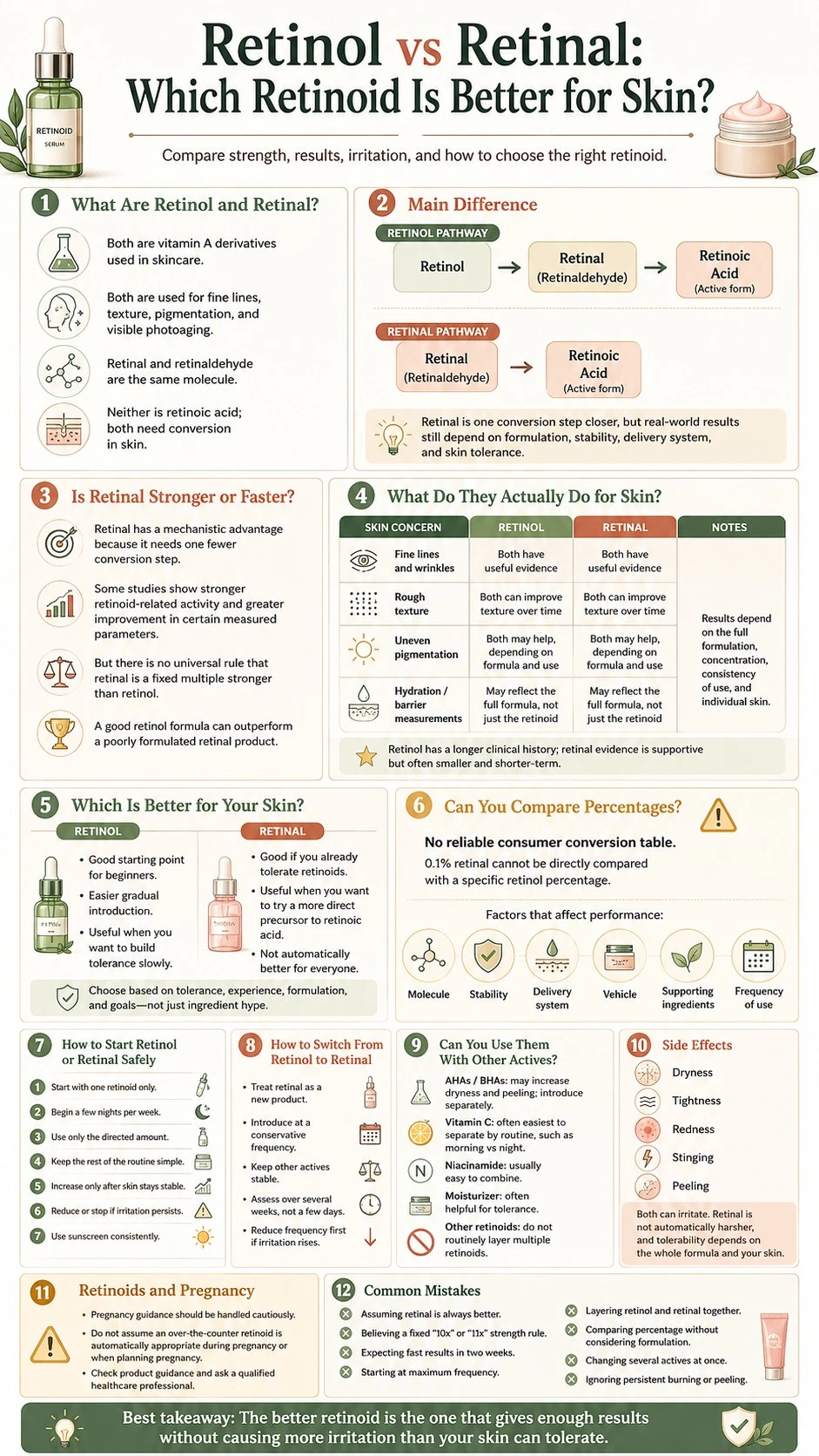
What Are Retinol and Retinal?

Retinol and retinal are both members of the retinoid family derived from vitamin A. In cosmetic skincare, they are commonly used in products designed to improve the appearance of fine lines, uneven texture, pigmentation, and other visible signs associated with photoaging.
Retinal and retinaldehyde refer to the same molecule in this context. “Retinal” is simply the shorter name commonly used on skincare products and in marketing.
Neither should be confused with retinoic acid, the biologically active form that interacts directly with retinoid receptors. Retinol and retinal depend on metabolic conversion within skin cells before producing retinoic-acid-mediated activity.[1]
For a broader overview of vitamin A derivatives and other actives, see our Skincare Active Ingredients guide.
The Main Difference: One Conversion Step vs Two
Human keratinocytes can convert retinol into retinal and then retinal into retinoic acid.[1] This gives the commonly used pathway:
Retinol → Retinal → Retinoic Acid
Retinal therefore enters the pathway one step later than retinol. That is the biochemical reason retinal is often positioned as a more direct cosmetic retinoid.
The conversion pathway does not create a simple percentage calculator. Enzyme activity, formulation stability, delivery, concentration, vehicle, and skin condition all affect how much useful retinoid activity a finished product produces.
Is Retinal Stronger or Faster Than Retinol?
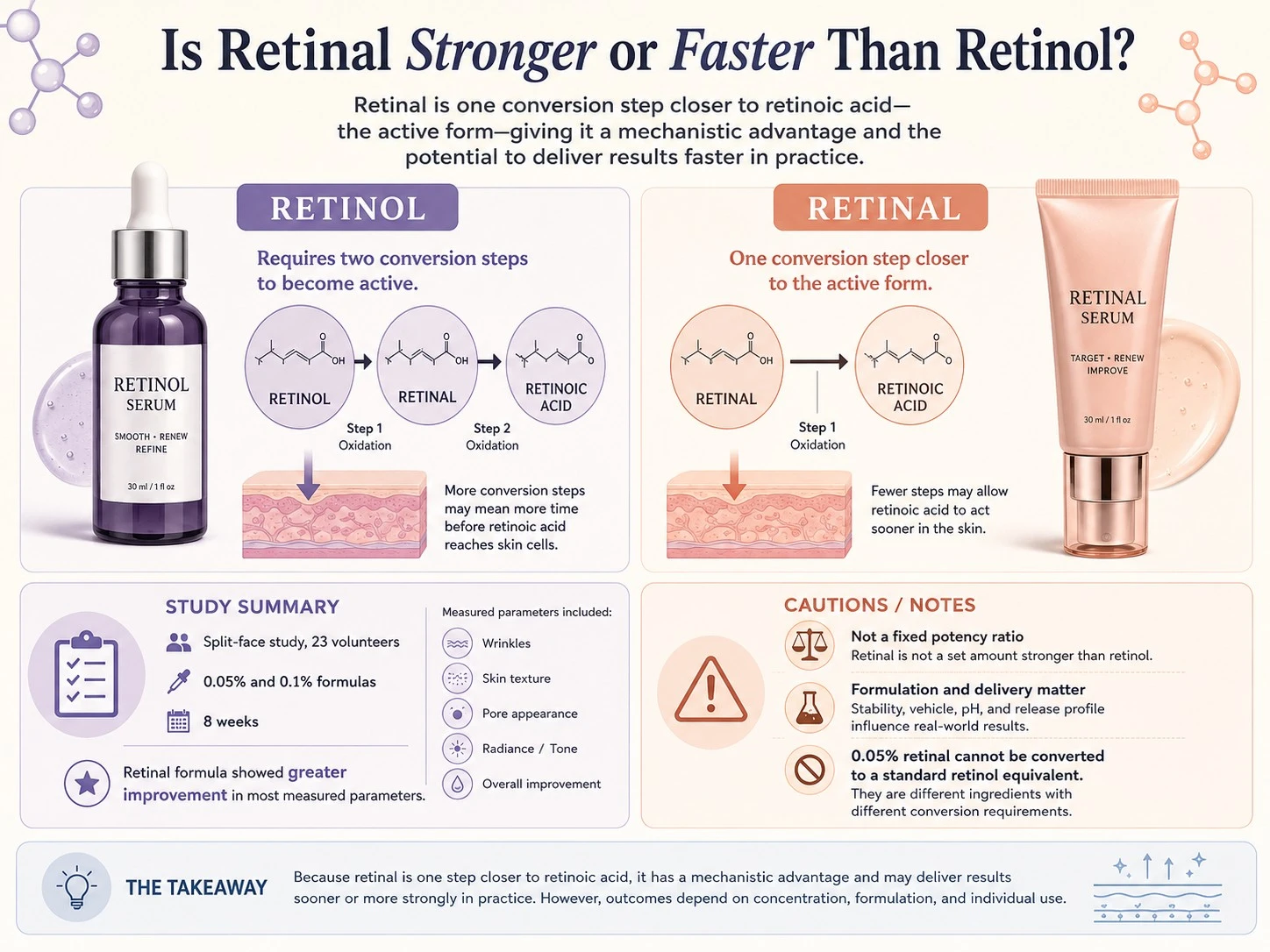
Retinal has a reasonable mechanistic advantage because it requires one fewer metabolic conversion. Human-skin research has also shown stronger retinoid-related biological activity from retinaldehyde than retinol under certain experimental conditions.[5]
A small randomized split-face study provides more practical evidence. Twenty-three volunteers used a multilamellar-vesicle retinal formula containing 0.05% or 0.1% retinal on one side of the face and retinol at the same nominal concentrations on the other. After eight weeks, both sides improved, while the retinal formulation produced significantly greater improvement in most measured objective parameters except dermal density.[4]
That study does not prove that retinal itself is universally a fixed multiple stronger than retinol. The retinal side used a specific delivery system, so the study compared finished formulations as well as active ingredients.
Claims such as “retinal is 10 times stronger” or “11 times faster” should therefore not be treated as universal conversion rules. There is no standardized clinical ratio that allows you to convert 0.05% retinal into an equivalent percentage of retinol.
What Do Retinol and Retinal Actually Do for Skin?
Both ingredients have clinical evidence for visible photoaging, but the depth and design of that evidence differ.
| Skin Concern | Retinol | Retinal |
|---|---|---|
| Fine lines and wrinkles | Controlled studies support gradual improvement with consistent use, including long-duration treatment data[2] | Clinical studies support improvement in wrinkle and texture measurements[3][4] |
| Rough texture | Can improve visible photodamage and skin surface quality over time[2] | 0.05% and 0.1% retinal creams improved texture in a three-month clinical study[3] |
| Uneven pigmentation | Long-term retinol treatment has improved mottled pigmentation in controlled research[2] | 0.1% retinal improved melanin measurements in one controlled study, while 0.05% did not show the same statistically significant effect[3] |
| Hydration and barrier measurements | Depends heavily on the complete formulation | Some retinal studies reported improved hydration and lower transepidermal water loss, but those outcomes reflect the finished creams as well as retinal itself[3] |
Retinol has the advantage of a longer clinical history. A one-year controlled study of 0.1% stabilized retinol found progressive improvements in several signs of photodamage compared with vehicle.[2] Retinal research is supportive but generally includes smaller populations and shorter treatment periods.
Which Is Better for Your Skin?
Choose based on tolerance, experience, formulation, and your willingness to adjust the routine rather than assuming retinal is automatically the upgrade everyone needs.
- If you are completely new to retinoids: A conservative retinol formula is often an easier starting point because there is usually more room to increase frequency or strength gradually.
- If you already tolerate retinol well: Retinal can be a logical next option when you want to test a more direct retinoic-acid precursor without moving immediately to prescription treatment.
- If your skin is easily irritated: Do not choose from the ingredient name alone. Low-strength retinal has been well tolerated in clinical studies, but vehicle, supporting ingredients, frequency, and your current barrier condition can change the result.[3][5]
- If photoaging is your main concern: Both have useful evidence. Consistency with a tolerable product is more important than repeatedly switching to a supposedly stronger retinoid.
- If acne is your main concern: Do not assume retinal is automatically a better acne treatment because it sits closer to retinoic acid. Cosmetic retinol and retinal products are not interchangeable with prescription acne retinoids. See our Skincare Routine for Acne-Prone Skin for a broader acne-focused routine.
Can You Compare Retinol and Retinal Percentages?
Not reliably. A label showing 0.1% retinal and another showing 0.3% or 1% retinol does not tell you which finished product will be more effective or more irritating.
Several variables interfere with a simple percentage comparison:
- Molecule: Retinol and retinal occupy different positions in the conversion pathway.
- Stability: Retinoids can degrade if the formulation and packaging do not protect them adequately.
- Delivery system: Encapsulation, emulsions, vesicles, and other delivery approaches can change how the active reaches the skin.
- Vehicle: The cream, serum, gel, or emulsion surrounding the retinoid can affect both performance and irritation.
- Supporting ingredients: Moisturizing and barrier-support ingredients may make an otherwise active formula easier to tolerate.
- Frequency: A lower-strength product used consistently may produce more useful results than a stronger product that repeatedly forces you to stop.
Treat percentage as one specification, not as a universal potency score.
How to Start Retinol or Retinal Safely
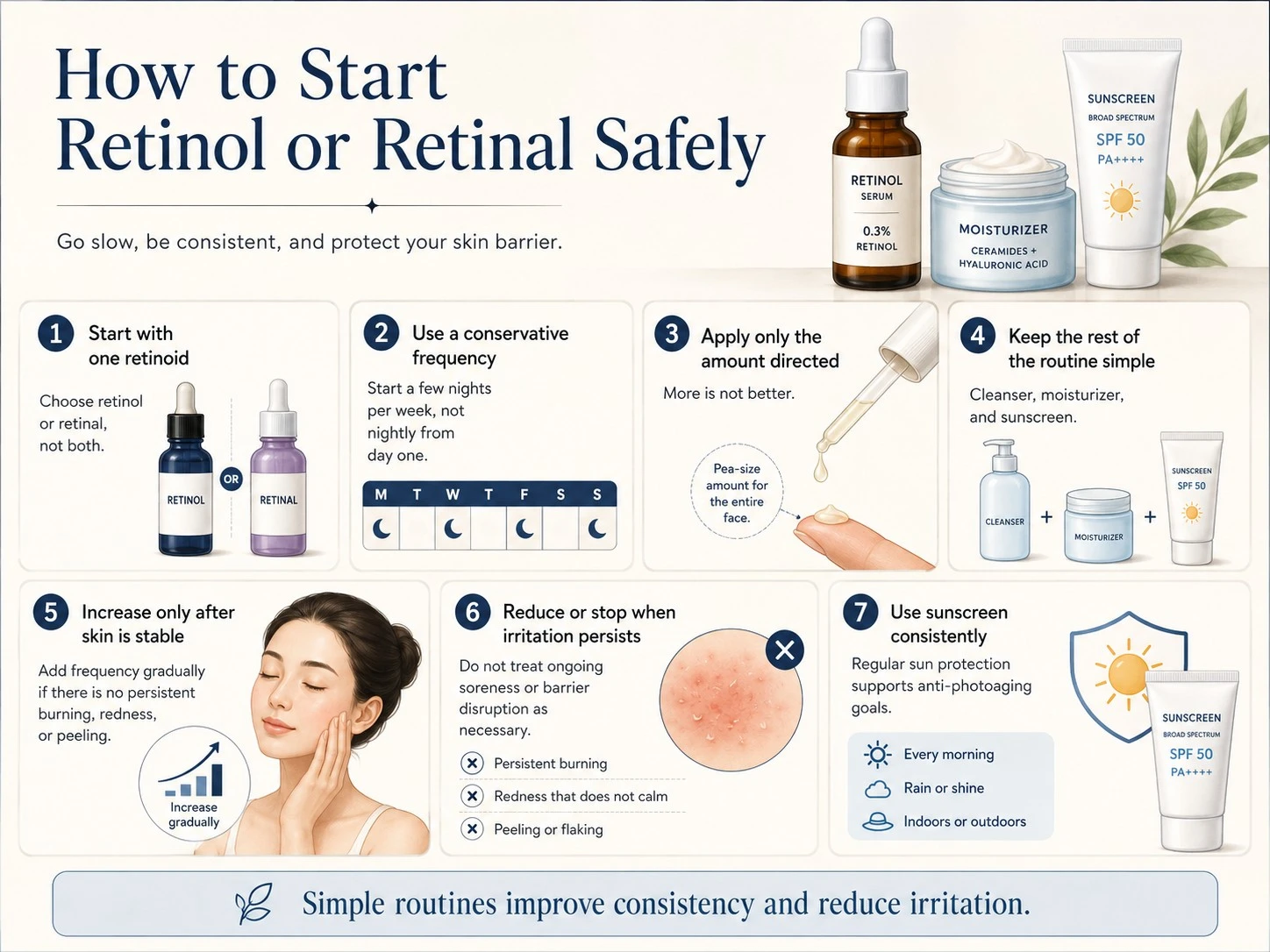
The goal is to build consistent exposure without creating enough irritation that you have to abandon the routine.
- Start with one retinoid: Choose retinol or retinal rather than layering both.
- Use a conservative frequency: Begin a few nights per week rather than assuming nightly use is necessary from the first application.
- Apply the amount directed by the product: More product does not produce a proportionally better result.
- Keep the rest of the routine simple: Cleanser, moisturizer, and sunscreen make it easier to judge whether the retinoid itself is working for you.
- Increase only after your skin is stable: Add frequency gradually if you have no persistent burning, marked redness, or continuing peeling.
- Reduce or stop when irritation persists: Do not interpret ongoing soreness or barrier disruption as a necessary stage of treatment.
- Use sunscreen consistently: If you use retinol or retinal to address visible photoaging, regular sun protection helps limit ongoing UV-driven skin aging.[7] See our How to Use Sunscreen Correctly for Full Protection guide for application details.
If you are starting with retinol specifically, our Retinol Guide covers application, side effects, and routine placement in more detail.
How to Switch From Retinol to Retinal
Do not convert your current retinol percentage into a supposedly equivalent retinal percentage. There is no validated consumer conversion table.
Instead, treat retinal as a new product:
- Stop increasing your current retinol before the switch.
- Introduce the retinal at a conservative frequency.
- Keep other active products stable while you assess tolerance.
- Judge the new formula over several weeks rather than after a few applications.
- If irritation rises noticeably, reduce frequency before assuming you need to return permanently to retinol.
Changing only one variable at a time makes it much easier to identify whether the new retinoid or another part of the routine is responsible for a reaction.
Can You Use Retinol or Retinal With Other Actives?

Many ingredients can exist in the same overall skincare routine, but the practical limit is often irritation rather than a direct chemical incompatibility.
- AHAs and BHAs: Adding exfoliating acids to a new retinoid can increase dryness, stinging, and peeling. Introduce them separately and reduce total active frequency when necessary.
- Vitamin C: It does not need to be excluded automatically. Using vitamin C in the morning and a retinoid at night is a simple way to separate potentially irritating steps.
- Niacinamide: Usually easy to combine and may fit either the same routine or an alternate application.
- Moisturizer: A basic moisturizer can make retinoid use easier to tolerate.
- Other retinoids: Do not routinely layer retinol, retinal, tretinoin, adapalene, or other retinoids unless a clinician has given you a specific reason to do so.
If you use several active products, our Skincare Routine Order guide can help simplify the rest of the routine.
Retinol vs Retinal Side Effects
Both can cause irritation. Common problems include dryness, tightness, redness, stinging, and peeling, particularly when the product is introduced too frequently or combined with several other irritating actives.
Retinal should not be assumed to be harsher solely because it is one metabolic step closer to retinoic acid. Retinaldehyde at 0.05% and 0.1% has shown good tolerability in human studies, although individual formulas and users vary.[3][5]
If your skin becomes persistently sore, shiny, raw, or increasingly reactive, stop escalating the retinoid. Our Skin Barrier guide explains how to recognize a routine that has become too irritating.
Retinoids and Pregnancy
Pregnancy guidance needs to be separated from ordinary cosmetic-use advice. In the European Union, topical retinoid medicines are contraindicated during pregnancy and for women planning pregnancy as a precaution.[6]
Cosmetic retinol and retinal products are not necessarily regulated in the same way as prescription topical retinoid medicines in every market. If you are pregnant, planning pregnancy, or receiving fertility treatment, do not assume that an over-the-counter retinoid is automatically appropriate; check the product and local medical guidance with a qualified healthcare professional.
Common Retinol vs Retinal Mistakes
- Assuming retinal is always better: A shorter conversion pathway does not make formulation quality irrelevant.
- Using a fixed “10×” or “11×” strength rule: There is no universal clinical conversion ratio between retinal and retinol percentages.
- Switching because results are not visible after two weeks: Retinoid changes are gradual and should be assessed over longer periods.
- Starting retinal at the maximum frequency: Stronger exposure is not useful if irritation forces repeated breaks.
- Layering retinol and retinal together: This usually adds complexity and irritation without a clear practical advantage.
- Comparing percentage without comparing formulation: Delivery system, stability, vehicle, and supporting ingredients all affect the finished product.
- Changing several actives at the same time: You lose the ability to identify which product is helping or causing irritation.
- Ignoring persistent burning or peeling: If the skin is becoming progressively more reactive, see Why Does Skincare Burn rather than continuing to increase use.
Final Thoughts
Retinal sits one metabolic step closer to retinoic acid than retinol, and some human studies suggest that well-formulated retinal can produce strong visible results at low nominal concentrations.[1][3][4] Retinol, however, has a longer clinical history and remains an effective option for photoaging when it is stable, well formulated, and used consistently.[2]
For most people, the better choice is the product that provides enough retinoid activity without repeatedly disrupting the skin barrier. Retinol is often a sensible starting point; retinal can be a useful progression, but neither ingredient should be selected by percentage or marketing claims alone.
FAQs About Retinol vs Retinal
Is retinal the same as retinaldehyde?
Yes. Retinal and retinaldehyde refer to the same vitamin A derivative in skincare. “Retinal” is the shorter name commonly used on product labels and in consumer-facing descriptions.
Is retinal stronger than retinol?
Retinal is one conversion step closer to retinoic acid and can show stronger retinoid activity under some conditions.[1][4][5] However, there is no universal potency ratio because formulation, delivery, stability, concentration, and frequency also affect performance.
Is 0.1% retinal equal to 1% retinol?
No validated clinical rule establishes that equivalence. A 0.1% retinal product should not automatically be treated as equal to 1% retinol or any other fixed retinol percentage.
Can I use retinol and retinal together?
There is usually little practical reason to layer them. Both feed into the same retinoid pathway, while combining them makes irritation and product assessment more difficult. Choose one retinoid and adjust its frequency before adding another.
Which works faster, retinol or retinal?
Retinal has the shorter conversion pathway and may produce faster measurable effects in some formulations, but product-level evidence does not support a universal timeline difference. A small direct comparison favored a specific retinal delivery system over retinol after eight weeks, but that result cannot be generalized to every product.[4]
Is retinal better for sensitive skin?
Not automatically. Low-strength retinal has been well tolerated in clinical studies, but sensitive skin can react to either ingredient.[3][5] Choose a conservative formulation and frequency, then judge tolerance from your own response rather than assuming one molecule is always gentler.
Sources
[1] Siegenthaler G et al. Retinol and Retinal Metabolism: Relationship to the State of Differentiation of Cultured Human Keratinocytes
[2] Randhawa M et al. One-Year Topical Stabilized Retinol Treatment Improves Photodamaged Skin in a Double-Blind, Vehicle-Controlled Trial
[3] Kwon HS et al. Efficacy and Safety of Retinaldehyde 0.1% and 0.05% Creams Used to Treat Photoaged Skin: A Randomized Double-Blind Controlled Trial
[4] Kim J et al. The Efficacy and Safety of Multilamellar Vesicle Containing Retinaldehyde: A Double-Blinded, Randomized, Split-Face Controlled Study
[5] Saurat JH et al. Topical Retinaldehyde on Human Skin: Biologic Effects and Tolerance
[6] European Medicines Agency. Retinoid-Containing Medicinal Products
[7] Hughes MC et al. Sunscreen and Prevention of Skin Aging: A Randomized Trial


