


Lactic acid is often described as a “gentle AHA,” but that label can be misleading if it makes you ignore concentration, pH, or frequency. A mild formula used occasionally can be easy to tolerate; a stronger or more acidic formula used too often can still cause burning, redness, peeling, or a damaged-feeling barrier.
The useful question is not simply whether lactic acid is gentle. It is whether a particular lactic acid product fits your skin, your current routine, and the result you want.
What Is Lactic Acid in Skincare?
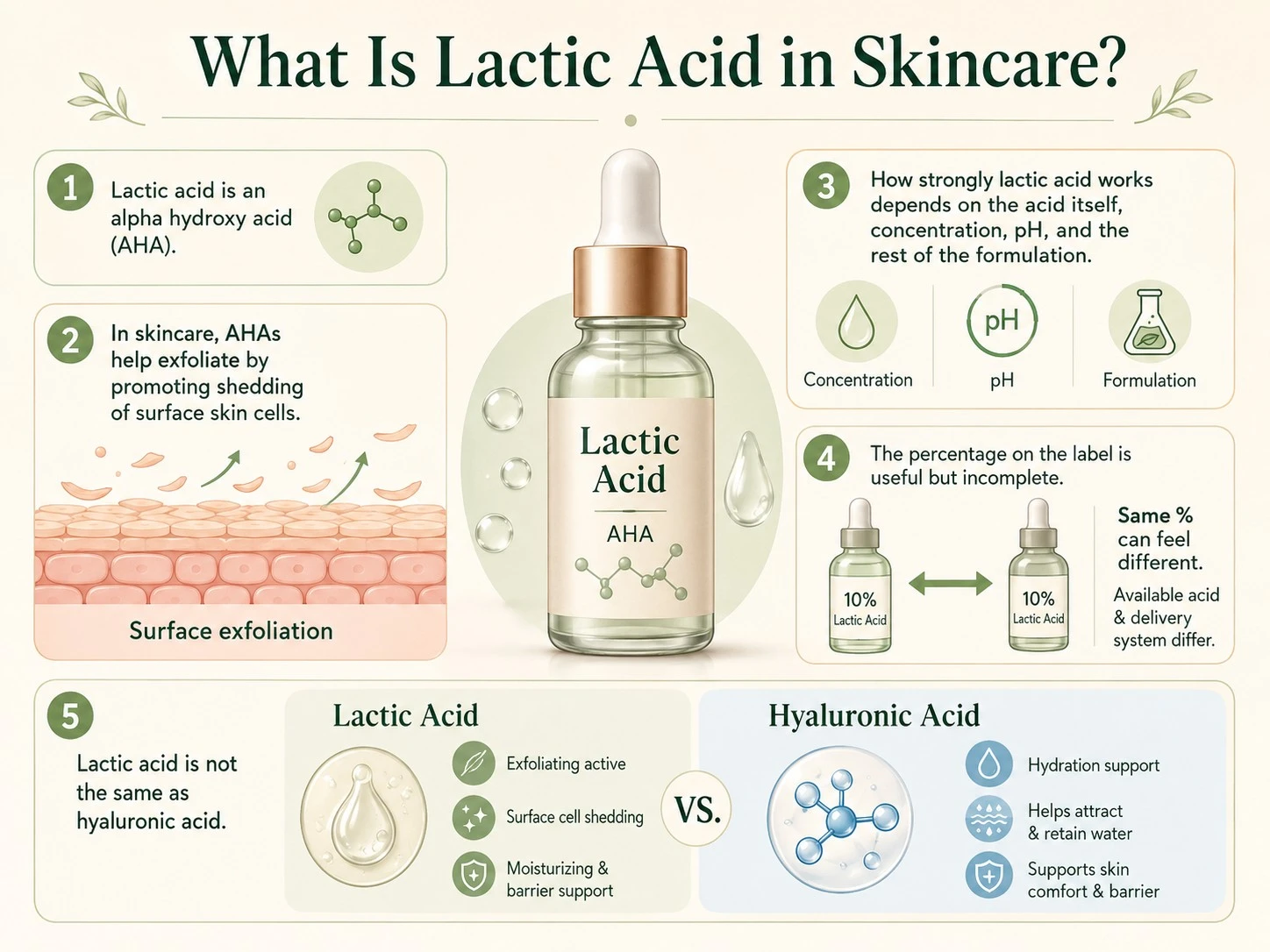
Lactic acid is an alpha hydroxy acid, or AHA. In skincare, AHAs promote shedding of surface skin cells. The degree of exfoliation is influenced by the acid itself, its concentration, the product’s pH, and the rest of the formulation.[1][2]
That makes the percentage on the front of a product useful but incomplete information. Two products with the same lactic acid percentage can feel different because the amount of available acid and the delivery system can differ.[2]
Lactic acid should also not be confused with hyaluronic acid. Hyaluronic acid is mainly used to support hydration, while lactic acid is an exfoliating active that can also have moisturizing and barrier-related effects.
What Does Lactic Acid Do for Skin?
Lactic acid stands out because it combines surface exfoliation with useful moisture-related effects. Topical lactic acid can improve rough texture and some signs of photodamage while also influencing hydration and barrier-related skin properties.[3][4][5]
| Potential benefit | What that means in practice | Evidence boundary |
|---|---|---|
| Smoother texture | Exfoliation can reduce the rough, uneven feel caused by surface cell buildup. | Topical lactic acid can improve skin smoothness and reduce surface roughness.[3][4] |
| Brighter-looking skin | Removing excess surface buildup can make dull skin look clearer and more even. | This is a cosmetic appearance benefit, not a guarantee of “skin whitening.” |
| More even-looking tone | Regular exfoliation may gradually improve some superficial uneven pigmentation. | An 8% L-lactic acid trial improved mottled hyperpigmentation on treated forearms, but lactic acid is not a treatment for every cause of dark spots.[4] |
| Softer fine lines | Longer-term use may improve the appearance of fine surface lines associated with photodamage. | Topical 8% and 12% lactic acid produced modest improvements in photodamaged skin and the appearance of fine lines; these results should not be treated as equivalent to prescription anti-aging treatment.[3][4] |
| Hydration and barrier support | Lactic acid can improve moisture-related skin properties instead of acting only as a stripping exfoliant. | L-lactic acid can increase stratum corneum ceramides and support moisture-related skin properties, including hydration and resistance to dryness.[5][6] |
What Strength of Lactic Acid Should You Use?
Both concentration and pH influence how strongly lactic acid affects epidermal turnover.[2] A lower-pH product can behave more actively than the same percentage at a higher pH.
- If you are new to exfoliating acids: start with a lower-strength finished product and a low frequency rather than jumping to the strongest option.
- If you already tolerate AHAs: a moderate-strength leave-on formula may be reasonable, but increase frequency or strength one variable at a time.
- If you are considering a high-strength peel: do not treat a professional peel concentration as an at-home target. Strong peel products require a different level of control and risk management.
For cosmetic products, a commonly cited safety benchmark is 10% AHA or less at a final pH of 3.5 or higher, together with appropriate sun-protection precautions.[1] This should not be treated as a universal global concentration rule; permitted concentrations, product classifications, warnings, and directions can vary by market.
How to Use Lactic Acid in Your Skincare Routine
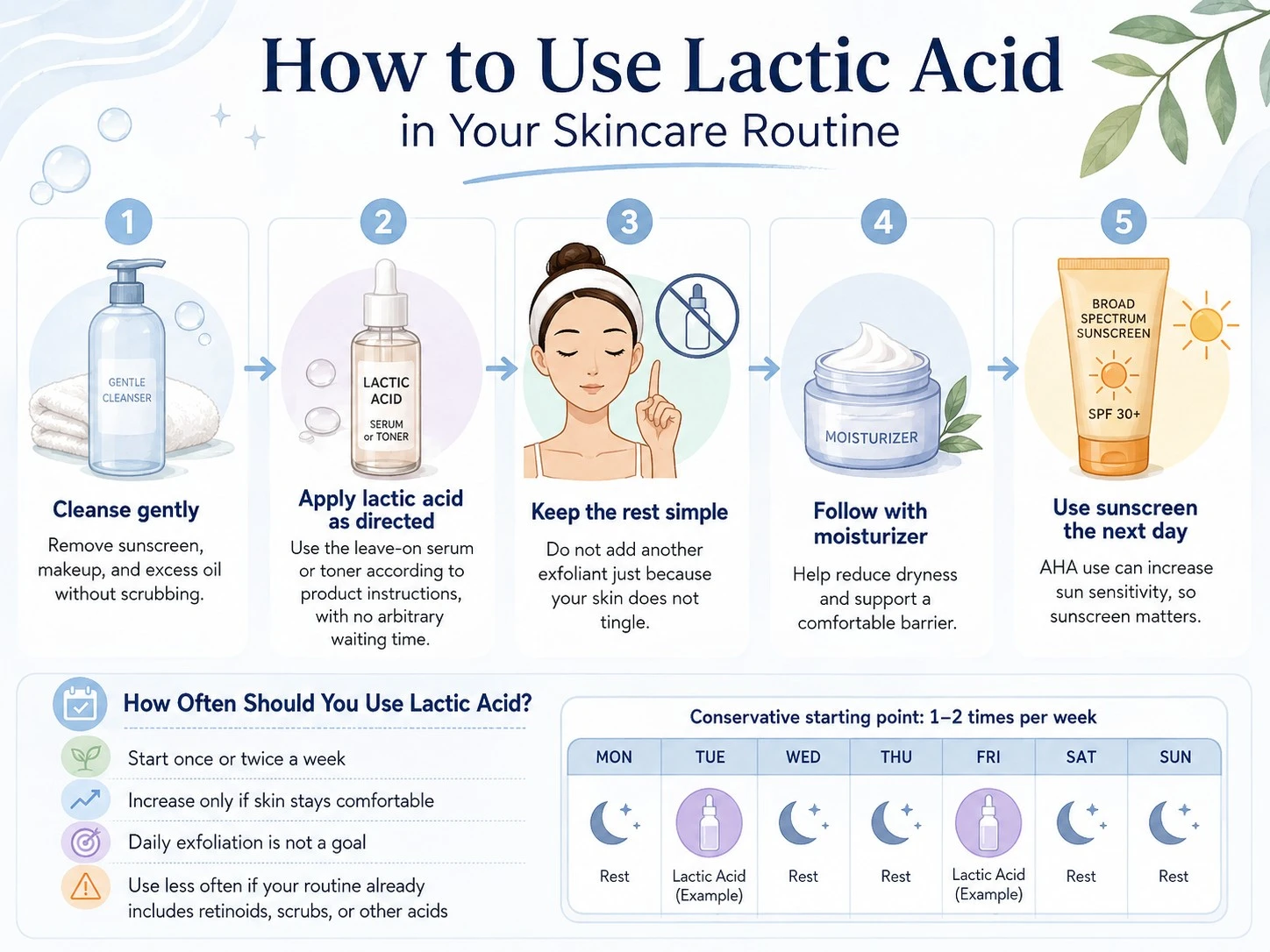
A simple routine makes it easier to tell whether lactic acid is helping or irritating your skin. Before first use, consider a small-area test; see How to Patch Test Skincare Products Before Using Them for a practical approach.
- Cleanse gently. Remove sunscreen, makeup, and excess oil without scrubbing.
- Apply the lactic acid product as directed. For a leave-on serum or toner, follow the product instructions rather than adding an arbitrary waiting time.
- Keep the rest of the routine simple. Do not add another exfoliant just because your skin does not tingle.
- Follow with moisturizer. A moisturizer can reduce dryness and help support a comfortable barrier.
- Use sunscreen the next day. AHA use can increase sun sensitivity, so make sun protection part of the routine rather than an optional extra.[1] If you need a refresher, see Sunscreen 101: How to Choose, Apply, and Reapply SPF.
How Often Should You Use Lactic Acid?
For a new leave-on exfoliant, once or twice a week is a conservative starting point. Increase only when your skin remains comfortable and the product directions support more frequent use. Daily exfoliation is not a goal in itself.
Your ideal frequency also depends on what else is in the routine. If you already use retinoids, exfoliating cleansers, scrubs, or another acid, you may need less lactic acid rather than more. For a broader frequency framework, see How Often Should You Exfoliate Your Face.
What Can You Use With Lactic Acid?
Most “ingredient conflicts” are really tolerance problems. Finished skincare products are not automatically chemically incompatible just because they contain different actives, but combining several irritating steps can overwhelm the skin.
| Ingredient or product | Can it be used in the same routine? | Practical approach |
|---|---|---|
| Hyaluronic acid | Usually yes | Useful when you want extra hydration around an exfoliating step. See Hyaluronic Acid for Skin: Benefits, Uses & How to Apply. |
| Ceramides and moisturizer | Usually yes | A sensible pairing when dryness or barrier comfort is a priority. See Ceramides for Skin: Benefits, Barrier Repair & Use. |
| Niacinamide | Usually yes | There is no need for a blanket separation rule. Let product directions and your tolerance decide. |
| Retinol | Potentially, but start on separate nights | Both can irritate. Introduce one active at a time and alternate initially. See Retinol Guide: Benefits, Side Effects & How to Use. |
| Other AHAs, salicylic acid, or strong scrubs | Use caution | Avoid stacking separate exfoliants at first. More exfoliation does not automatically mean faster results. |
| Vitamin C | Potentially | They do not need to be treated as universally incompatible, but separate them if using both together increases stinging or irritation. |
Lactic Acid vs Glycolic Acid
Lactic acid and glycolic acid are both AHAs, so they overlap in what they can do: exfoliate the surface, improve roughness, and support a smoother, brighter appearance. Lactic acid is often chosen when a more hydration-friendly or lower-irritation AHA experience is desired, while glycolic acid is often chosen when stronger resurfacing is the priority.
| Factor | Lactic acid | Glycolic acid |
|---|---|---|
| Primary role | Surface exfoliation with useful moisture-related properties | Surface exfoliation with strong resurfacing potential |
| Tolerance | L-lactic acid produced fewer consumer complaints than glycolic acid in one comparative study.[6] | Can be very effective, but some users find it more irritating at active strengths. |
| Best starting point | Often reasonable for dry-feeling or easily irritated skin that still needs exfoliation | Often reasonable for experienced AHA users who tolerate stronger exfoliation |
| What matters beyond the acid name | Concentration, pH, vehicle, frequency, and the rest of the routine can change the real-world effect.[1][2] | |
Neither acid is automatically “better.” The better choice is the one that produces the improvement you want without persistent irritation.
Side Effects and Signs You Are Over-Exfoliating

Potential AHA-related adverse effects include burning, rash, swelling, peeling, itching, tenderness, and increased sunburn, with stronger exfoliating products carrying greater irritation risk.[1]
Reduce frequency or stop the product if you develop persistent burning, redness, tightness, unusual sensitivity, or visible peeling that continues rather than settling quickly. Do not try to “fix” irritation by adding more acids or active treatments.
If your skin is already sunburned, cracked, inflamed, or recovering from a procedure, it is usually better to wait until the barrier is comfortable before restarting exfoliation. Our guides to Over-Exfoliated Skin: Signs, Healing & Safe Routine and the skin barrier can help you simplify the routine while your skin recovers.
Seek medical advice if a reaction is severe, involves marked swelling or blistering, affects the eyes, or does not improve after you stop the product.
Final Thoughts
Lactic acid is most useful when you want controlled surface exfoliation without making “stronger” the goal. It can improve roughness, dullness, some uneven tone, and the look of fine surface lines while offering moisture-related benefits that make it distinct from many purely exfoliating actives.
Choose the product by the whole formula, not just the percentage. Start slowly, keep the routine simple, moisturize, and protect your skin from the sun. If irritation keeps increasing, reducing exfoliation is usually more useful than adding another active.
FAQs About Lactic Acid for Skin
Can I use lactic acid every day?
Some finished products are designed for frequent use, but daily use is not necessary for everyone. Start less often, follow the product directions, and increase only if your skin remains comfortable.
Is lactic acid good for sensitive skin?
It can be a reasonable AHA option for some sensitive or dry-feeling skin, but “gentler” does not mean irritation-proof. Use a lower-strength formula, introduce it slowly, and avoid applying it when your skin is already inflamed or barrier-damaged.
Does lactic acid help dark spots?
It may gradually improve some superficial uneven pigmentation as part of its exfoliating effect. An 8% L-lactic acid clinical trial reported improvement in mottled hyperpigmentation on treated forearms.[4] Persistent or changing pigmentation can have many causes, so lactic acid should not be treated as a universal dark-spot treatment.
Can I use lactic acid with retinol?
They can exist in the same overall skincare routine, but starting them on separate nights makes irritation easier to identify. Once your skin clearly tolerates both, follow the directions of the finished products rather than assuming they must always be separated.
Is lactic acid better than glycolic acid?
Not universally. Lactic acid can be attractive when hydration and tolerance are priorities; glycolic acid may suit people who want a stronger AHA approach and tolerate it well. Formula strength and pH can matter as much as the ingredient name.[2][6]
Should I use lactic acid in the morning or at night?
Night use is convenient because it keeps an exfoliating step separate from the daytime routine, but it is not a universal requirement. What is essential is following the product directions and using effective sun protection because AHAs can increase sun sensitivity.[1]
Sources
[1] U.S. Food and Drug Administration. Alpha Hydroxy Acids
[2] Thueson DO et al. The Roles of pH and Concentration in Lactic Acid-Induced Stimulation of Epidermal Turnover
[3] Smith WP. Epidermal and Dermal Effects of Topical Lactic Acid
[4] Stiller MJ et al. Topical 8% Glycolic Acid and 8% L-Lactic Acid Creams for the Treatment of Photodamaged Skin
[5] Rawlings AV et al. Effect of Lactic Acid Isomers on Keratinocyte Ceramide Synthesis, Stratum Corneum Lipid Levels and Stratum Corneum Barrier Function
[6] Smith WP. Comparative Effectiveness of Alpha-Hydroxy Acids on Skin Properties


