


Enlarged pores are one of the easiest skincare concerns to over-treat. A person sees visible dots around the nose or cheeks, adds stronger cleansers and several acids, starts extracting them manually, and may end up with more redness and texture than before.
The problem is that “large pores” do not have one cause. Oil and congestion can make some pores more obvious, while others are related more strongly to follicle structure, acne, sun damage, or reduced support around the opening. Effective skincare starts by identifying which of these patterns best matches what you actually see.
What Are Enlarged Pores?
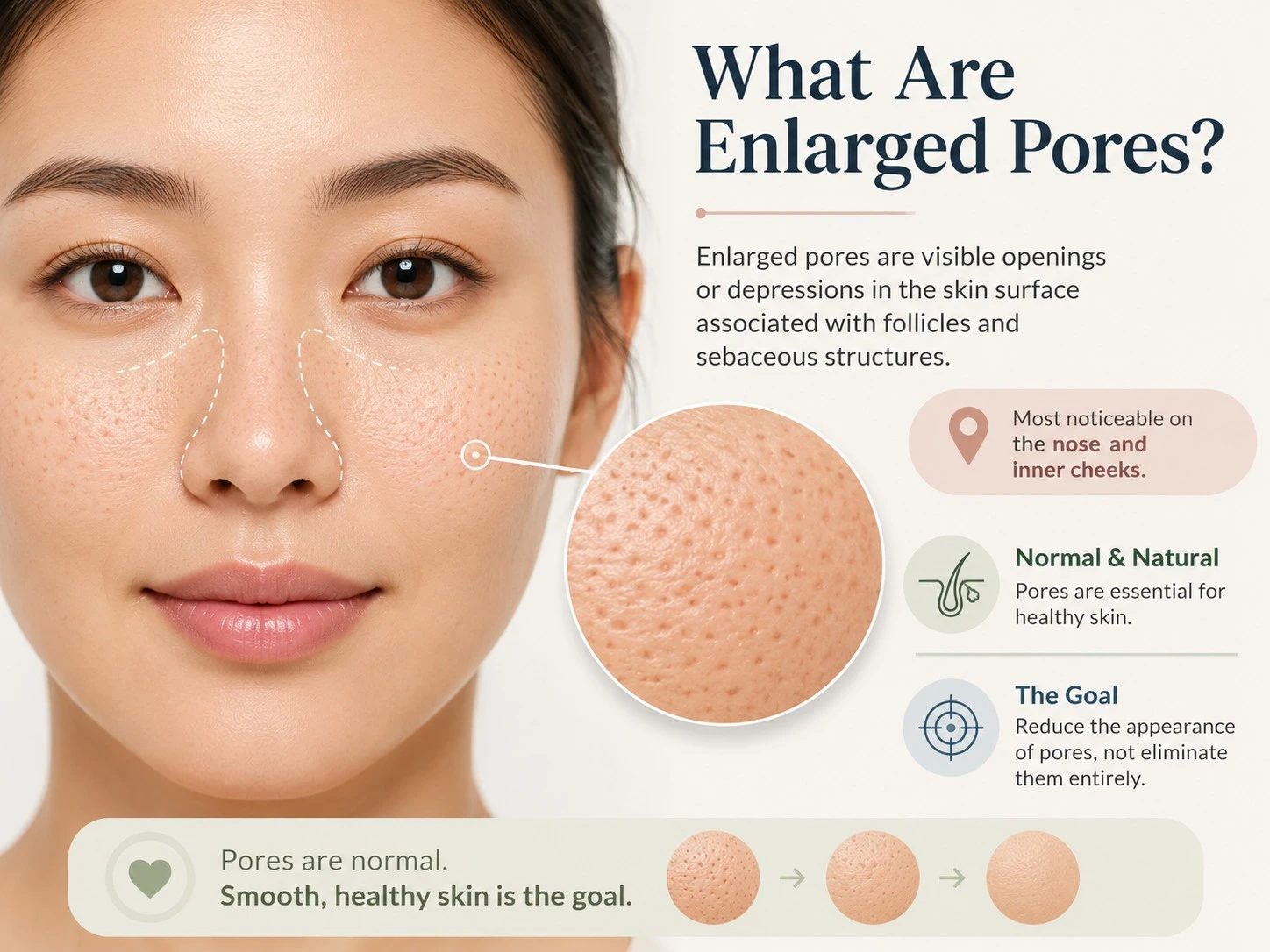
Enlarged pores are visible depressions or openings in the skin surface associated with follicular and glandular structures. They are especially noticeable on areas such as the nose and inner cheeks, where sebaceous activity and visible follicles are often greater.[2][3]
The phrase “open pores” is also widely used, but it can create the wrong mental model. The concern is usually that a pore has become more visually prominent—not that it has opened like a door and needs to be physically closed.
Pores are normal skin structures. The realistic goal of skincare is therefore to reduce their visible prominence, not to create permanently poreless skin.
Why Do Pores Look Larger?
Several different factors can increase pore visibility, and more than one may be operating at the same time.[2][3]
| Main Driver | What Happens | Common Clue |
|---|---|---|
| High sebum production | Greater oil output is associated with more visible facial pores | Persistent shine, especially through the nose, forehead, or inner cheeks |
| Clogging and comedones | Oil and keratin buildup can make the follicular opening more obvious | Blackheads, whiteheads, or recurring congestion within the visible pore |
| Reduced skin elasticity | Less support around the pore can make the opening appear broader or less compact | Pores becoming more noticeable alongside other changes in skin firmness or photoaging |
| Larger follicle volume | The underlying follicular structure itself contributes to visible pore size | Pores remain clearly visible even when the skin is clean and not especially oily |
| Acne and inflammation | Repeated follicular inflammation can alter the appearance of pore openings and surrounding texture | Enlarged pores occurring in areas with current or previous acne |
This explains why one “pore-minimizing” product cannot produce the same result for everyone. A salicylic acid product may make a meaningful difference when the main problem is congestion, but it cannot change a naturally larger follicle into an invisible one.
Can You Permanently Shrink Enlarged Pores?
Skincare can make pores less noticeable, but it cannot erase the underlying openings from the skin. Even professional treatments are better understood as methods for improving pore appearance rather than creating a permanent pore-free surface.[1][2][4]
The distinction matters because different treatments improve different contributors. Clearing a blackhead can reduce the apparent size of a clogged opening. Reducing excessive sebum can make oily pores less conspicuous. Retinoids and procedures that improve surrounding skin texture or support may help another pattern.
None of those outcomes means the pore itself has been permanently “closed.” If oil production, congestion, sun damage, acne, or age-related changes continue, pore visibility can change again over time.
Which Skincare Ingredients Can Help Enlarged Pores?
Choose an active by the reason your pores look enlarged. Using every ingredient associated with “pore care” at once usually creates more irritation than additional benefit.
| Ingredient | Best Fit | What It Can Realistically Do | Main Limitation |
|---|---|---|---|
| Salicylic acid | Oily skin, blackheads, whiteheads, or clogged pores | Helps exfoliate and unclog follicles, which can make congested pores less noticeable[1][5] | Can cause dryness or irritation when overused |
| Retinol and other retinoids | Comedones, acne-prone skin, photoaging, or reduced firmness | Retinoids can help prevent follicular clogging, and some can improve the appearance of photoaged skin and visible pores[1][4][5] | Irritation, peeling, and dryness can limit tolerance |
| Niacinamide | Oiliness or a routine that also needs barrier and hydration support | Can be a useful supporting ingredient in pore-focused skincare and may help when excess sebum contributes to visibility[2][4] | It should not be treated as a permanent pore-shrinking ingredient |
| Glycolic acid and other AHAs | Rough surface texture or photoaged skin rather than deeply clogged follicles | Can improve surface exfoliation and overall texture, which may make pores less visually dominant[4] | Adding AHAs to an already aggressive acid or retinoid routine can increase irritation |
Salicylic acid and retinoids generally have the clearest role when visible pores overlap with congestion or acne. Niacinamide is more appropriately treated as a supporting option, while AHAs are useful when rough surface texture is part of the visual problem.
A Simple Skincare Routine for Enlarged Pores
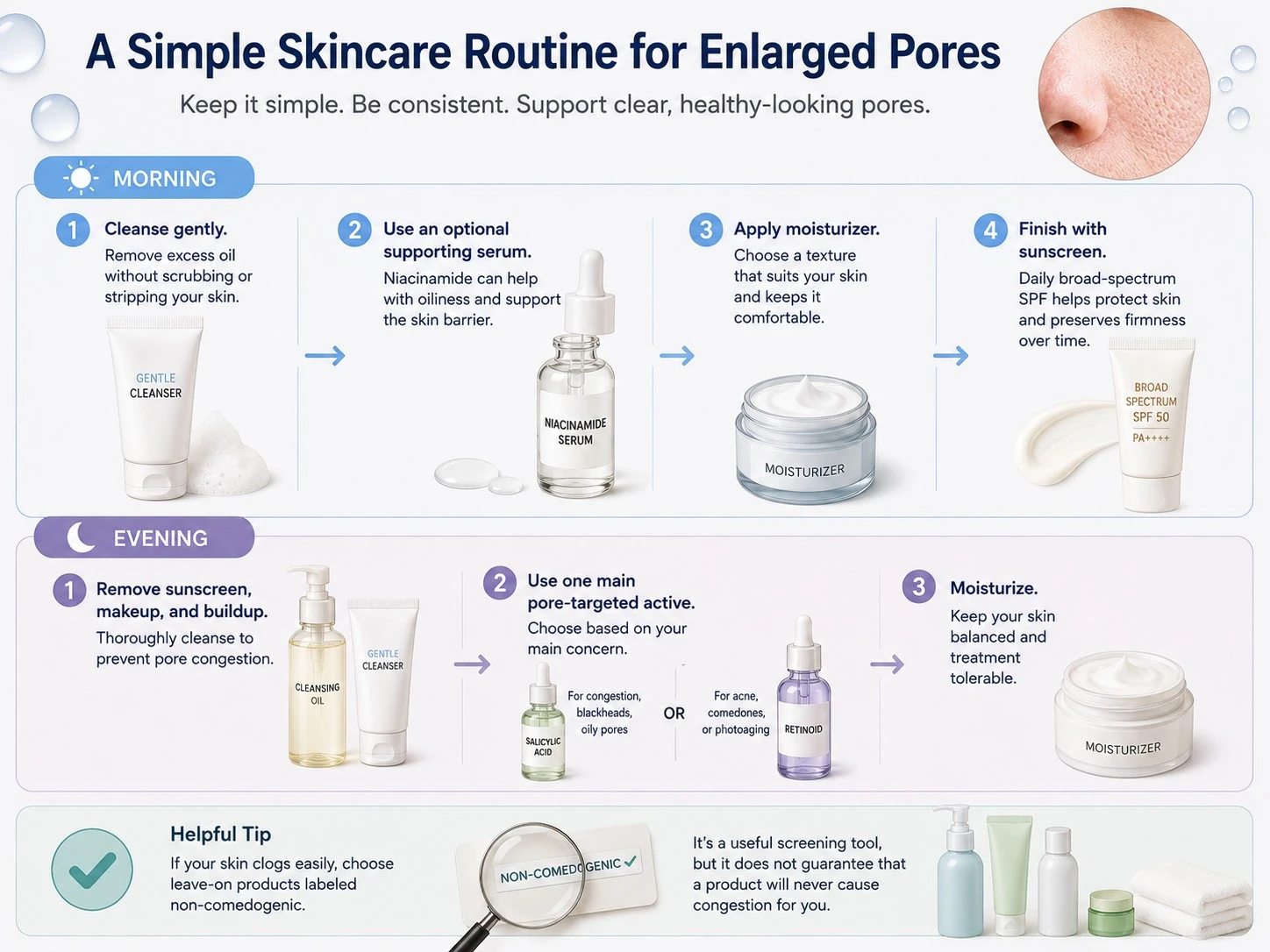
A pore-focused routine does not need several “tightening” products. Start with a stable base and introduce one active according to the main cause.
Morning
- Cleanse gently. Remove excess oil without scrubbing or trying to leave the skin completely oil-free.[1]
- Use an optional supporting serum. Niacinamide can fit here if oiliness or barrier support is part of your goal.
- Apply moisturizer. Choose a texture appropriate for your skin rather than skipping moisturizer simply because your pores are visible.
- Finish with broad-spectrum sunscreen. Cumulative sun damage reduces skin firmness and can make pores more noticeable over time.[1][2]
Evening
- Remove sunscreen, makeup, and buildup.
- Use one main pore-targeted active. Choose salicylic acid when congestion is dominant or an appropriate retinoid when acne, comedones, or photoaging are part of the problem.
- Moisturize. Keeping the treatment tolerable is more useful than repeatedly increasing exfoliation strength.
If your skin clogs easily, non-comedogenic labeling can be a useful screening tool for leave-on products, but it does not guarantee that a particular formula will never contribute to congestion.
Enlarged Pores vs Blackheads and Sebaceous Filaments
Many people trying to “shrink pores” are actually looking at a mixture of visible pore openings, blackheads, and sebaceous filaments. Identifying which one dominates changes what treatment can realistically accomplish.[6]
| What You See | What It Is | What Happens After Extraction |
|---|---|---|
| Enlarged pore | A visibly prominent skin opening or depression | Removing surface contents does not eliminate the underlying pore |
| Blackhead | An open comedone containing a plug of oil and keratin | Clearing the clog can improve appearance, but new comedones can form again |
| Sebaceous filament | A normal structure that helps conduct sebum toward the skin surface | It can refill because the structure itself is normal and remains present[6] |
This distinction is particularly useful on the nose. If the main concern is repeated gray, tan, or dark dots rather than the outline of the pore itself, determine whether you are dealing with sebaceous filaments or blackheads before escalating treatment.
What Can Make Enlarged Pores Look Worse?
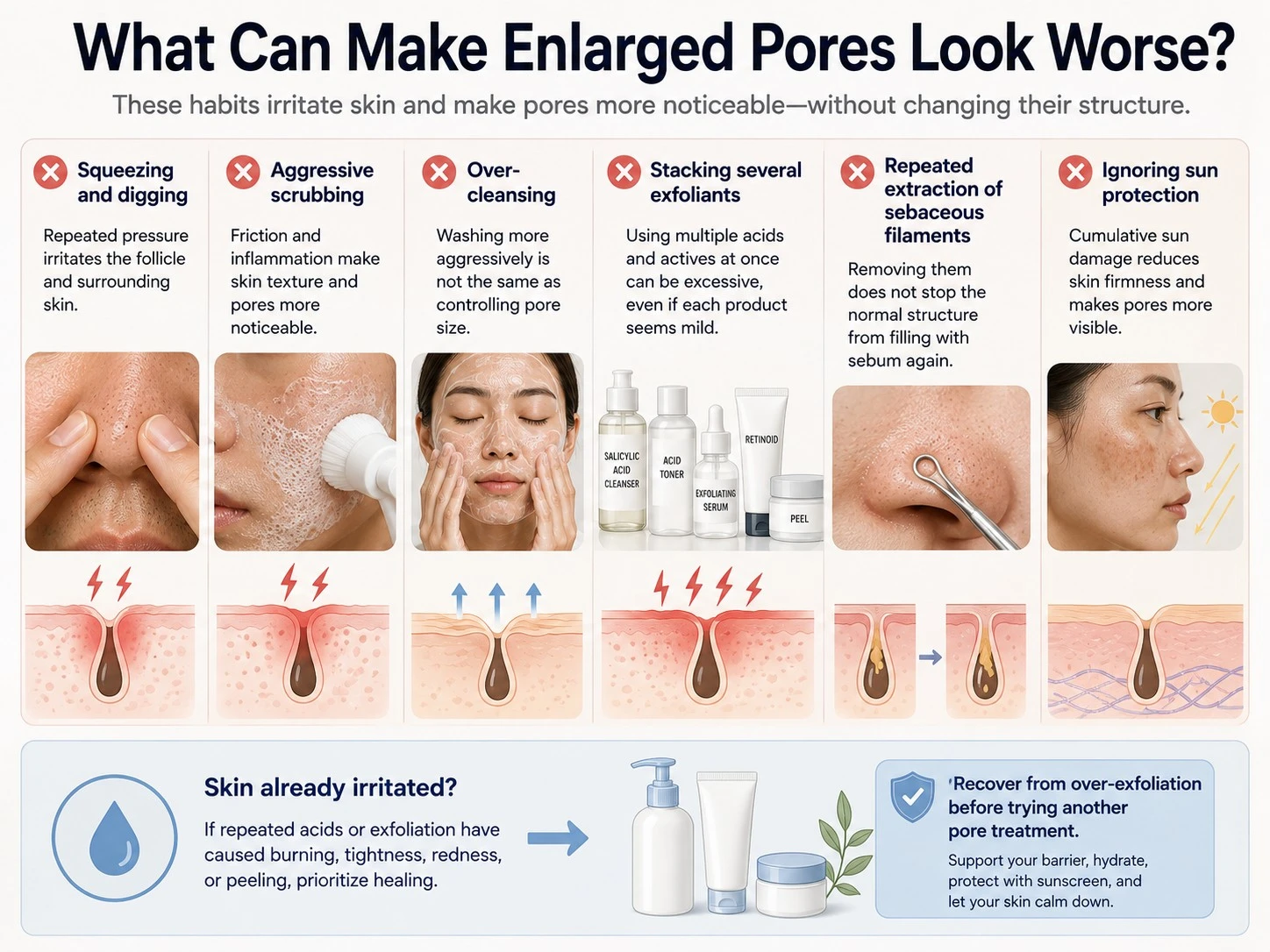
Several common attempts to “deep clean” pores can make the surrounding skin more irritated without changing the underlying anatomy.
- Squeezing and digging: repeated pressure can irritate the follicle and surrounding skin.[1][6]
- Aggressive scrubbing: friction and inflammation can make skin texture and pores more noticeable.[1]
- Over-cleansing: washing more aggressively is not the same as controlling the factors that determine visible pore size.
- Stacking several exfoliants: a salicylic acid cleanser, acid toner, exfoliating serum, retinoid, and weekly peel can become excessive even when each product looks reasonable alone.
- Repeated extraction of sebaceous filaments: removing them does not stop the normal structure from filling with sebum again.[6]
- Ignoring sun protection: cumulative sun damage can contribute to reduced skin firmness and more visible pores.[1][2]
If repeated acids or exfoliation have already caused persistent burning, tightness, redness, or peeling, the priority is to recover from over-exfoliation rather than introduce another pore treatment.
When to Consider Professional Treatment
Professional treatment becomes more relevant when enlarged pores remain a significant concern after a consistent skincare routine, when reduced skin elasticity is a major driver, or when the visible texture overlaps with acne scarring.
Dermatology literature describes several approaches, including chemical peels, lasers, and radiofrequency-based procedures. These treatments target different combinations of sebum, epidermal texture, collagen support, and surrounding skin structure, and the quality of evidence varies across modalities.[2][4]
Fractional microneedling radiofrequency is one example with clinical evidence showing improvement in enlarged-pore scores after a series of treatments, although available studies are relatively small and do not establish it as the best option for every patient.[7]
The appropriate procedure depends on the cause of the visible pores, skin characteristics, acne or scarring history, tolerance for downtime, and the risk profile of the treatment. A dermatologist can also determine whether depressions that look like large pores are actually acne scars or another structural skin change.
Final Thoughts
Enlarged pores are easier to manage when you stop treating them as one uniform problem. Excess sebum, clogging, follicle structure, reduced elasticity, acne, and sun damage can all contribute, so the best treatment depends on which factor is most important for your skin.
For most home routines, start simply: cleanse gently, keep congestion under control, introduce one appropriate active, moisturize, and protect the skin from the sun. The goal is not to permanently close every pore. It is to make the skin surface look clearer and more even without creating irritation in the process.
FAQs About Enlarged Pores
Why Do Pores Look Larger on the Nose and Cheeks?
These areas contain prominent pilosebaceous structures and often produce more sebum, so visible pores can be especially noticeable there. Follicle size and skin elasticity also affect how prominent they appear.[2][3]
Is Salicylic Acid or Retinol Better for Enlarged Pores?
It depends on the cause. Salicylic acid is particularly useful when blackheads, whiteheads, or congestion are making pores more visible. Retinol and other retinoids can be more useful when comedones, acne, photoaging, or reduced firmness are also part of the problem.[1][4][5]
Does Niacinamide Shrink Pores?
Niacinamide can be a useful supporting ingredient, particularly when oiliness contributes to pore visibility, but it does not permanently close or remove pores. Treat it as part of an overall routine rather than a guaranteed pore-shrinking treatment.[2][4]
Can Dry or Dehydrated Skin Have Enlarged Pores?
Yes. High sebum is only one contributor to enlarged pores. Follicle size, reduced skin elasticity, sun damage, and acne can also affect pore appearance, so someone does not need to have very oily skin to notice large pores.[2][3]
Can Squeezing Make Pores Look Larger?
Repeated squeezing, picking, or digging can irritate the follicle and surrounding skin, which can make pores and texture more noticeable. Sebaceous filaments also refill naturally, so repeated extraction does not permanently solve that pattern.[1][6]
How Long Does It Take to Make Enlarged Pores Look Smaller?
There is no single timeline because the result depends on the cause and treatment. Removing excess surface oil or a clog can change appearance relatively quickly, while changes related to acne treatment, retinoid use, skin texture, or professional procedures require longer-term consistency. Judge progress over time rather than expecting a pore-tightening product to create an immediate permanent change.
Sources
[1] American Academy of Dermatology. What Can Treat Large Facial Pores?
[2] DermNet. Enlarged Pores
[3] Lee SJ et al. Facial Pores: Definition, Causes, and Treatment Options
[4] Parvar SY et al. The Efficacy and Adverse Effects of Treatment Options for Facial Pores: A Review Article
[5] American Academy of Dermatology. American Academy of Dermatology Issues Updated Guidelines for the Management of Acne
[6] Cleveland Clinic. Sebaceous Filaments: Difference From Blackheads & Treatment
[7] Huang Y et al. Efficacy and Safety of Fractional Micro-Needling Radiofrequency for the Treatment of Enlarged Pores on the Cheeks of a Chinese Cohort


