
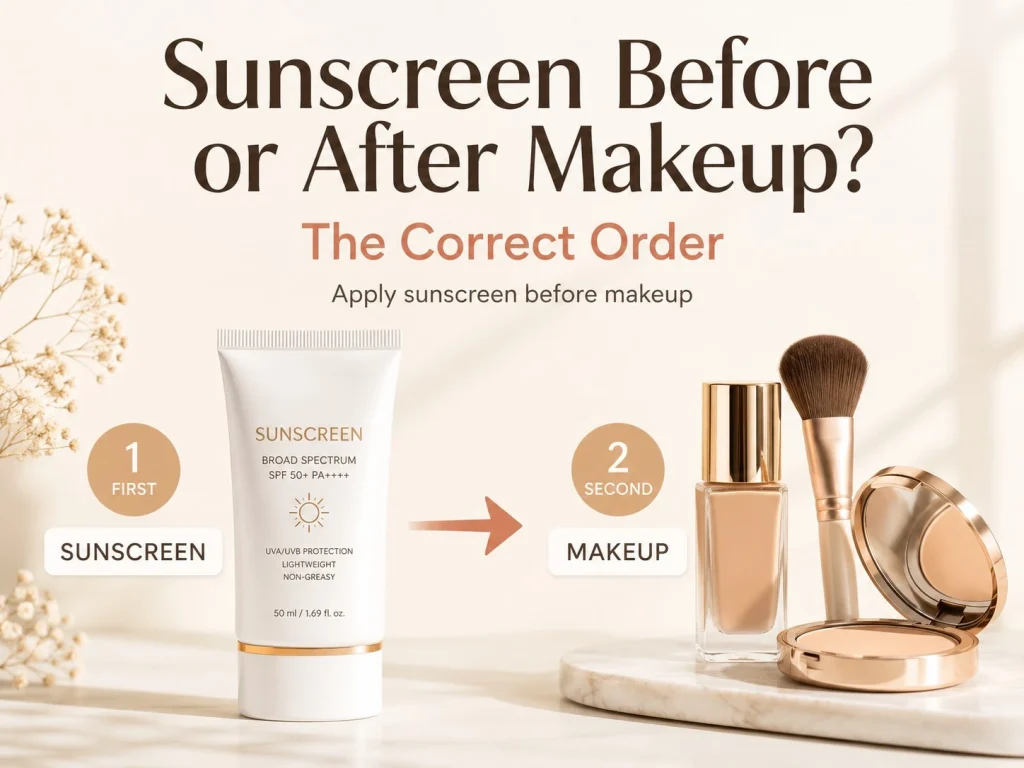


The basic order is simple: skincare, sunscreen, then makeup. The harder part is keeping the sunscreen layer even while making foundation sit smoothly. Using too little sunscreen, rubbing aggressively, or stacking incompatible textures can leave patchy coverage even when the products were applied in the correct order.
Why Sunscreen Goes Under Makeup
Sunscreen needs to form a continuous, adequately applied layer over exposed skin. Putting foundation, concealer, powder, or blush underneath it makes that layer harder to spread evenly and is likely to smear the makeup. Sunscreen therefore belongs after skincare but before products whose main job is color or finish.
Makeup with SPF is useful as extra protection, not a dependable substitute for a separate sunscreen. People normally use much less foundation or powder than the amount used to establish the labeled SPF, and makeup is often concentrated on the center of the face rather than spread evenly to the hairline, ears, and neck.[3]
Applying makeup over sunscreen does not automatically cancel the sunscreen. In a controlled study using products at amounts intended to resemble real use, layering facial makeup over sunscreen produced more even coverage and greater measured protection than either product alone. The result supports the order of sunscreen first and makeup second, but it does not prove that every product combination performs the same way or that makeup can compensate for too little sunscreen.[4]
How Long Should Sunscreen Set Before Makeup?
There is no universal evidence-based rule that every sunscreen must wait exactly 15 or 20 minutes before makeup. U.S. sunscreen directions commonly say to apply 15 minutes before sun exposure; that instruction concerns the start of UV exposure, not a mandatory makeup countdown.[1]
For makeup application, use the finish as your practical guide. Wait until the sunscreen has formed an even layer and is no longer so wet or mobile that a sponge, brush, or fingertip immediately lifts it. Depending on the formula, the amount used, humidity, and the layers underneath, this may take a few minutes. Follow any more specific direction on the product label.
If the sunscreen still feels very slippery, makeup may streak it. If you wait longer and it remains sticky, that may simply be the product’s finish rather than a sign that it has not “absorbed.” Changing the application method or choosing a sunscreen with a more makeup-compatible finish is often more useful than waiting indefinitely.
How to Apply Makeup Without Disturbing Sunscreen
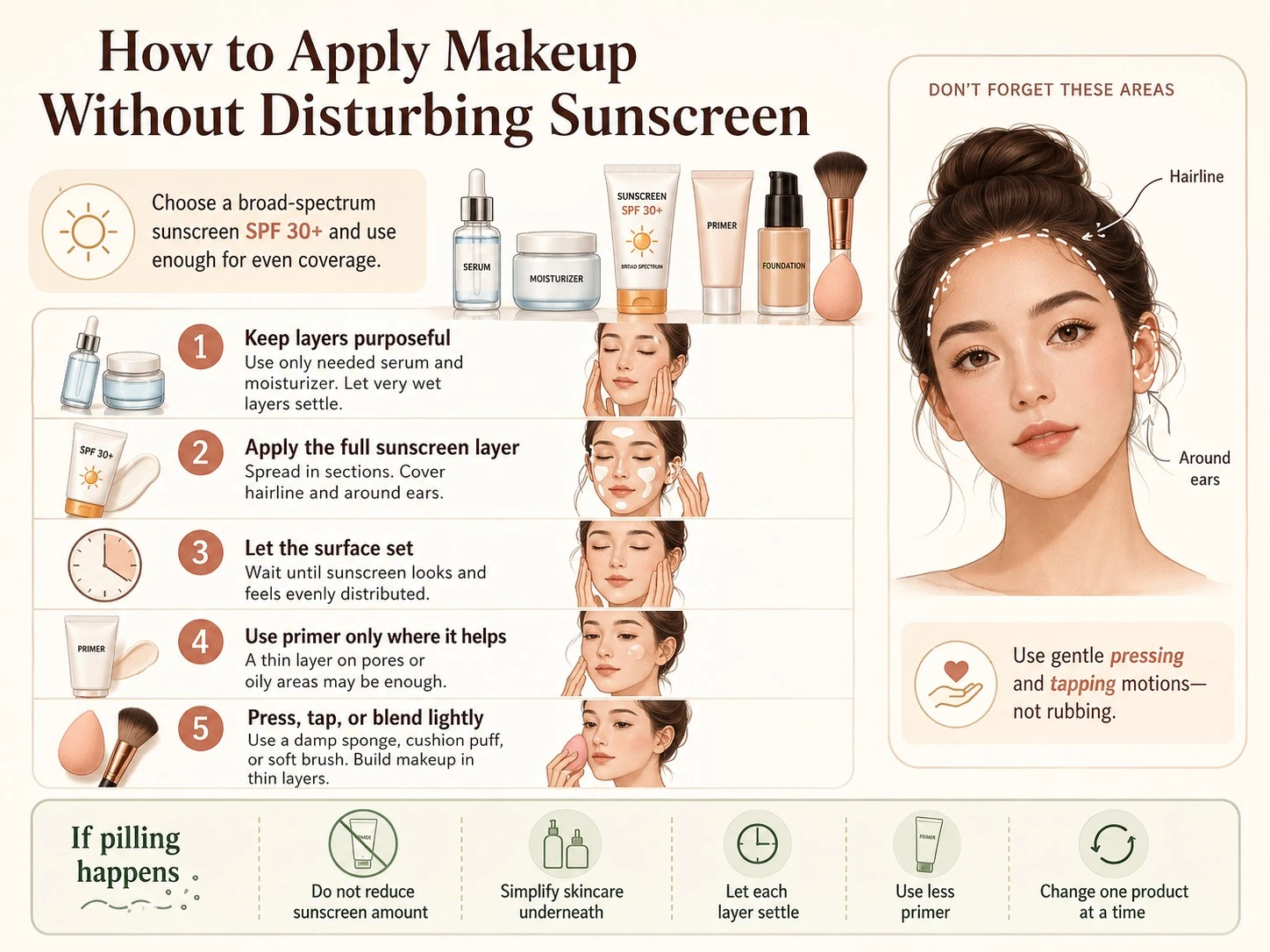
Start with a sunscreen that suits your skin and the finish you want. A lightweight lotion may sit better under makeup than a rich cream on oily skin, while dry skin may prefer a more emollient base. Whatever the texture, choose a broad-spectrum product with SPF 30 or higher and use enough to cover exposed skin.[2]
Use this sequence to reduce patchiness and pilling:
- Keep the layers purposeful. Apply only the serum and moisturizer you need, and give very wet layers time to settle. Too many film-forming products increase the chance that the next layer will roll up.
- Apply the full sunscreen layer. Spread it in sections rather than trying to drag one large amount across the entire face. Cover easy-to-miss areas such as the hairline and around the ears. This guide to how much sunscreen to use on your face explains the quantity issue in more detail.
- Let the surface set. The sunscreen should look and feel evenly distributed before you add primer or foundation.
- Use primer only where it helps. A thin layer on pores or oily areas may be enough. Applying a heavy primer over the whole face creates another opportunity to shift the sunscreen.
- Press, tap, or blend lightly. A damp sponge, cushion puff, or soft brush can work, but the best tool is the one that deposits makeup without repeated hard rubbing. Build coverage in thin layers.
If products start rolling into small flakes, do not solve the problem by cutting the sunscreen amount. Pilling can come from incompatible thickeners or film formers, excessive layers, insufficient settling time, or repeated rubbing. Try simplifying the skincare underneath, allowing each layer to settle, using less primer, or changing one product at a time. The full troubleshooting guide explains why sunscreen pills and how to isolate the cause.
How to Reapply Sunscreen Over Makeup
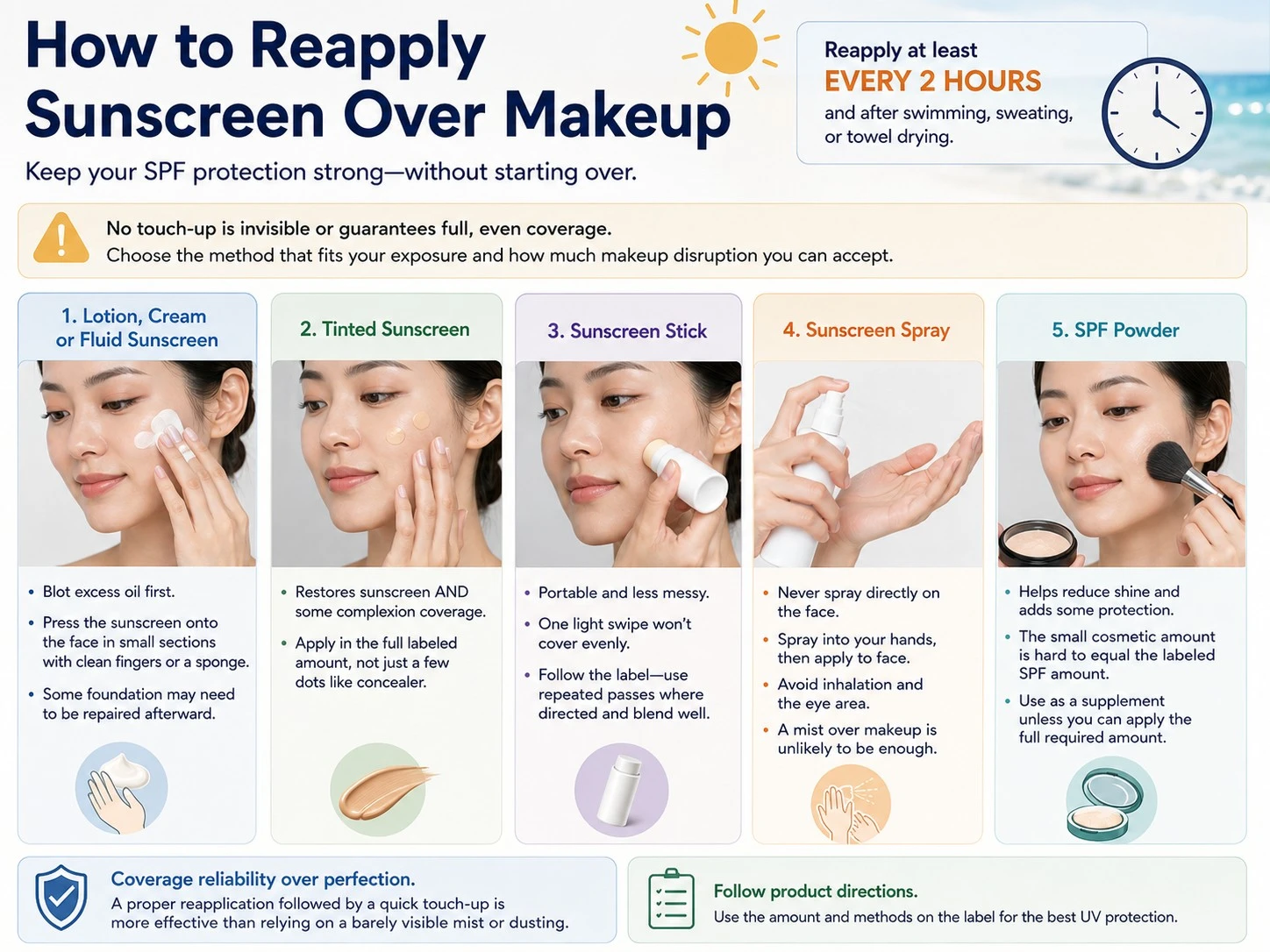
When you are outdoors, sunscreen generally needs to be reapplied at least every two hours and after swimming, sweating, or towel drying, according to the label.[1] Makeup makes this less convenient, but it does not stop UV exposure or extend the sunscreen’s labeled wear time.
No touch-up format is both completely invisible and guaranteed to deliver a full, even sunscreen layer. Choose the method based on exposure and how much cosmetic disruption you can accept:
- Lotion, cream, or fluid sunscreen: This gives you the clearest control over amount and coverage. Blot excess oil first, then press the sunscreen onto the face in small sections with clean fingers or a sponge. Some foundation may need to be repaired afterward.
- Tinted sunscreen: A tinted formula can restore sunscreen and some complexion coverage at the same time. It is most useful when you can apply the product in its full labeled amount rather than treating it as a few dots of concealer.
- Sunscreen stick: A stick is portable and can reduce dripping, but a single light swipe is unlikely to cover every contour evenly. Follow the label, use repeated passes where directed, and blend enough to close gaps without removing the product.
- Sunscreen spray: Never spray sunscreen directly onto the face. Spray it into your hands, then apply it to the face, avoiding inhalation and the eye area.[5] A fine mist floating over finished makeup should not be assumed to supply an adequate dose.
- SPF powder: Powder can reduce shine and add some protection, but the small cosmetic amount normally dusted on the face is difficult to equate with the amount needed for labeled protection. Treat it as a supplement unless you can follow the sunscreen’s application directions fully and evenly.
For a long outdoor day, coverage reliability matters more than keeping makeup untouched. A substantial reapplication followed by a cosmetic touch-up is more defensible than relying on an imperceptible mist or dusting. For the timing rules and exposure factors, see how often to reapply sunscreen.
Where Moisturizer, Primer, and Different Sunscreen Types Fit
Moisturizer
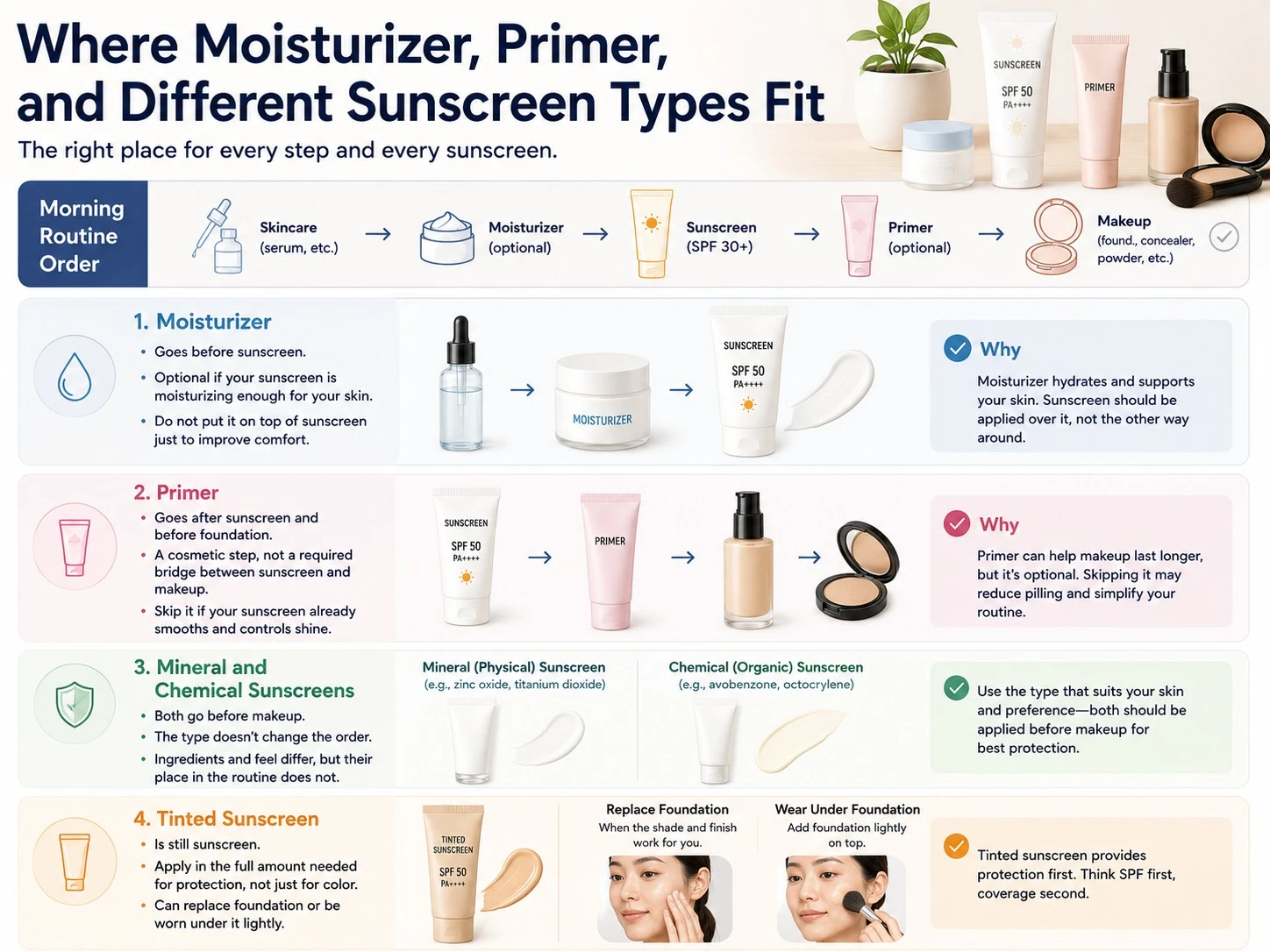
Moisturizer goes before sunscreen. It is optional if your sunscreen is moisturizing enough for your skin, but it should not be placed on top of the sunscreen merely to improve comfort. The fuller routine logic is covered in sunscreen or moisturizer first.
Primer
Primer goes after sunscreen and before foundation. It is a cosmetic step, not a required bridge between sunscreen and makeup. If the sunscreen already smooths the skin and controls shine, skipping primer may reduce pilling and make the routine simpler.
Mineral and Chemical Sunscreens
Both mineral sunscreens and sunscreens using organic filters go before makeup. The claim that one type must touch bare skin while the other must sit on top of makeup is not a useful routine-order rule. Their ingredients and cosmetic feel differ, but their place in the routine does not. For the meaningful formulation differences, see mineral vs chemical sunscreen.
Tinted Sunscreen
Tinted sunscreen is still sunscreen. Apply it in the full amount needed for protection, not merely in the amount that gives the prettiest color coverage. It may replace foundation when its shade and finish work for you, or foundation can be added lightly on top. Learn more about what tinted sunscreen can and cannot do.
Final Thoughts
Apply sunscreen after skincare and before primer or makeup. Use enough, let the layer become even and stable, and apply cosmetics without aggressive rubbing. For outdoor reapplication, prioritize a complete, label-directed sunscreen layer over a perfectly untouched makeup finish.
FAQs About Sunscreen and Makeup
Can you mix sunscreen with foundation?
Do not mix them in your hand unless the sunscreen’s directions explicitly allow it. Apply sunscreen as its own complete layer, let it set, and then add foundation. This preserves better control over the sunscreen amount and evenness.
Do the SPF values in sunscreen and foundation add together?
No. SPF 30 sunscreen plus SPF 30 foundation does not equal SPF 60. The protection from layered products depends on the amount, evenness, and performance of the finished layers; treat makeup SPF as supplemental rather than adding the label numbers.[4]
Should you apply sunscreen around the eyes before eye makeup?
Protect exposed skin around the eyes if the product is suitable for that area, but keep sunscreen out of the eyes and follow its warning label. A sunscreen stick can make controlled application around the eyes easier. Do not spray sunscreen toward the face; apply facial spray sunscreen from the hands instead.[5]
Do you need sunscreen under makeup for evening events?
Not for UV protection once it is fully dark. Apply it if you will travel, wait outdoors, or be near daylight before sunset. Sunscreen is determined by UV exposure, not by whether the event is labeled “evening.”
Sources
[1] U.S. Food and Drug Administration. Sunscreen: How to Help Protect Your Skin from the Sun
[2] American Academy of Dermatology Association. How to Apply Sunscreen
[3] The Skin Cancer Foundation. Top Trends in Skin Protection
[4] Kim MA, Jung YC, Bae J, Ha J, and Kim E. Layering Sunscreen With Facial Makeup Enhances Its Sun Protection Factor Under Real-Use Conditions
[5] American Academy of Dermatology Association. How to Use Stick and Spray Sunscreens


