
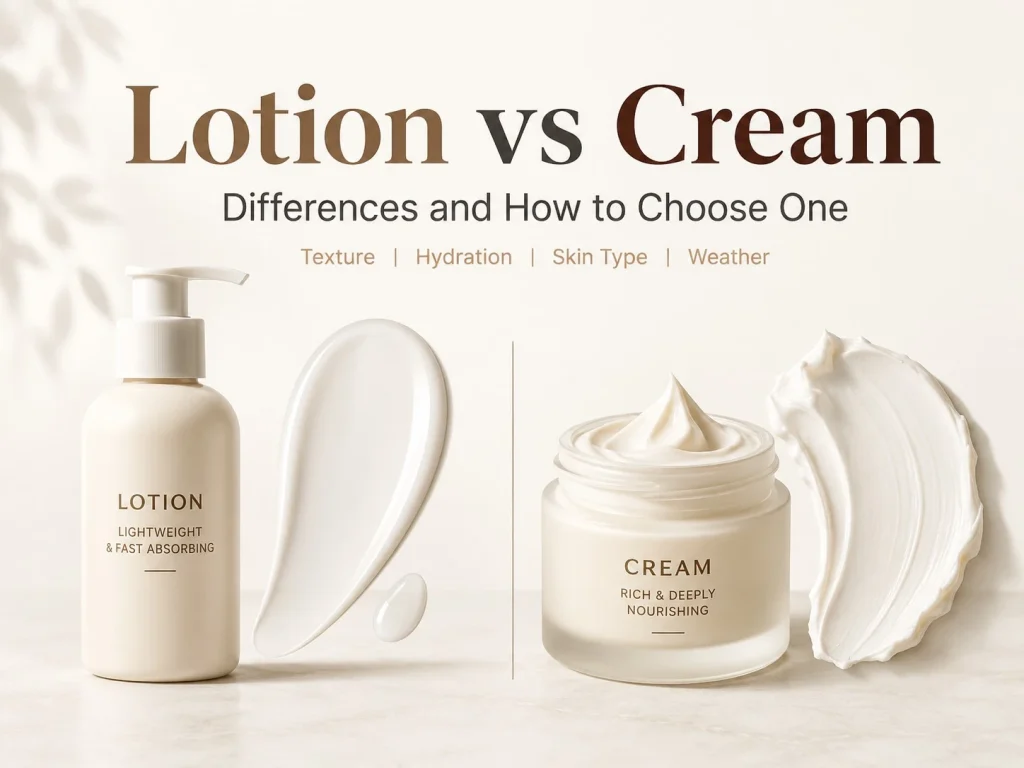

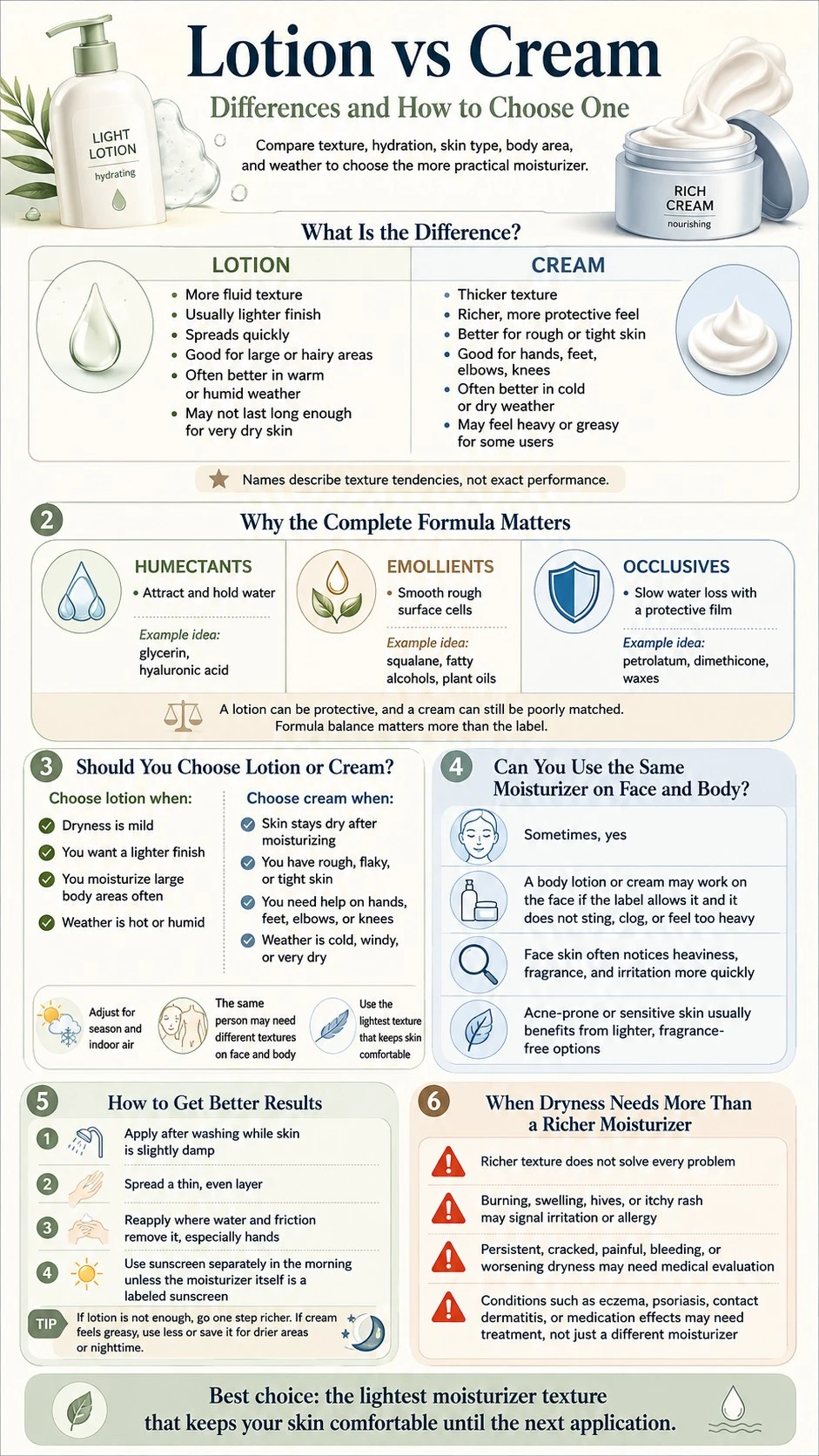
Lotion and cream are both moisturizer formats, but the names mainly describe texture tendencies. Their actual performance depends on the finished formula, the area where you apply it, and what your skin needs at that moment.
That means the answer can change across your face and body, between summer and winter, or when a treatment makes skin drier than usual. The comparison below helps you choose a sensible starting point and then adjust by results.
What Is the Difference Between Lotion and Cream?
In everyday skincare, lotion usually describes a more fluid emulsion, while cream describes a thicker one. Creams commonly contain more oil-phase or structuring material, but brands do not follow one universal recipe. Treat the name as a useful texture clue, not an exact performance specification.[1]
| Decision factor | Lotion | Cream |
|---|---|---|
| Texture | Usually fluid and easy to pump or pour | Usually thicker and more structured |
| Typical formula tendency | Often higher in water and lower in rich oils or waxes | Often contains more oil-phase, emollient, or occlusive material |
| Spread and finish | Spreads quickly over large or hairy areas and often feels lighter | Takes more work to spread and often leaves a richer, longer-lasting film |
| Useful starting point | Normal to oily-feeling skin, mild dryness, daytime body use, or hot and humid weather | Dry to very dry skin, rough patches, hands, cold weather, or overnight use |
| Possible drawback | May not protect persistently dry skin for long enough | May feel greasy, pill under other products, or be too heavy for some acne-prone users |
These patterns help with a first choice, not a guarantee. A well-designed lotion can outperform a poorly matched cream for a particular person. If you are comparing other light textures, the guide to gel vs cream moisturizer covers that separate decision.
Why the Complete Formula Still Matters
Most lotions and creams are emulsions that combine water-based and oil-based ingredients. Oils, waxes, silicones, emulsifiers, and thickeners influence viscosity, spread, finish, and staying power. A lotion can therefore be quite protective, while a cream can feel rich without being the best match for a particular person’s skin.
Moisturizing performance usually comes from three overlapping functions: humectants attract and hold water in the outer skin layer, emollients smooth rough spaces around surface cells, and occlusives slow evaporation by leaving a water-resistant film.[2] Creams often provide more emollient or occlusive support, but the balance of these functions matters more than one highlighted ingredient or the category name. The guide to humectants, emollients, and occlusives explains the roles in more detail; what moisturizer does covers their shared purpose.
Should You Choose Lotion or Cream?

Start with how your skin feels now, not a permanent skin-type label. The same person may prefer lotion on the torso in summer, cream on the hands in winter, and a different face moisturizer during acne treatment.
- Choose lotion for mild dryness or frequent all-over use. Its fluid spread can make it easier to cover arms, legs, or hairy areas without a heavy film. A product that feels acceptable is more likely to be used consistently.
- Choose cream when dryness persists between applications. Tightness, rough flakes, chapping, or repeated dryness soon after lotion suggest that a richer texture may give better water-loss protection. Creams and ointments are generally more effective than lotions for very dry skin.[3]
- Adjust for weather and indoor air. Heat and humidity often make a light lotion more wearable. Cold wind and low humidity, including dry heated indoor air, can increase the need for a cream, especially on exposed areas.
- Treat body areas separately. Thin lotion spreads well across the back, limbs, or hair-bearing skin. Cream can stay longer on hands, feet, elbows, knees, and other rough spots. You do not need one texture everywhere.
- Consider the rest of the routine. Acne treatments, retinoids, frequent handwashing, swimming, and exfoliation can increase dryness. A cream may improve comfort, but it cannot make an irritating routine harmless or substitute for prescribed care.
- Let wearability break a close tie. If two formulas keep the skin equally comfortable, choose the one you will use at the needed amount and frequency. A richer product that remains in the jar is less useful than a lighter one you apply reliably.
Do not confuse dry skin with dehydrated skin. Dry skin has too little protective oil, while dehydration describes too little water and can occur even when the surface looks shiny. The guide to dehydrated vs dry skin can refine the choice. For a broader decision across ingredients and textures, use the guide to choosing a moisturizer for your skin type.
Can You Use the Same Moisturizer on Your Face and Body?
Sometimes. “Face” and “body” describe intended use and product positioning; they do not create an absolute safety wall. A simple body lotion or cream may work on the face if its label permits that use and it does not sting, irritate, or contribute to congestion. Likewise, a face cream can be used on a small body area, although it may be unnecessarily expensive.
Facial skin often makes sensory problems more obvious. A rich body cream may feel heavy under sunscreen or makeup, and fragrance or strong active ingredients may bother the face or eye area. Acne-prone users should look for facial products labeled oil-free, non-comedogenic, or “won’t clog pores,” while remembering that no label predicts every individual response.[5] The article on whether oily skin needs moisturizer explains when a lighter formula still helps.
For sensitive or easily irritated skin, compare the full ingredient list and favor fragrance-free options when practical. “Unscented” can still mean that fragrance ingredients mask the base odor; see fragrance-free vs unscented skincare for the labeling distinction.
How to Get Better Results From Lotion or Cream
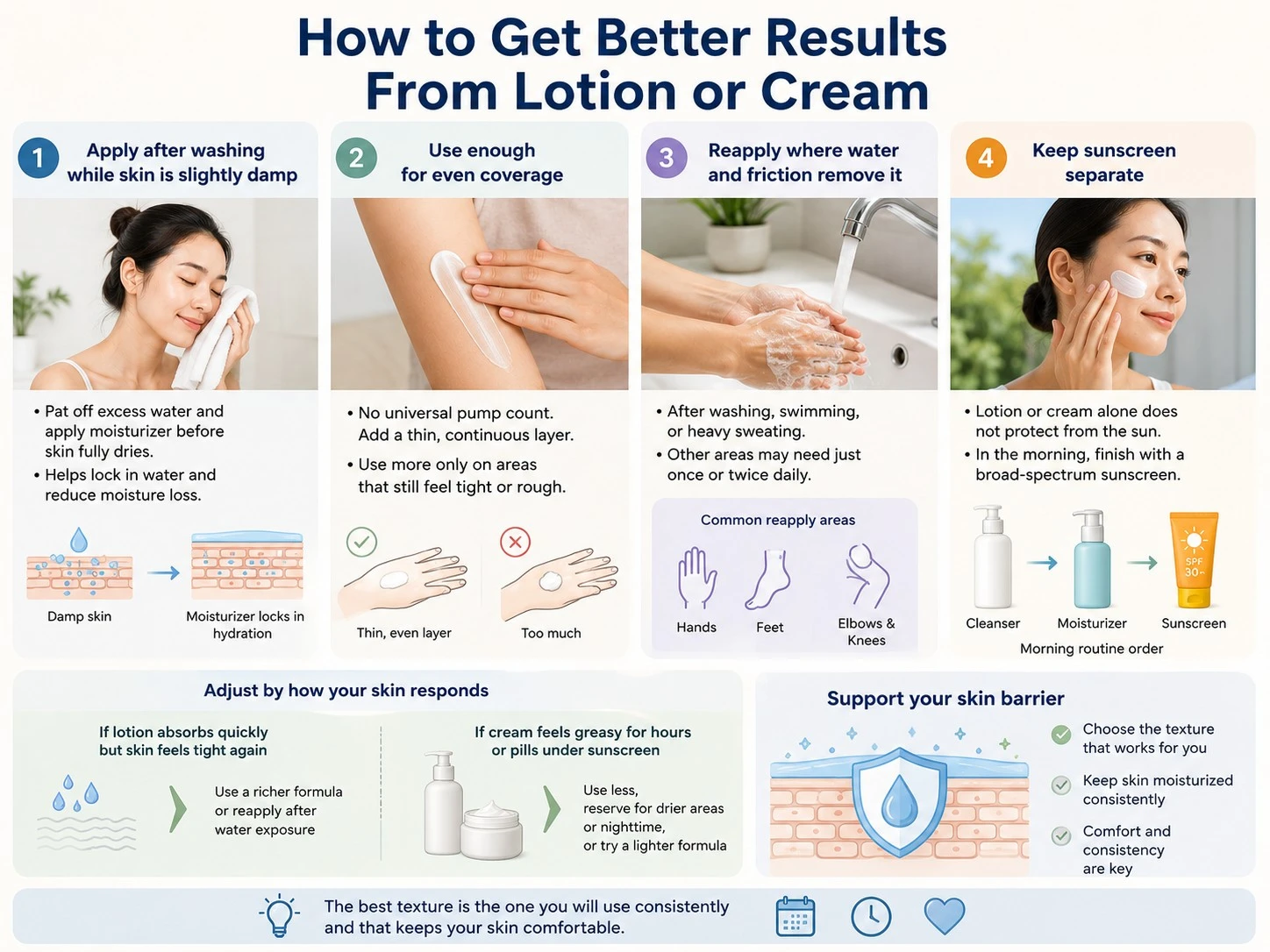
- Apply after washing while the skin is slightly damp. Pat off excess water, then spread moisturizer before the surface becomes fully dry. This helps the formula retain water that would otherwise evaporate.[1]
- Use enough for even coverage. There is no universal pump count because dispensers, body areas, and textures differ. Add a thin continuous layer; use more only where the skin still feels tight or rough.
- Reapply where water and friction remove it. Hands may need moisturizer after washing, while other areas may stay comfortable with once- or twice-daily use. Follow the label and any medical instructions.
- Keep sunscreen separate. Plain lotion or cream does not provide sun protection. In the morning, apply a properly labeled broad-spectrum sunscreen as the final skincare step unless the moisturizer itself is an approved sunscreen used according to its directions.
If lotion absorbs quickly but the skin feels tight again, move one step richer or reapply after water exposure. If a cream feels greasy for hours or pills under sunscreen, use less, reserve it for drier areas or nighttime, or try a lighter formula. The best texture supports the skin barrier without making the routine difficult to follow.
When Dryness Needs More Than a Richer Moisturizer
Changing from lotion to cream can help ordinary dryness, but ongoing symptoms are not always a texture problem. Stop a product that repeatedly causes burning, swelling, hives, or an itchy spreading rash. New stinging can come from fragrance, preservatives, active ingredients, damaged skin, or contact allergy—not simply from insufficient richness.
Seek medical evaluation when dryness is severe, painful, cracked, bleeding, infected-looking, rapidly worsening, or persistent despite gentle cleansing and regular moisturizing. Eczema, psoriasis, contact dermatitis, medication effects, and other conditions may require diagnosis and treatment rather than another cosmetic moisturizer.[3]
FAQs About Lotion and Cream
Is cream always more moisturizing than lotion?
No. Cream is usually richer and often slows water loss more effectively, so it is a sensible starting point for very dry skin. However, category names are not standardized enough to rank every product. A well-formulated lotion may work better for you than a cream that is irritating, difficult to spread, or too unpleasant to use consistently.
Is cream better than lotion for eczema?
Not for every person or every product. In a randomized trial of 550 children with eczema, lotion, cream, gel, and ointment groups showed no meaningful difference in eczema severity over 16 weeks, while reactions and preferences varied by product type.[4] That study does not prove that all moisturizers are equal or replace an eczema treatment plan. Use a fragrance-free emollient you can apply consistently and follow medical advice for persistent or severe eczema.
Does cream clog pores more easily than lotion?
Not automatically. Creams tend to feel heavier, but pore congestion depends on the complete formula, the amount used, the area, and individual response. If you are acne-prone, choose a facial moisturizer labeled non-comedogenic or “won’t clog pores,” introduce it without several other new products, and switch if breakouts consistently increase.[5]
Can you use lotion and cream together?
Yes, but layering is optional. You can use lotion over a large area and add cream only to dry patches, or apply cream later if lotion does not provide lasting comfort. Applying both everywhere usually adds residue without a clear benefit when one product already keeps the skin comfortable.
Is body cream the same as body butter?
Not necessarily. Body cream is usually a thick water-and-oil emulsion. Body butter often describes an even richer product with more oils or plant butters and sometimes less water, but the terms are not strictly standardized. Compare the ingredient list, directions, and actual finish instead of assuming “butter” is always stronger.
Sources
[1] American Academy of Dermatology Association. How to Pick the Right Moisturizer for Your Skin
[2] DermNet. Emollients and Moisturizers (Moisturisers)
[3] American Academy of Dermatology Association. Dermatologists’ Top Tips for Relieving Dry Skin
[4] Ridd MJ, Santer M, MacNeill SJ, et al. Effectiveness and Safety of Lotion, Cream, Gel, and Ointment Emollients for Childhood Eczema
[5] American Academy of Dermatology Association. Moisturizer: Why You May Need It If You Have Acne


