


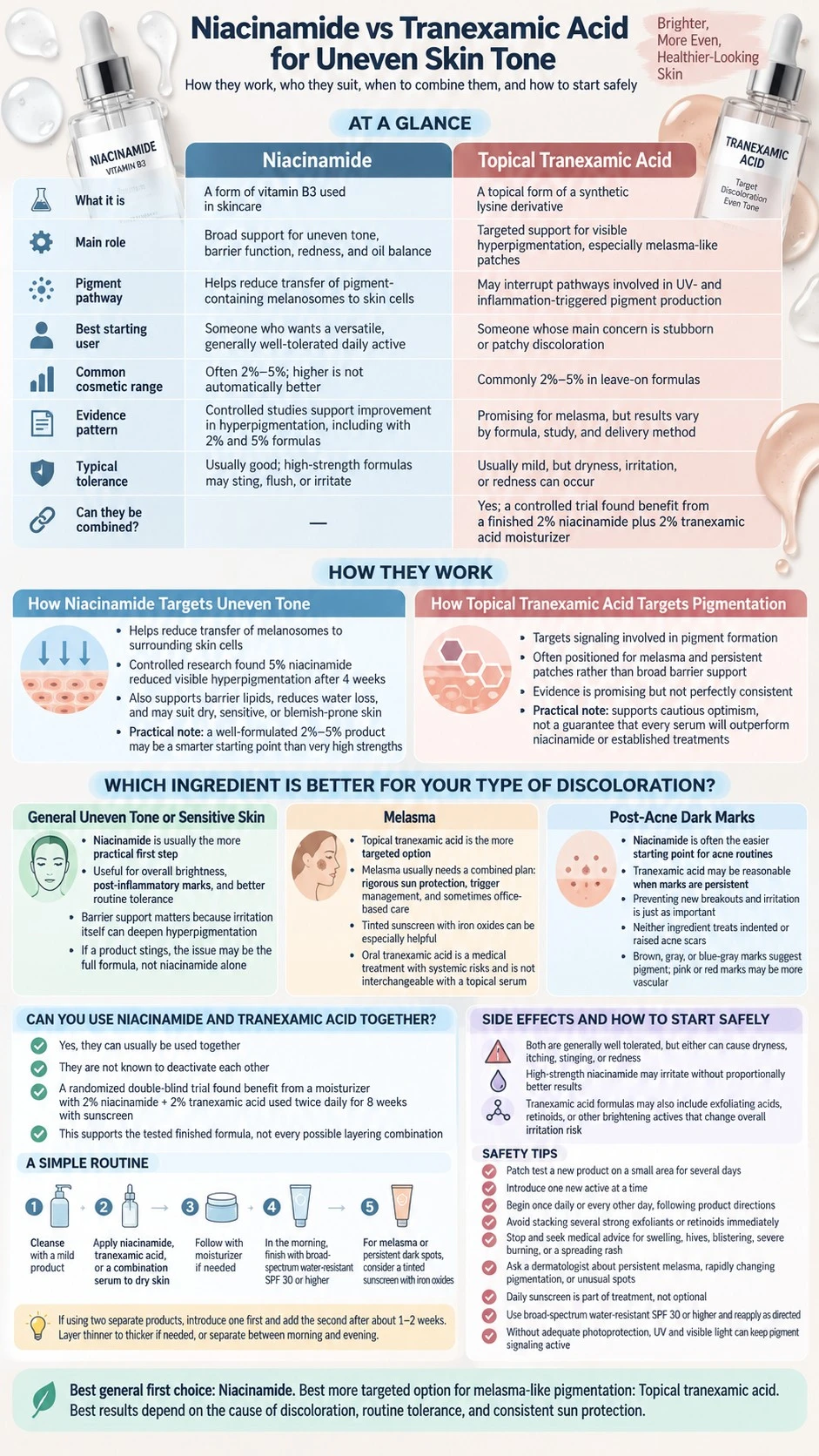
Uneven skin tone can describe several different problems: lingering post-acne marks, sun-related spots, irritation-induced pigmentation, or melasma. That is why a simple “which is stronger?” comparison can be misleading. Niacinamide and tranexamic acid influence pigmentation through different pathways, and neither can overcome an untreated trigger such as recurring acne, irritation, or unprotected sun exposure.
This comparison focuses on topical skincare. Oral tranexamic acid is a prescription medical treatment with systemic risks and is not interchangeable with a cosmetic serum.
Niacinamide vs Tranexamic Acid at a Glance
| Feature | Niacinamide | Topical tranexamic acid |
|---|---|---|
| What it is | A form of vitamin B3 used in skincare | A topical form of a synthetic lysine derivative originally used medically in oral or injectable forms |
| Main skincare role | Broad support for uneven tone, barrier function, redness, and oil balance | Targeted support for visible hyperpigmentation, especially melasma-like patches |
| Pigment pathway | Helps reduce transfer of pigment-containing melanosomes to skin cells | May interrupt pathways involved in UV- and inflammation-triggered pigment production |
| Best starting user | Someone who wants a versatile, generally well-tolerated daily active | Someone whose main concern is stubborn or patchy discoloration |
| Common cosmetic range | Often 2%–5%; higher is not automatically better | Commonly 2%–5% in leave-on formulas |
| Evidence pattern | Controlled studies support improvement in hyperpigmentation, including with 2% and 5% formulas | Promising for melasma, but results vary by formula, study, and delivery method |
| Typical tolerance | Usually good; high-strength formulas may sting, flush, or irritate | Usually mild, but dryness, irritation, or redness can occur |
| Can they be combined? | Yes, if the full routine remains tolerable | Yes; a controlled trial found benefit from a finished 2% niacinamide plus 2% tranexamic acid moisturizer |
The table describes common topical use, not a guaranteed response. Product vehicle, supporting ingredients, packaging, and consistent use can matter as much as the headline active.
How Do Niacinamide and Tranexamic Acid Work?
How Niacinamide Targets Uneven Tone
Niacinamide does not primarily work by blocking tyrosinase, the enzyme often targeted by pigment treatments. Laboratory and clinical research suggests it can reduce the transfer of melanosomes—the pigment-containing structures made by melanocytes—to surrounding skin cells. In a controlled study, 5% niacinamide reduced visible hyperpigmentation after four weeks, while a separate part of the study evaluated a 2% niacinamide sunscreen formula.[1]
Its broader appeal comes from functions beyond pigmentation. Niacinamide can support barrier lipids, reduce water loss, and help skin tolerate a routine more comfortably. That makes it useful when uneven tone occurs alongside dryness, sensitivity, visible redness, or blemish-prone skin. However, a 10% or 20% label does not prove faster fading. For reactive skin, a well-formulated 2%–5% product may be the more sensible starting point.
How Topical Tranexamic Acid Targets Pigmentation
Tranexamic acid in skincare is used to target signaling involved in pigment formation. Its proposed topical action includes reducing plasmin-related inflammatory signaling that can contribute to melanogenesis after UV exposure or hormonal triggers. In practical terms, it is most often positioned for melasma and persistent patches rather than as an all-purpose barrier ingredient.
The evidence is promising but not perfectly consistent. A split-face randomized trial of 5% topical tranexamic acid in 23 women found improvement from baseline after 12 weeks, but it was not significantly better than the vehicle, and the tranexamic-acid side had more erythema.[2] A broader meta-analysis found that tranexamic acid can improve melasma across delivery routes, while also calling for better standardization and long-term evidence.[3] Those findings support cautious optimism, not a claim that every topical tranexamic acid serum will outperform niacinamide or established treatments.
Which Ingredient Is Better for Your Type of Discoloration?
General Uneven Tone or Sensitive Skin
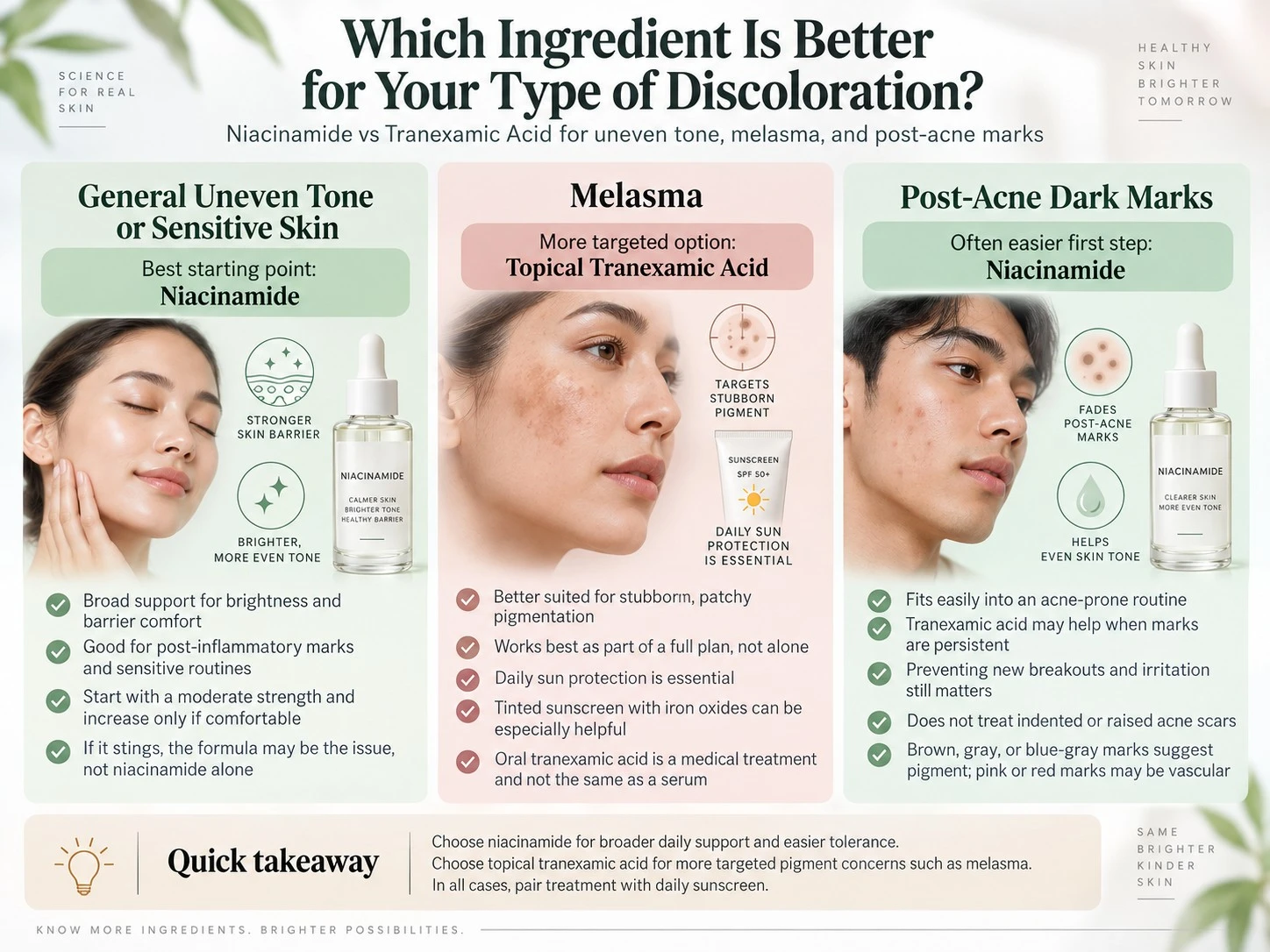
Niacinamide is usually the more practical first step when the goal is overall brightness, fewer visible post-inflammatory marks, and better routine tolerance. Its broader barrier-support role is valuable because irritation can itself trigger or deepen hyperpigmentation, particularly in darker skin tones. The American Academy of Dermatology recommends addressing the cause of dark spots and avoiding products that burn or sting.[4]
Start with a moderate-strength niacinamide formula rather than assuming maximum concentration is best. Use it once daily for the first week or two, then increase only if your skin remains comfortable. If a formula stings, the issue may be the concentration, solvent system, fragrance, or another active—not necessarily niacinamide alone.
Melasma
Topical tranexamic acid is the more targeted choice for melasma, but melasma rarely responds to one ingredient in isolation. Dermatology guidance emphasizes a combined plan: rigorous sun protection, appropriate topical treatment, trigger management, and sometimes office-based care.[5] Tinted sunscreen containing iron oxides can be especially useful because visible light may worsen melasma and other forms of hyperpigmentation.
Evidence also differs by tranexamic acid route. Oral tranexamic acid has shown stronger average effects in some analyses, but it is a systemic medicine with contraindications and potential clot-related risks. It should only be considered after a clinician reviews personal and family medical history. Do not drink, swallow, or repurpose a topical product, and do not seek oral tablets simply because a serum seems slow.
Post-Acne Dark Marks
For flat brown or gray marks left after acne, niacinamide is often the easier starting point because it can fit into an acne routine without adding a highly specialized treatment. Topical tranexamic acid may be reasonable when marks are persistent, but preventing new breakouts and irritation is equally important. Neither ingredient treats indented scars or raised scars, which require a different plan.
Skin tone changes after acne can also include persistent redness rather than excess melanin. A brown, gray, or blue-gray mark suggests pigment is involved; a pink or red mark may be predominantly vascular. If you are unsure, a dermatologist can identify the pattern and prevent months of mismatched treatment.
Can You Use Niacinamide and Tranexamic Acid Together?
Yes. These ingredients are not known to deactivate each other, and a randomized, double-blind trial evaluated a finished moisturizer containing 2% niacinamide and 2% tranexamic acid. Forty-two women used the test product or its vehicle twice daily for eight weeks, with assigned sunscreen in the morning; the combination improved irregular facial pigmentation more than the vehicle.[6]
That trial supports the specific finished formula, not every possible layering combination. It also cannot tell us how much of the result came from niacinamide, tranexamic acid, their interaction, the moisturizer base, or sunscreen. “Can be used together” is therefore better supported than “always works better together.”
For the simplest routine:
- Cleanse with a mild product.
- Apply a niacinamide, topical tranexamic acid, or combination serum to dry skin.
- Follow with moisturizer if needed.
- In the morning, finish with broad-spectrum, water-resistant SPF 30 or higher. For melasma or persistent dark spots, consider a tinted formula with iron oxides.[4]
If using two separate products, introduce one first and wait about one to two weeks before adding the second. You may layer thinner to thicker, but exact order matters less than comfort and consistency. Separating them between morning and evening is also reasonable if layering causes pilling or irritation.
Side Effects and How to Start Safely
Both topical ingredients are generally well tolerated, but either can cause dryness, itching, stinging, or redness. High-strength niacinamide products may be more irritating without delivering proportionally better results. Topical tranexamic acid formulas often include exfoliating acids, retinoids, or brightening ingredients that change the product’s overall risk profile.
Use these safeguards:
- Patch-test a new product on a small area for several days before applying it widely.
- Introduce one new active at a time so you can identify the cause of irritation.
- Begin once daily or every other day, following the product instructions.
- Avoid stacking several strong exfoliants or retinoids immediately.
- Stop and seek medical advice for swelling, hives, blistering, severe burning, or a spreading rash.
- Ask a dermatologist about persistent melasma, rapidly changing pigmentation, or spots with irregular borders, bleeding, or other unusual features.
Daily sunscreen is part of treatment, not an optional add-on. Use a broad-spectrum, water-resistant SPF 30 or higher and reapply as directed, especially outdoors. Without adequate photoprotection, UV and visible-light exposure can continue signaling pigment production while your serum tries to reduce its appearance.
FAQs About Niacinamide vs Tranexamic Acid
Which Ingredient Should Go First?
When layering separate products, apply the thinner, more fluid formula first and the thicker one second. If their textures are similar, the order is unlikely to determine the result. Use the sequence that minimizes pilling and irritation, or use one in the morning and the other at night.
How Long Do Niacinamide and Tranexamic Acid Take to Work?
Expect gradual change, not overnight fading. Niacinamide showed measurable improvement after four weeks in one controlled study.[1] Topical tranexamic acid trials commonly run for eight to twelve weeks.[2] Individual results depend on the cause and depth of pigmentation, the formula, consistency, and sun protection. Photographing the area monthly in the same lighting is more reliable than checking it every day.
Can You Use Niacinamide and Tranexamic Acid Every Day?
Many people can use them daily, including in a combined formula, but tolerance should guide frequency. Start once a day or every other day and increase only if your skin remains comfortable. If you also use retinoids or exfoliating acids, introduce products gradually instead of adding everything at once.
Is Topical Tranexamic Acid the Same as Oral Tranexamic Acid?
No. A topical cosmetic is applied to the skin, while oral tranexamic acid is a systemic prescription medicine. Oral treatment may be used off-label for melasma under medical supervision, but it requires screening for health risks and is not a substitute for a serum. Never ingest a topical product or self-prescribe oral tranexamic acid.
Sources
[1] Hakozaki et al. The effect of niacinamide on reducing cutaneous pigmentation and suppression of melanosome transfer
[2] Kanechorn Na Ayuthaya et al. Topical 5% tranexamic acid for the treatment of melasma in Asians: a double-blind randomized controlled clinical trial
[3] Alsharif et al. Tranexamic acid as a therapeutic option for melasma management: meta-analysis and systematic review of randomized controlled trials
[4] American Academy of Dermatology. How to fade dark spots in darker skin tones
[5] American Academy of Dermatology. Melasma: Diagnosis and treatment


