


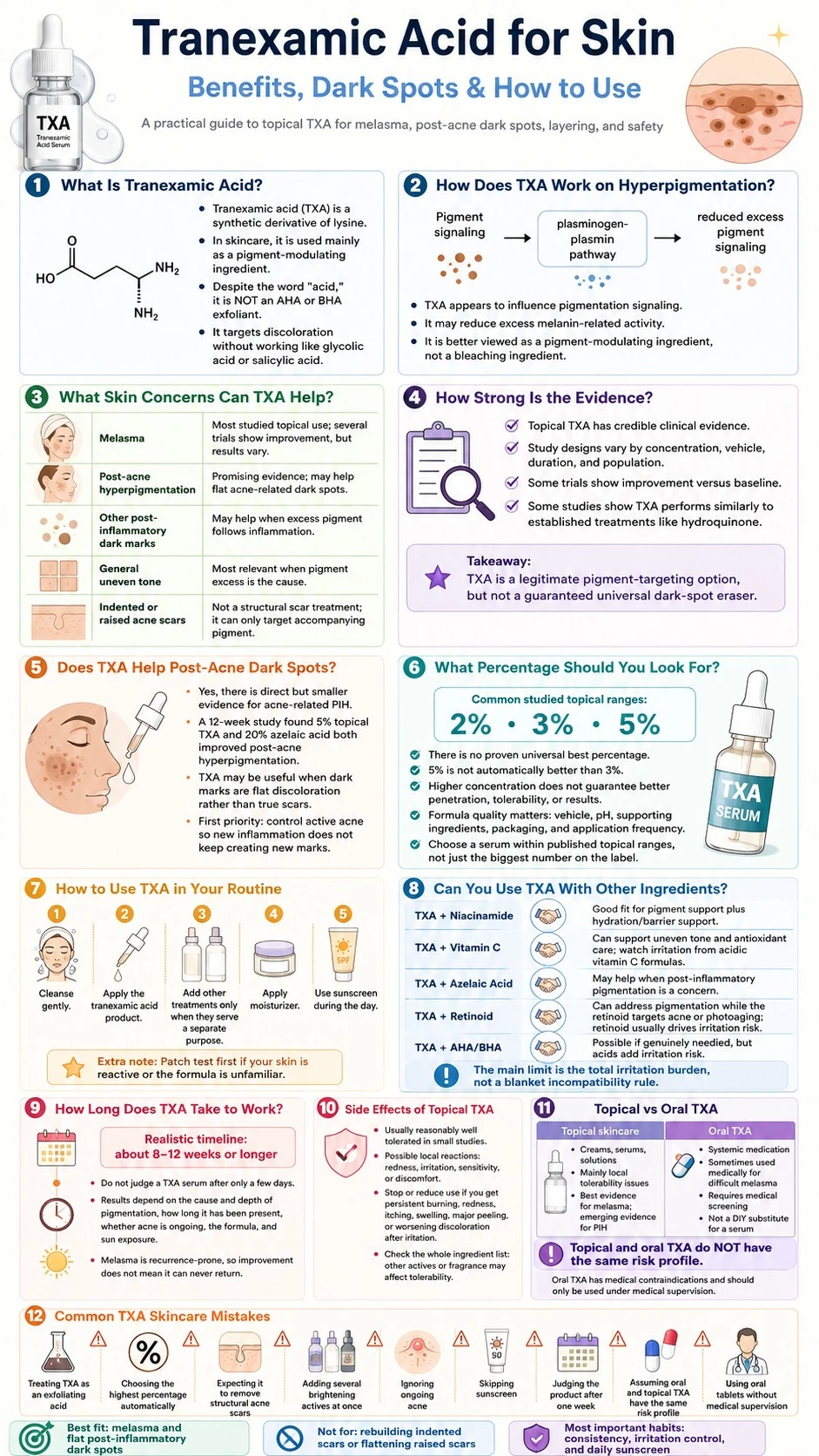
Tranexamic acid has moved from medicine into pigmentation-focused skincare, but that history can create confusion. A topical tranexamic acid serum is not simply a weaker version of a tranexamic acid tablet, and its role is not the same as glycolic acid, salicylic acid, or another exfoliating “acid.”
For skincare, the useful question is narrower: can a topical formula containing tranexamic acid reduce unwanted pigmentation without adding excessive irritation? Clinical evidence is most developed for melasma, while newer research also supports a possible role in post-acne hyperpigmentation. The results are promising but not uniform enough to treat tranexamic acid as a guaranteed dark-spot eraser.
What Is Tranexamic Acid?
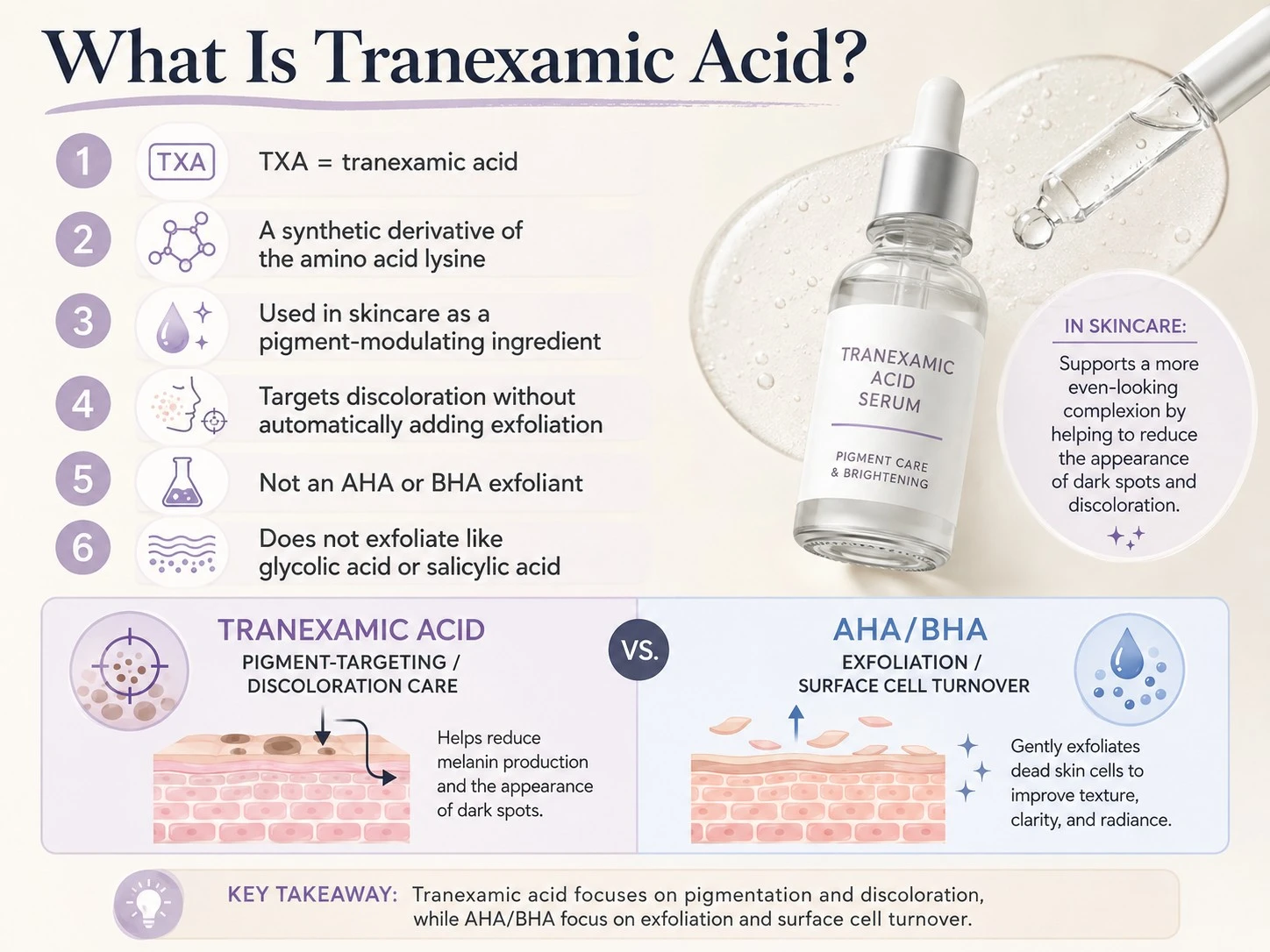
Tranexamic acid, often shortened to TXA, is a synthetic derivative of the amino acid lysine. Systemically, it is an antifibrinolytic medicine that inhibits the plasminogen-plasmin pathway. Dermatology research has explored that same pathway because it also participates in signaling associated with pigmentation.[1]
In topical skincare, tranexamic acid is used primarily as a pigment-modulating ingredient. Despite the word “acid” in its name, it is not an AHA or BHA exfoliant. It does not work by dissolving surface bonds between dead skin cells in the way glycolic or salicylic acid does.
That distinction makes TXA useful for people who want to target discoloration without automatically adding another exfoliating step to the routine.
How Does Tranexamic Acid Work on Hyperpigmentation?
Pigmentation is controlled by more than one pathway. In melasma in particular, ultraviolet exposure, inflammation, melanocyte signaling, vascular changes, and interactions between different skin cells can all contribute to the visible patches.
Tranexamic acid appears to influence pigmentation partly through the plasminogen-plasmin system and downstream communication between keratinocytes and melanocytes. Clinical biopsy research with topical TXA has reported reductions in epidermal melanin and changes in signaling and vascular markers after treatment.[1]
The practical implication is important: TXA does not simply bleach existing pigment. It is better viewed as an ingredient that can interfere with some of the signaling involved in excessive pigment production.
What Skin Concerns Can Tranexamic Acid Help?
The quality of evidence differs substantially by condition. The strongest reason to choose TXA is not “brightening” in the broadest possible sense, but a pigmentation pattern that matches the conditions in which it has actually been studied.
| Skin Concern | Evidence Direction | What to Expect |
|---|---|---|
| Melasma | Most extensively studied topical use | Several clinical trials report improvement, including studies comparing TXA with hydroquinone, but results are not uniformly positive.[2][3][5] |
| Post-acne hyperpigmentation | Promising but smaller evidence base | A randomized trial found 5% topical TXA and 20% azelaic acid both improved acne-related PIH over 12 weeks.[4] |
| Other post-inflammatory dark marks | Biologically plausible, but evidence depends on the cause | May be useful when excess melanin follows inflammation, but controlling the trigger remains essential |
| General uneven tone | Depends on why the tone is uneven | Most relevant when pigment excess is responsible; it will not correct every source of discoloration |
| Indented or raised acne scars | Not a structural scar treatment | TXA can target accompanying pigment, but it cannot rebuild a depressed scar or flatten raised scar tissue |
If the main problem is flat brown or gray discoloration rather than texture, it helps to first identify the type of hyperpigmentation you are treating. Melasma, post-acne PIH, sun-related pigmentation, and other pigment disorders do not always respond to the same strategy.
How Strong Is the Evidence for Topical Tranexamic Acid?
Topical TXA has credible clinical evidence, but the studies are heterogeneous. Different trials have used different concentrations, vehicles, populations, treatment durations, comparators, and methods for measuring pigmentation.
For example, a 12-week randomized split-face trial of 5% topical TXA found improvement from baseline but no significant advantage over its vehicle, and erythema occurred more on the TXA-treated side.[2] That result is an important reminder that improvement during a skincare study does not automatically prove the active ingredient caused all of the improvement.
Other randomized studies have been more favorable. In a 2024 split-face trial in Indonesian participants with mixed-type melasma, 3% TXA and 4% hydroquinone both reduced melasma severity over eight weeks, without a significant difference in patient-rated improvement between treatments.[3] A separate 12-week study comparing 5% TXA with 4% hydroquinone also reported improvement with both formulations.[5]
Taken together, these findings support TXA as a legitimate pigment-targeting option while also showing why it should not be marketed as universally superior to established melasma treatments.
Does Tranexamic Acid Help Post-Acne Dark Spots?
There is direct evidence for acne-related post-inflammatory hyperpigmentation, although it is much smaller than the melasma literature.
In a randomized 12-week study, 5% topical TXA solution and 20% azelaic acid both improved post-acne hyperpigmentation. The overall pigment scores were comparable between groups, while TXA produced fewer reported treatment-related side effects during the first month.[4]
That does not establish TXA as the best treatment for every acne mark. The first priority is still to control active acne so new inflammation does not continually create fresh discoloration.
It is also important to distinguish a dark mark from a structural acne scar. Tranexamic acid is intended for pigment. An indentation, ice-pick scar, rolling scar, or raised scar requires a different treatment strategy.
What Percentage of Tranexamic Acid Should You Look For?
There is no established universal concentration that every effective skincare product must contain. Clinical studies of conventional topical formulations have evaluated concentrations including approximately 2%, 3%, and 5%, with different results across different vehicles and populations.[1][2][3][5]
This means two common shortcuts are unreliable:
- “5% must be better than 3%.” Studies using different formulations cannot be compared as though concentration were the only variable.
- “More TXA means faster fading.” Higher concentration does not automatically improve penetration, stability, tolerability, or clinical performance.
The finished formulation matters. Solvent system, vehicle, pH, supporting ingredients, packaging, application frequency, and the condition being treated can all affect how a product performs.
For an over-the-counter serum, a concentration that fits published topical ranges is more meaningful than simply choosing the largest number on the label.
How to Use Tranexamic Acid in Your Skincare Routine
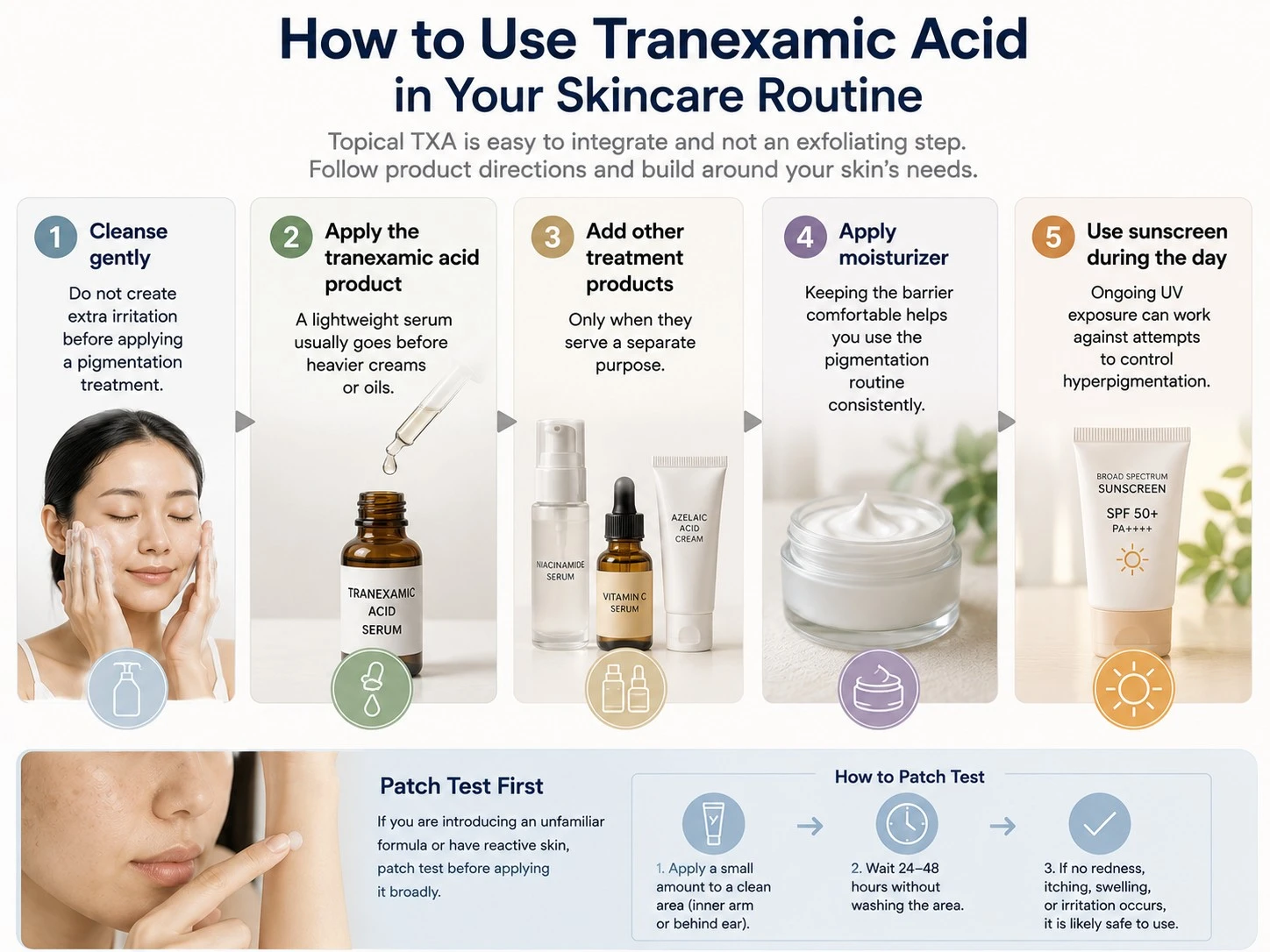
Topical TXA is usually straightforward to integrate because it is not inherently an exfoliating step. Follow the directions for the specific product, since the texture and supporting ingredients determine where it fits best.
- Cleanse gently. Do not create extra irritation before applying a pigmentation treatment.
- Apply the tranexamic acid product. A lightweight serum usually goes before heavier creams or oils.
- Add other treatment products only when they serve a separate purpose.
- Apply moisturizer. Keeping the barrier comfortable helps you use the pigmentation routine consistently.
- Use sunscreen during the day. Ongoing ultraviolet exposure can work against attempts to control hyperpigmentation.
If you are introducing an unfamiliar formula or have reactive skin, patch test the skincare product before applying it broadly.
Can You Use Tranexamic Acid With Other Skincare Ingredients?
TXA can often be combined with other pigment-targeting ingredients because the main limitation is usually the complete formula and total irritation burden, not a well-established chemical prohibition between TXA and every other active.
| Combination | Why It May Make Sense | What to Watch |
|---|---|---|
| Tranexamic acid + niacinamide | Can combine pigment targeting with hydration and barrier-supporting functions | A multi-active serum is not automatically better than a simpler formula |
| Tranexamic acid + vitamin C | Uses different approaches to uneven pigmentation and antioxidant support | Sensitive skin may react to an acidic vitamin C formula even when TXA itself is tolerated |
| Tranexamic acid + azelaic acid | Both can be relevant when post-inflammatory pigmentation is a concern | Using two treatments is unnecessary when one already provides adequate results |
| Tranexamic acid + retinoid | Can address pigmentation while the retinoid targets acne, photoaging, or cell turnover | The retinoid is more likely to determine dryness and irritation tolerance |
| Tranexamic acid + AHA/BHA | May combine pigment control with exfoliation when both are genuinely needed | The acid adds irritation risk; do not increase exfoliation simply to make TXA work faster |
If several pigment actives are already in the routine, adding TXA should have a clear reason. Pigmentation treatment usually benefits more from consistency and irritation control than from collecting every brightening ingredient available.
How Long Does Tranexamic Acid Take to Work?
Do not evaluate a pigmentation serum after a few days. Many topical TXA clinical studies have assessed results over approximately 8–12 weeks, so gradual change over several months is a more realistic expectation than immediate fading.[1][2][3][4][5]
The actual timeline depends on:
- the cause and depth of the pigmentation;
- how long the discoloration has been present;
- whether active acne or inflammation is continuing;
- the TXA formulation and concentration;
- other pigment-targeting treatments in the routine;
- sun and visible-light exposure;
- individual skin tone and pigment response.
Melasma is also a chronic, recurrence-prone condition. Improvement during treatment should not be interpreted as proof that pigmentation can never return.
What Are the Side Effects of Topical Tranexamic Acid?

Topical TXA has generally been reasonably well tolerated in small clinical studies, but it is not irritation-proof. Reported local reactions have included redness, irritation, sensitivity, or discomfort, and tolerance depends on the finished formulation.[2][4][5]
Stop or reduce use if a new product causes persistent:
- burning;
- redness;
- itching;
- swelling;
- significant peeling;
- worsening discoloration following irritation.
Also check the whole ingredient list before blaming TXA alone. A serum may contain exfoliating acids, fragrance, retinoids, botanical extracts, or other actives that affect tolerability.
Topical vs Oral Tranexamic Acid: Why the Difference Matters
Tranexamic acid is available through several routes, and their safety considerations should not be blended together.
| Route | How It Is Used for Pigmentation | Key Practical Point |
|---|---|---|
| Topical skincare | Applied to the skin in creams, serums, or solutions | Clinical studies mainly report local tolerability issues; evidence is strongest for melasma and emerging for PIH |
| Oral TXA | Systemic medication sometimes used by dermatologists for difficult melasma | Requires medical screening and should not be self-prescribed for cosmetic pigmentation[6][7] |
| Intradermal or procedure-assisted TXA | Used in some clinical melasma protocols | This is a professional procedure and should not be treated as equivalent to applying a cosmetic serum |
A recent randomized trial comparing oral and 5% topical TXA found improvement with both approaches over 12 weeks in a small group of melasma patients.[6] That does not mean oral tablets are an appropriate upgrade when a serum seems too slow.
Systemic TXA has medical contraindications that do not apply in the same way to ordinary topical skincare exposure. For example, U.S. oral tablet prescribing information includes contraindications involving active or previous thromboembolic disease, intrinsic thrombotic risk, and combined hormonal contraception.[7]
If a dermatologist is considering oral TXA for melasma, medical history, medications, and clotting risk need to be assessed before treatment.
Common Tranexamic Acid Skincare Mistakes
- Treating TXA as an exfoliating acid. It does not need to create peeling to work.
- Choosing the highest percentage automatically. Formulation quality matters as much as the number on the label.
- Expecting it to remove structural acne scars. TXA addresses pigment, not lost or excess scar tissue.
- Adding several brightening actives at once. Irritation can worsen the very pigmentation you are trying to improve.
- Ignoring ongoing acne. New inflammatory lesions can continue creating new PIH while old spots fade.
- Skipping sunscreen. A pigment-targeting routine is harder to evaluate when ultraviolet exposure continues stimulating discoloration.
- Judging the product after one week. Most clinical studies evaluate change over weeks to months rather than days.
- Assuming oral and topical TXA have the same risk profile. They are different routes with very different exposure and clinical considerations.
- Using oral tablets without medical supervision. Systemic TXA is medication, not a DIY skincare supplement.[7]
Final Thoughts
Tranexamic acid is one of the more interesting non-exfoliating options for pigmentation because it targets signaling involved in excess pigment rather than relying primarily on surface exfoliation.
Its strongest topical evidence is for melasma, with emerging clinical support for post-acne hyperpigmentation. The evidence is promising rather than perfectly consistent, so TXA is best treated as one useful option—not a guaranteed replacement for every established pigmentation treatment.
Choose a well-formulated topical product, give it enough time to evaluate, control the source of inflammation, keep the rest of the routine tolerable, and use consistent sun protection. If pigmentation is severe, recurrent, difficult to identify, or not improving despite a well-designed routine, professional diagnosis matters more than adding another brightening serum.
FAQs About Tranexamic Acid for Skin
Is Tranexamic Acid Good for Dark Spots?
It can be useful for some pigment-related dark spots, particularly melasma and post-inflammatory hyperpigmentation. A randomized study also found improvement in acne-related PIH with 5% topical TXA.[3][4][5] It will not treat every cause of a dark spot, so diagnosis matters when pigmentation is unusual or persistent.
Is Tranexamic Acid Better Than Niacinamide?
They are not direct substitutes. Tranexamic acid has a more specific role in pigment-focused treatment, while niacinamide has broader functions involving the skin barrier, hydration, and other aspects of skin appearance. They can also be formulated or used within the same routine.
Can I Use Tranexamic Acid Every Day?
Many topical studies have used TXA once or twice daily, but the correct frequency depends on the specific product and your tolerance.[1][2][4] Follow the product directions rather than assuming every concentration should be used at the same frequency.
Can I Use Tranexamic Acid With Retinol?
They can generally fit within the same skincare regimen because TXA is not an exfoliating acid. If your retinol already causes dryness or irritation, introduce the TXA product separately so you can identify how your skin responds to each formula.
Does Tranexamic Acid Exfoliate the Skin?
No. Tranexamic acid is not an AHA or BHA and does not primarily work by exfoliating the surface of the skin. Its pigment-related activity involves other signaling pathways, including the plasminogen-plasmin system.[1]
Does Topical Tranexamic Acid Cause Blood Clots?
The thrombotic warnings associated with systemic tranexamic acid should not automatically be transferred to ordinary topical skincare exposure. Topical clinical studies have mainly reported local effects such as irritation or erythema.[2][4][5] Oral TXA is different: it produces systemic exposure and carries medical contraindications related to thromboembolic risk in prescribing information.[7]
Sources
[1] Kim SJ et al. Efficacy and Possible Mechanisms of Topical Tranexamic Acid in Melasma
[2] Kanechorn Na Ayuthaya P et al. Topical 5% Tranexamic Acid for the Treatment of Melasma in Asians: A Double-Blind Randomized Controlled Clinical Trial
[3] Yasnova N et al. The Effectiveness and Safety of 3% Tranexamic Acid Cream vs. 4% Hydroquinone Cream for Mixed-Type Melasma in Skin of Color
[4] Sobhan M et al. A Comparative Study of 20% Azelaic Acid Cream Versus 5% Tranexamic Acid Solution for Postinflammatory Hyperpigmentation in Patients With Acne Vulgaris
[5] El-Husseiny R et al. Efficacy and Safety of Tranexamic Acid 5% Cream vs Hydroquinone 4% Cream in Treating Melasma
[6] Babaei M et al. Randomized Clinical Trial on the Efficacy of Oral Tranexamic Acid Versus Topical Tranexamic Acid in Treatment of Melasma
[7] DailyMed. Tranexamic Acid Tablets Prescribing Information


