


Alpha arbutin appears in serums, creams, masks, and multi-ingredient dark-spot treatments. Its appeal is easy to understand: it targets pigment production without acting like an exfoliating acid or retinoid. That does not make every alpha-arbutin product equally effective or irritation-free.
The useful question is not whether the ingredient “brightens” in the abstract. It is whether your discoloration is the kind a cosmetic product can reasonably improve, whether the formula is tolerable, and whether your routine prevents new pigment from replacing what fades.
What Is Alpha Arbutin and How Does It Work?
Alpha arbutin is a glycosylated derivative of hydroquinone. In simpler terms, its structure joins a sugar molecule to a hydroquinone-related component. It is used in cosmetics to help make excess pigmentation look less visible.
Skin color comes from melanin, a protective pigment made through several biochemical steps. Tyrosinase helps drive key early steps in that process. Alpha arbutin can inhibit tyrosinase activity, which gives skin less opportunity to produce new excess pigment.[1] It does not scrub existing pigment off the surface, bleach skin instantly, or stop all melanin production.
“Arbutin” is not always a precise label. Alpha arbutin and beta arbutin are structural isomers: they contain the same basic components arranged differently. They also have different safety concentration assessments, so a percentage for beta arbutin should not be copied onto an alpha-arbutin product.[2] Check the ingredient list for the exact INCI name rather than assuming every arbutin formula is interchangeable.
Alpha arbutin is also not the same finished ingredient as hydroquinone. Their chemical relationship helps explain both alpha arbutin’s pigment-focused action and the need to control hydroquinone traces in formulas, but it does not make their strength, evidence, risks, or U.S. regulatory status identical.
What Can Alpha Arbutin Do for Skin?
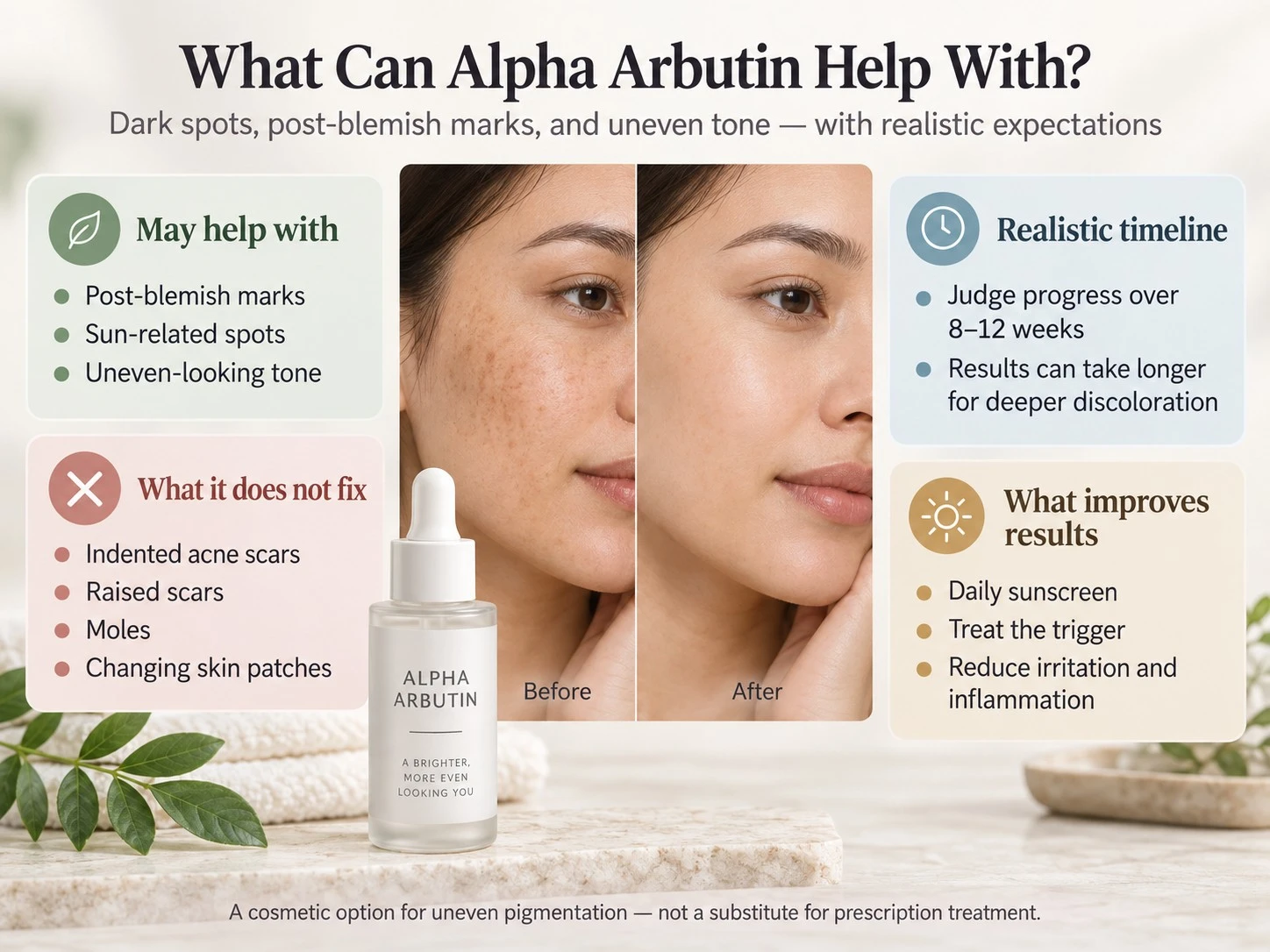
Alpha arbutin is most relevant to excess pigment near the skin’s surface. It may support gradual improvement in post-blemish marks, sun-related spots, and a generally uneven-looking tone. It cannot correct an indented acne scar, fill raised scar tissue, remove a mole, or identify the cause of a changing patch.
The evidence is promising but less definitive than many product pages suggest. Laboratory and skin-model studies support tyrosinase inhibition, while human trials often study arbutin variants or formulas containing several active ingredients rather than alpha arbutin alone.[1]
For example, a small split-face pilot trial tested a cream with 5% alpha arbutin plus 2% kojic acid against a prescription triple-combination cream for melasma. The combination showed clinical benefit and fewer adverse events, but the trial involved 30 participants and cannot isolate alpha arbutin from kojic acid. Its research concentration also does not override regional cosmetic safety limits.[3] Another study followed 124 women using a regimen containing 2% alpha arbutin, 10% trihydroxybenzoic acid glucoside, and sunscreen. Pigment measures improved over 90 days, but the design had no comparison group and again tested a complete regimen, not alpha arbutin by itself.[4]
Those limits lead to a realistic conclusion: alpha arbutin is a reasonable cosmetic option for uneven pigmentation, especially when you want a non-exfoliating approach, but it is not a guaranteed substitute for a diagnosed melasma plan or prescription treatment. Judge progress over about 8 to 12 weeks with photos taken in similar light. Pigment often fades slowly, and deeper or continually triggered discoloration can take much longer.[5]
Results also depend on stopping the trigger. If acne, eczema, rubbing, or an irritating product keeps creating inflammation, new post-inflammatory marks can continue to appear. Learn the difference between acne scars and dark spots before expecting a pigment serum to change skin texture.
How to Choose an Alpha-Arbutin Product
Choose the finished formula, not the biggest percentage on the front label. A well-designed product must keep the ingredient stable, deliver it evenly, and remain comfortable enough for consistent use.
- Confirm the ingredient: Look for Alpha-Arbutin in the ingredient list. Do not assume bearberry extract, beta arbutin, deoxyarbutin, and alpha arbutin have identical evidence or concentration limits.
- Use concentration as context: Many facial products contain up to 2% alpha arbutin. The 2% figure is a European safety-assessment limit for face creams, not proof that 2% is the universally ideal or most effective dose.[2]
- Match the vehicle to your routine: A water-based serum usually layers easily under moisturizer, while a cream can combine the brightening step with emollience. A rinse-off mask or cleanser has shorter contact time and should not be assumed equivalent to a leave-on product.
- Inspect the whole formula: Fragrance, exfoliating acids, retinoids, kojic acid, or other brighteners can change tolerance and make it harder to identify what caused irritation.
- Prefer intact, clearly labeled packaging: Follow storage directions and stop using a product that has changed markedly in color, odor, or texture. The quality of an unknown or poorly labeled skin-lightening product cannot be judged from its headline ingredient alone.
Alpha arbutin fits best when the primary concern is excess pigment rather than active acne, rough texture, or wrinkles. For a broader view of causes and treatment paths, use the guide to hyperpigmentation before choosing an active.
How to Use Alpha Arbutin in Your Routine
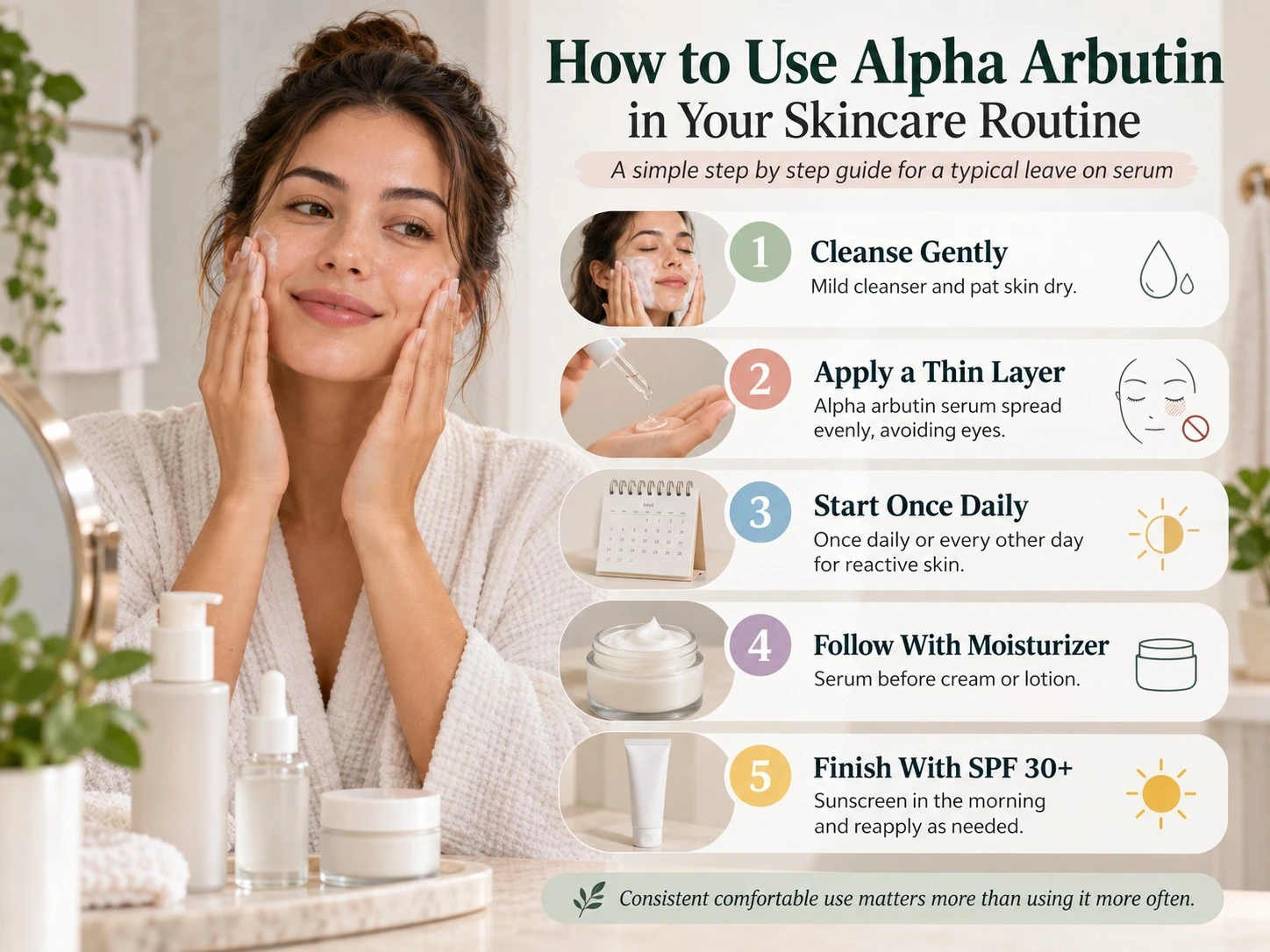
The label controls frequency and order because alpha arbutin appears in different product types. For a typical leave-on serum, this simple sequence provides a safe starting framework:
- Cleanse gently. Use a mild cleanser and pat the skin dry. Do not scrub dark spots; friction and inflammation can make discoloration harder to manage.
- Apply the labeled amount. Spread a thin, even layer over the areas directed on the label. Avoid broken skin and keep the product out of the eyes.
- Start once daily. Use it every other day if your skin is reactive or if the formula contains other strong actives. Increase toward the label’s schedule only after the skin remains comfortable.
- Follow with moisturizer. A serum usually sits before cream or lotion. If alpha arbutin is already in your moisturizer, do not add a separate layer merely to duplicate the ingredient.
- Finish the morning routine with sunscreen. Use a broad-spectrum sunscreen with SPF 30 or higher and reapply as needed. Tinted sunscreen containing iron oxides can add visible-light protection, which is especially relevant when dark spots or melasma are concerns.[5]
You can use alpha arbutin in the morning, evening, or both when the label permits and your skin tolerates it. Twice daily is not automatically better than once daily. Consistent, comfortable use is more valuable than a schedule that causes redness and creates more post-inflammatory pigment.
What Can You Use With Alpha Arbutin?
Alpha arbutin has no universal category-level rule that forbids it from being used with vitamin C, niacinamide, retinol, or exfoliating acids. Compatibility depends on the complete formulas and your skin’s tolerance, not a viral “never mix” chart.
- Niacinamide: This is often an easy pairing because niacinamide products are commonly formulated for daily use. Apply separate serums from thinner to thicker, or use a product containing both. Read more about niacinamide for skin if barrier support, oiliness, or redness is also part of your decision.
- Vitamin C: Both can target uneven tone through different pathways. They may be used in the same routine when the products layer comfortably, or separated between morning and evening for simplicity. The form and strength of vitamin C matter more than a blanket pairing rule.
- Retinol: The ingredients are not inherently incompatible, but retinol is more likely to cause dryness or irritation. Establish tolerance to one product before adding the other, or alternate routines. A dedicated retinol guide is more useful than treating alpha arbutin as protection against retinoid irritation.
- AHAs, BHAs, or kojic acid: These may already be combined in pigment formulas. Adding separate high-strength products increases the irritation load without guaranteeing faster fading. Reduce frequency or separate applications if stinging, redness, or flaking develops.
When two formulas pill, feel sticky, or irritate, that is a practical compatibility problem even if the ingredients can coexist chemically. Simplify the routine and reintroduce one product at a time. The guide to mixing skincare ingredients explains how to separate true incompatibility from cumulative irritation.
Side Effects and Safety Limits
Alpha arbutin is generally well tolerated in cosmetic formulas, but no active is irritation-proof. Possible reactions include burning, itching, redness, dryness, or a rash. Rare reports of dermatitis have been described with arbutin-containing products.[1]
European safety reviewers consider alpha arbutin safe at up to 2% in face creams and 0.5% in body lotions, including combined exposure at those levels. They also state that hydroquinone should be kept as low as possible and no higher than unavoidable trace amounts.[2] This is a safety conclusion for specified cosmetic uses, not a promise that every product at those concentrations will suit every person.
Stop the product and simplify your routine if irritation develops. Seek medical care for facial swelling, blistering, widespread hives, eye involvement, trouble breathing, or another severe reaction. A dermatologist should also evaluate a spot that changes shape or color, bleeds, becomes painful, appears without a clear cause, or does not respond as expected.
Be cautious with products sold as powerful skin bleachers or unlabeled “whitening” creams. Alpha arbutin and hydroquinone are not interchangeable names. In the United States, nonprescription skin-lightening products containing hydroquinone are not legally marketed OTC drugs, and serious adverse effects have been reported from such products.[6]
FAQs About Alpha Arbutin
Can you use alpha arbutin every day?
Yes, many alpha-arbutin products are designed for daily use. Follow the label and begin once daily or every other day if your skin is reactive. Reduce frequency or stop if you develop persistent burning, redness, itching, or flaking. Using more often than directed does not guarantee faster fading.
Is alpha arbutin the same as hydroquinone?
No. Alpha arbutin is a glycosylated hydroquinone derivative, but it is a distinct cosmetic ingredient with different use concentrations, evidence, and regulatory treatment. Do not use the names interchangeably or assume alpha arbutin delivers the same results as prescription hydroquinone.
Can you use alpha arbutin during pregnancy?
Pregnancy-specific human safety data for topical arbutin are limited. Reviews note low expected absorption and no reported reproductive risk in the available animal information, but also acknowledge the lack of human reproductive data.[7] Ask your obstetric clinician to review the complete product, especially because brightening formulas may contain other ingredients with different pregnancy guidance.
Does alpha arbutin lighten your natural skin tone?
Alpha arbutin does not identify a dark spot and act only inside its border. A full-face product can gradually brighten the treated area as it reduces new pigment production, although it is not intended to erase normal melanin or permanently change a person’s natural skin tone. Apply it for a defined concern and stop if you notice unwanted patchy lightening.
Sources
[1] Boo YC. Arbutin as a Skin Depigmenting Agent with Antimelanogenic and Antioxidant Properties
[2] Scientific Committee on Consumer Safety. Safety of alpha-arbutin and beta-arbutin in cosmetic products
[3] Tantanasrigul P, Sripha A, Chongmelaxme B. The Efficacy of Topical Cosmetic Containing Alpha-Arbutin 5% and Kojic Acid 2% Compared With Triple Combination Cream for the Treatment of Melasma: A Split-Face, Evaluator-Blinded Randomized Pilot Study
[5] American Academy of Dermatology Association. How to fade dark spots in darker skin tones
[6] U.S. Food and Drug Administration. FDA works to protect consumers from potentially harmful OTC skin lightening products
[7] Putra IB et al. Skin Changes and Safety Profile of Topical Products During Pregnancy


