


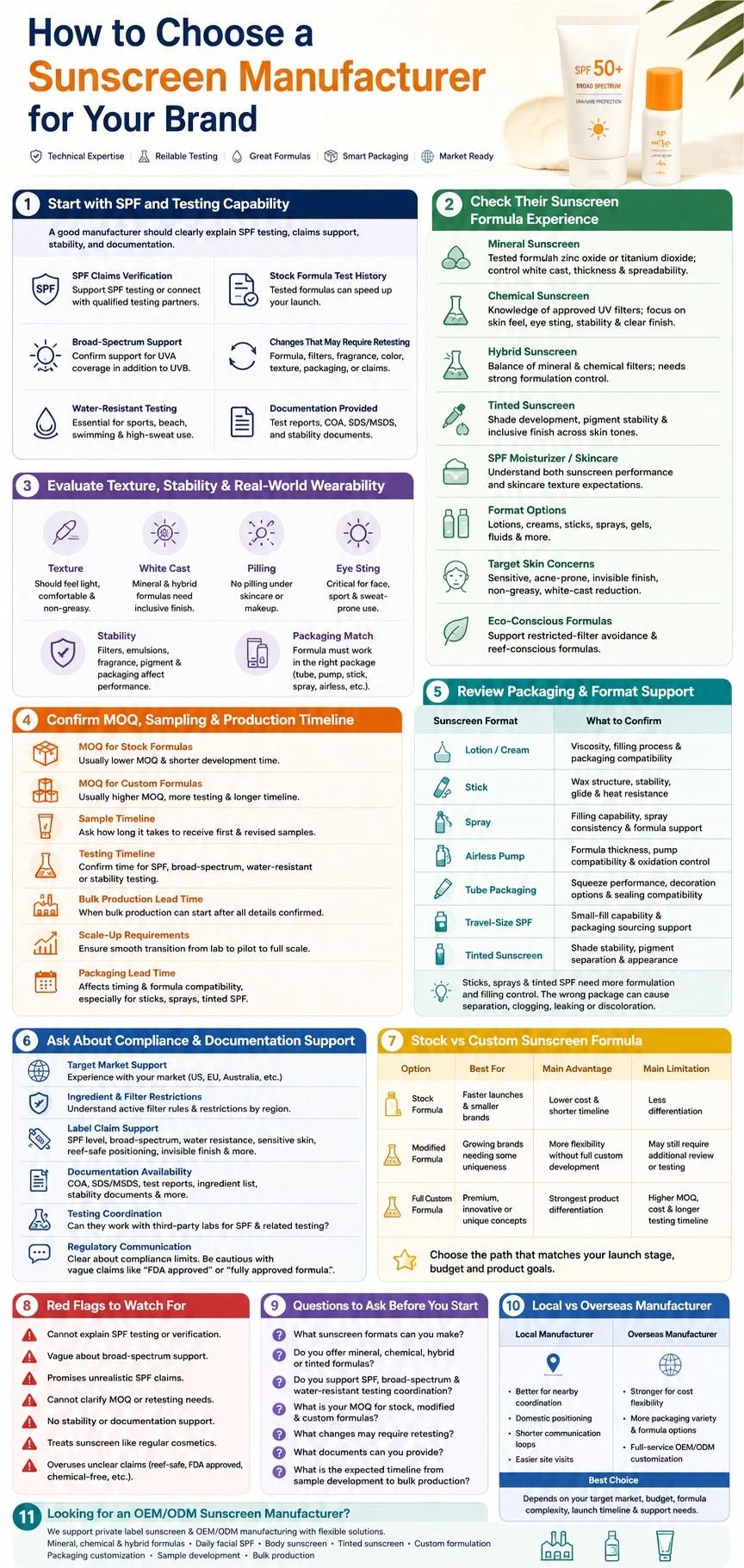
Start with SPF and Testing Capability
Sunscreen manufacturing is not just about filling a lotion into a tube. SPF claims, broad-spectrum protection, water-resistant claims, and formula stability all need proper support. A good sunscreen manufacturer should be able to explain how testing works, what documents they can provide, and what changes may affect the final claim.
Before you discuss packaging or price, ask these questions:
- How are SPF claims verified? Ask whether the manufacturer can support SPF testing or connect you with qualified testing partners.
- Can they support broad-spectrum claims? SPF mainly relates to UVB protection, so broad-spectrum support matters if your product also needs UVA coverage.
- Do they support water-resistant testing if needed? This matters for sports sunscreen, beach sunscreen, swimming products, and high-sweat use cases.
- Do their stock formulas have test history? A tested stock formula can be faster to launch than a new custom formula, but you still need to confirm what changes are allowed.
- What changes may require retesting? Formula changes, active filters, fragrance, color, texture, packaging, or claim changes may affect testing needs.
- What documentation can they provide? Ask about test reports, COA, SDS/MSDS, and stability-related documents.
Check Their Sunscreen Formula Experience

A sunscreen manufacturer should have experience with the exact type of SPF product you want to launch. A factory that can make a basic lotion may still struggle with a tinted mineral sunscreen, a clear chemical sunscreen, or a water-resistant sport formula.
- Mineral sunscreen Ask whether they have experience with zinc oxide or titanium dioxide formulas. Mineral SPF is often harder to make elegant because white cast, thickness, and spreadability need careful control.
- Chemical sunscreen Check whether they understand approved UV filters for your target market. Chemical formulas often need good work on skin feel, eye sting, stability, and clear finish.
- Hybrid sunscreen Hybrid formulas can balance mineral and chemical filters, but they require stronger formulation control. Ask whether the manufacturer has made hybrid SPF products before.
- Tinted sunscreen Tinted SPF needs shade development, pigment stability, and good blending across different skin tones. This is not the same as adding color to a regular lotion.
- SPF moisturizer or SPF skincare If your product is positioned as skincare with SPF, the manufacturer should understand both sunscreen performance and skincare texture expectations.
- Format options Confirm whether they can produce lotions, creams, sticks, sprays, gels, or lightweight fluids. Each format has different filling, stability, and packaging requirements.
- Target skin concerns Ask whether they can support sensitive skin, acne-prone skin, invisible finish, non-greasy feel, and white-cast reduction. These details often decide whether the product succeeds in real use.
- Eco-conscious formula needs Ask whether the manufacturer can support restricted-filter avoidance and reef-conscious formulas for markets such as Hawaii or Southeast Asia. Avoid vague “reef-safe” claims without ingredient and market review.
Evaluate Texture, Stability, and Real-World Wearability
A sunscreen can meet the SPF target and still fail as a product if people do not like wearing it. Texture, finish, and stability are not small details. They affect reviews, repeat purchases, and whether customers use the product correctly.
A strong sunscreen manufacturer should help balance protection, skin feel, and product stability.
- Texture matters. Heavy, greasy, sticky, or draggy formulas are harder to sell, especially for daily facial SPF.
- White cast can limit your market. Mineral and hybrid sunscreens need careful work if you want a more inclusive finish across skin tones.
- Pilling hurts daily use. Sunscreen that pills under skincare or makeup will frustrate customers, even if the SPF claim looks good.
- Eye sting affects repeat purchase. This is especially important for face sunscreen, sport sunscreen, and sweat-prone use cases.
- Stability affects performance and appearance. Filters, emulsions, fragrance, pigment, and packaging can all affect how the formula holds up over time.
- Packaging must match the formula. A sunscreen that works in a tube may not work well in a pump, stick, spray, or airless package without adjustment.
Confirm MOQ, Sampling, and Production Timeline
Sunscreen projects often take longer than regular skincare because testing, stability review, packaging compatibility, and claim support can add extra steps. Before you commit to a manufacturer, confirm the commercial details early.
Use this checklist before starting development:
- MOQ for stock formulas Stock sunscreen formulas usually have lower MOQs and shorter development timelines.
- MOQ for custom formulas Custom SPF formulas usually require higher MOQs, more testing, and longer review time.
- Sample timeline Ask how long it takes to receive first samples and revised samples.
- Testing timeline Confirm how long SPF, broad-spectrum, water-resistant, or stability-related testing may take.
- Bulk production lead time Ask when bulk production can start after formula, packaging, and testing details are confirmed.
- Scale-up requirements Make sure the formula can move from lab sample to pilot batch and full production without major changes.
- Packaging lead time Sunscreen packaging can affect both timing and formula compatibility, especially for sticks, sprays, tinted products, and custom components.
Review Packaging and Format Support

Sunscreen packaging is not just a branding decision. Different SPF formats need different filling methods, packaging compatibility, and stability support. A manufacturer should be able to explain which packaging works best for your formula type and target market.
| Sunscreen format | What to confirm |
|---|---|
| Lotion / cream | Viscosity, filling process, and packaging compatibility |
| Stick | Wax structure, stability, glide, and heat resistance |
| Spray | Filling capability, spray consistency, and formula support |
| Airless pump | Formula thickness, pump compatibility, and oxidation control |
| Tube packaging | Squeeze performance, decoration options, and sealing compatibility |
| Travel-size SPF | Small-fill capability and packaging sourcing support |
| Tinted sunscreen | Shade stability, pigment separation, and packaging appearance |
Ask whether the manufacturer has experience with your preferred format before bulk production starts. Sticks, sprays, and tinted SPF products need more formulation and filling control than basic lotions, and the wrong package can cause separation, clogging, leaking, discoloration, or stability problems.
Ask About Compliance and Documentation Support

Sunscreen requirements can vary significantly by market, so compliance support matters early in the project. A formula designed for one region may not automatically fit another market’s ingredient rules, labeling expectations, or sunscreen claim requirements.
Before moving forward, ask about these areas:
- Target market support Confirm whether the manufacturer has experience with your intended market, especially if you plan to sell in the United States, Europe, Australia, or multiple regions.
- Ingredient and active filter restrictions Sunscreen active filters allowed in one country may be restricted or handled differently elsewhere.
- Label claim support Claims such as SPF level, broad-spectrum protection, water resistance, sensitive skin, reef-safe positioning, or invisible finish may require supporting documentation or testing.
- Documentation availability Ask what documents they can provide, such as COA, MSDS/SDS, test reports, ingredient lists, or stability-related documents.
- Testing coordination support Some manufacturers can coordinate with third-party labs or testing partners for SPF and related testing support.
- Regulatory communication clarity Be cautious with vague claims like “FDA approved sunscreen factory” or “fully approved formula.” In most cases, sunscreen compliance depends on the formula, claims, testing, labeling, and market-specific requirements together.
The best manufacturers usually explain compliance limitations clearly instead of making overly broad guarantees.
Stock Formula vs Custom Sunscreen Formula: Which Should You Choose?
The right sunscreen development path depends on your budget, launch speed, target market, and product positioning. Some brands need a fast, lower-risk launch, while others need a more differentiated SPF product.
| Option | Best for | Main advantage | Main limitation |
|---|---|---|---|
| Stock formula | Faster launches and smaller brands | Lower cost and shorter timeline | Less differentiation |
| Modified formula | Growing brands needing some uniqueness | More flexibility without full custom development | May still require additional review or testing |
| Full custom formula | Premium, innovative, or unique SPF concepts | Strongest product differentiation | Higher MOQ, cost, and longer testing timeline |
Stock sunscreen formulas are usually the fastest path to market because testing history, packaging compatibility, and production processes may already be in place. Modified formulas give brands some room to adjust texture, fragrance, tint, finish, or packaging without starting from zero.
Full custom formulas are better for brands that need unique texture, premium wearability, or stronger differentiation, but they usually require higher MOQ, more testing, and longer development time. The best option is not always the most customized one. It is the one that matches your launch stage, budget, and product goals.
Red Flags When Choosing a Sunscreen Manufacturer

Some sunscreen manufacturers look good on the surface but become risky once you ask technical questions. Sunscreen is not a basic cosmetic filling project. If a supplier cannot explain testing, claims, stability, and documentation clearly, be careful.
- They cannot explain SPF testing. If a manufacturer cannot explain how SPF claims are verified or supported, they may not be ready for serious sunscreen development.
- They are vague about broad-spectrum support. Broad-spectrum protection is a major sunscreen claim. A supplier should be able to explain what support or testing coordination is available.
- They promise unrealistic SPF claims. Be cautious if a manufacturer promises very high SPF, instant approval, or guaranteed results before formula review and testing.
- They cannot clarify MOQ or retesting needs. You should know how stock, modified, and custom formulas differ in MOQ, testing, and development time.
- They offer no stability or documentation support. Sunscreen needs more than a nice sample. Ask about stability review, test reports, COA, SDS/MSDS, and other project documents.
- They treat sunscreen like regular cosmetic filling. Sunscreen formulas need more technical handling than basic lotions, creams, or cleansers.
- They overuse unclear claims. Terms like “reef-safe,” “FDA approved,” or “chemical-free” should be explained carefully. If a supplier uses these claims loosely, that is a warning sign.
Questions to Ask Before You Start a Sunscreen Project
Use these questions before you request samples or commit to development.
- What sunscreen formats can you make?
- Do you offer mineral, chemical, hybrid, or tinted sunscreen formulas?
- Do you support SPF, broad-spectrum, and water-resistant testing coordination?
- What is your MOQ for stock, modified, and custom formulas?
- What formula or packaging changes may require retesting?
- What documents can you provide, such as COA, SDS/MSDS, test reports, or stability records?
- What is the expected timeline from sample development to bulk production?
These questions help you see whether the supplier is truly prepared for sunscreen development or only offering general skincare manufacturing.
See also:
Questions to Ask a Sunscreen Manufacturer Before You Start
Local vs Overseas Sunscreen Manufacturer: What to Consider
The right choice depends on your target market, budget, formula complexity, launch timeline, and support needs. A local sunscreen manufacturer can be useful when nearby production, easier communication, and domestic market positioning matter most. An overseas manufacturer may be better when you need more cost flexibility, packaging variety, and OEM/ODM customization.
- Local manufacturer: Better for nearby coordination, domestic positioning, shorter communication loops, and easier site visits.
- Overseas manufacturer: Often stronger for cost flexibility, packaging variety, broader formula options, and full-service OEM/ODM customization.
- Best choice: Depends on where you sell, how complex your sunscreen formula is, how fast you need to launch, and what support you need for testing, packaging, and documentation.
This is only a quick comparison. If your project is cost-sensitive, packaging-heavy, or highly customized, it is worth comparing both local and overseas options before choosing a partner.
See also: China vs Local Sunscreen Manufacturer
Looking for an OEM/ODM Sunscreen Manufacturer?
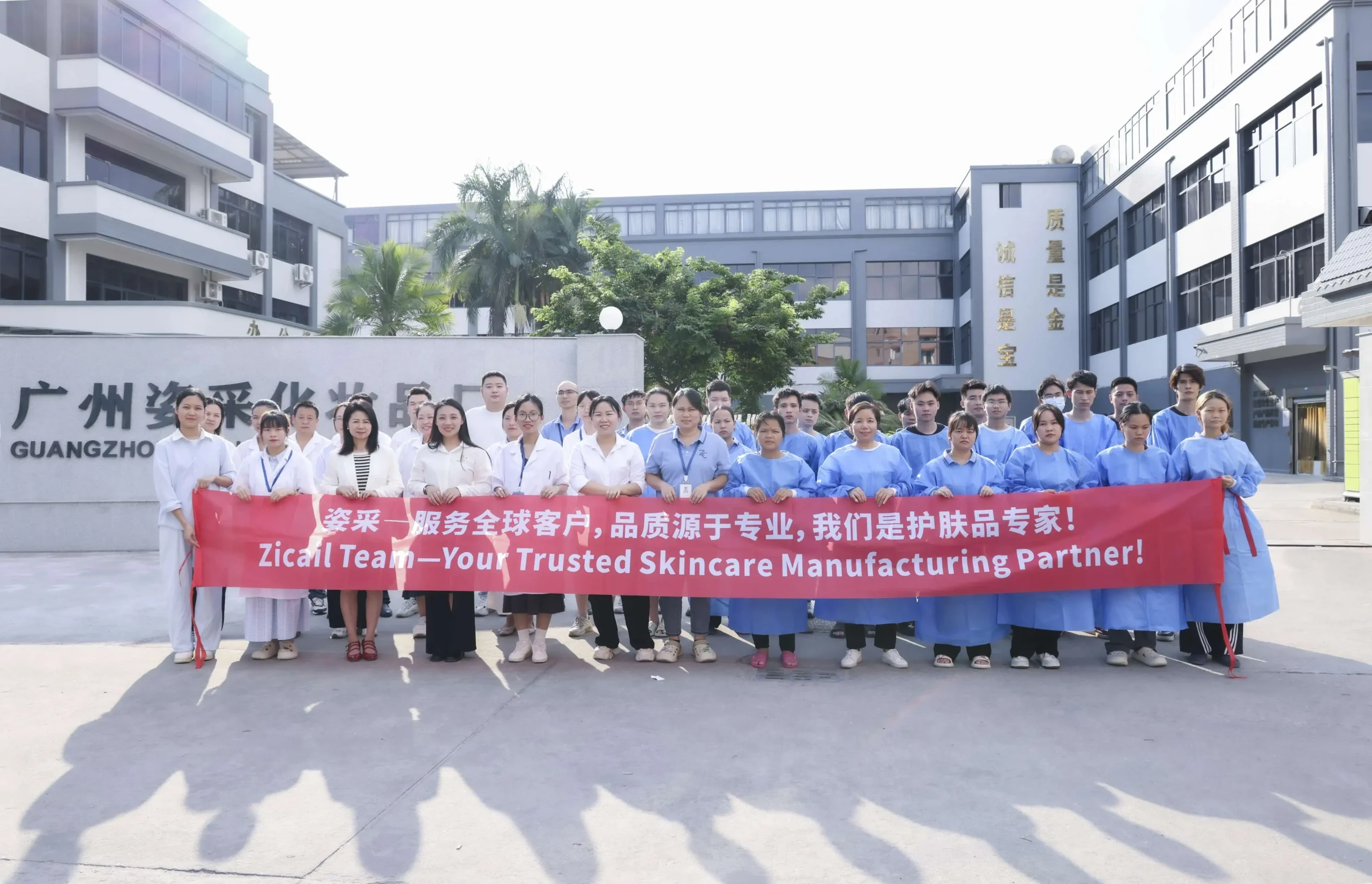
Zicail supports private label sunscreen and OEM/ODM sunscreen manufacturing for brands that need flexible formula and packaging solutions.
We can help develop mineral, chemical, and hybrid sunscreen formulas, including daily facial SPF, body sunscreen, tinted sunscreen, and broader sun care products. Our support can include custom formulation, packaging customization, sample development, and bulk production.
If you are planning a private label sunscreen line, contact us to discuss your formula, packaging, sample, and bulk production needs.


