


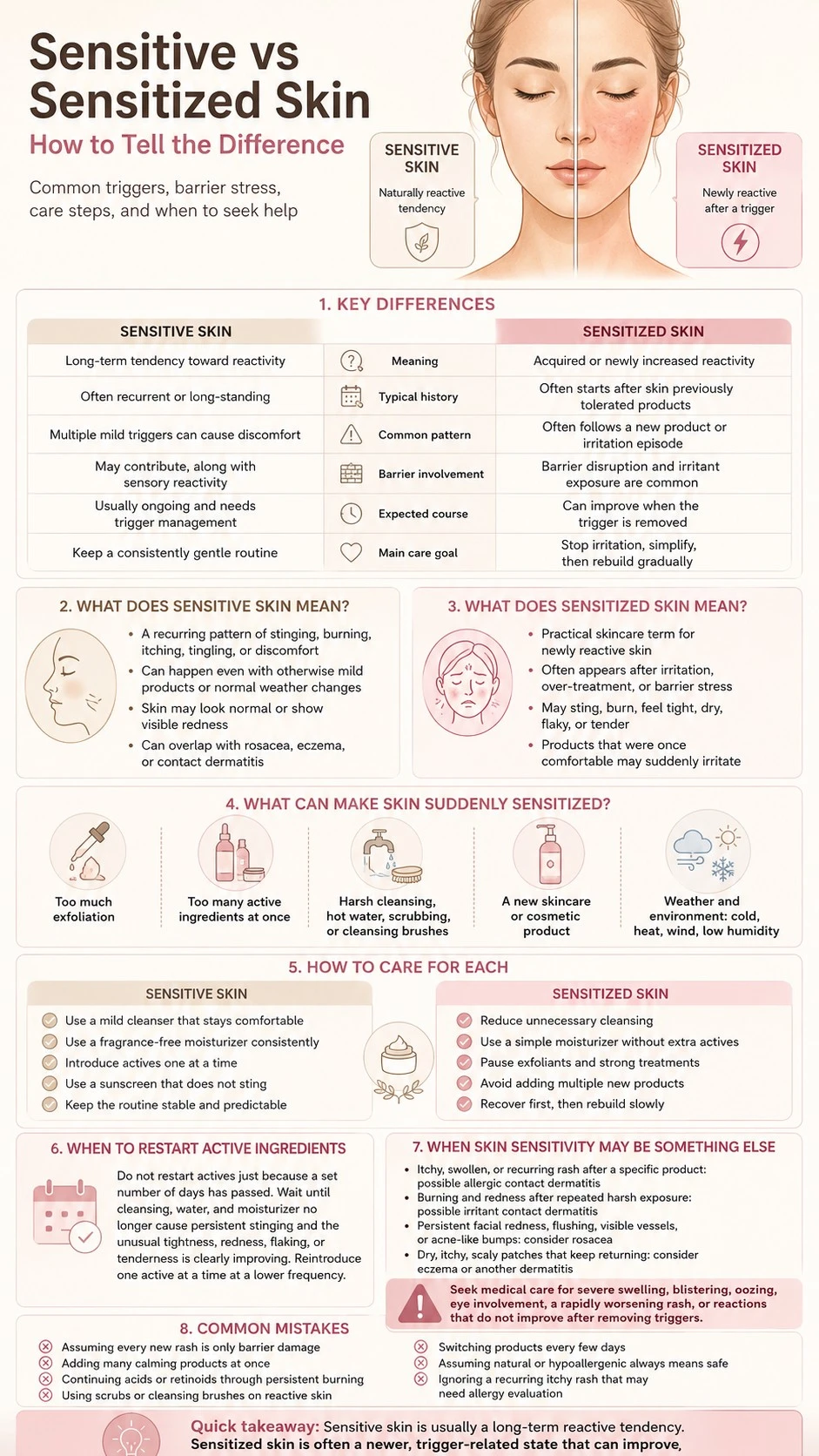
Sensitive vs Sensitized Skin: Key Differences
The most useful clues are your history, how suddenly the problem appeared, and whether removing a recent trigger changes the pattern. Appearance alone is not enough to tell the two apart.
| Feature | Sensitive Skin | Sensitized Skin |
|---|---|---|
| Meaning | A consensus-defined sensitivity syndrome in research; not a single disease diagnosis | An informal skincare term for acquired or newly increased reactivity |
| Typical history | Often recurrent or long-standing | Often starts after the skin previously tolerated similar products |
| Common pattern | Multiple mild triggers can cause discomfort | A recent product, routine change, or irritation episode often precedes symptoms |
| Barrier involvement | Barrier changes can contribute, but sensory-nerve mechanisms and other factors also matter[1][2] | Barrier disruption and irritant exposure are common explanations for newly reactive skin[4] |
| Expected course | May remain an ongoing tendency that requires trigger management | Can improve when the trigger is removed and the skin recovers |
| Main care goal | Build a consistently gentle, predictable routine | Stop the irritation cycle, simplify, then reintroduce products gradually |
What Does Sensitive Skin Actually Mean?
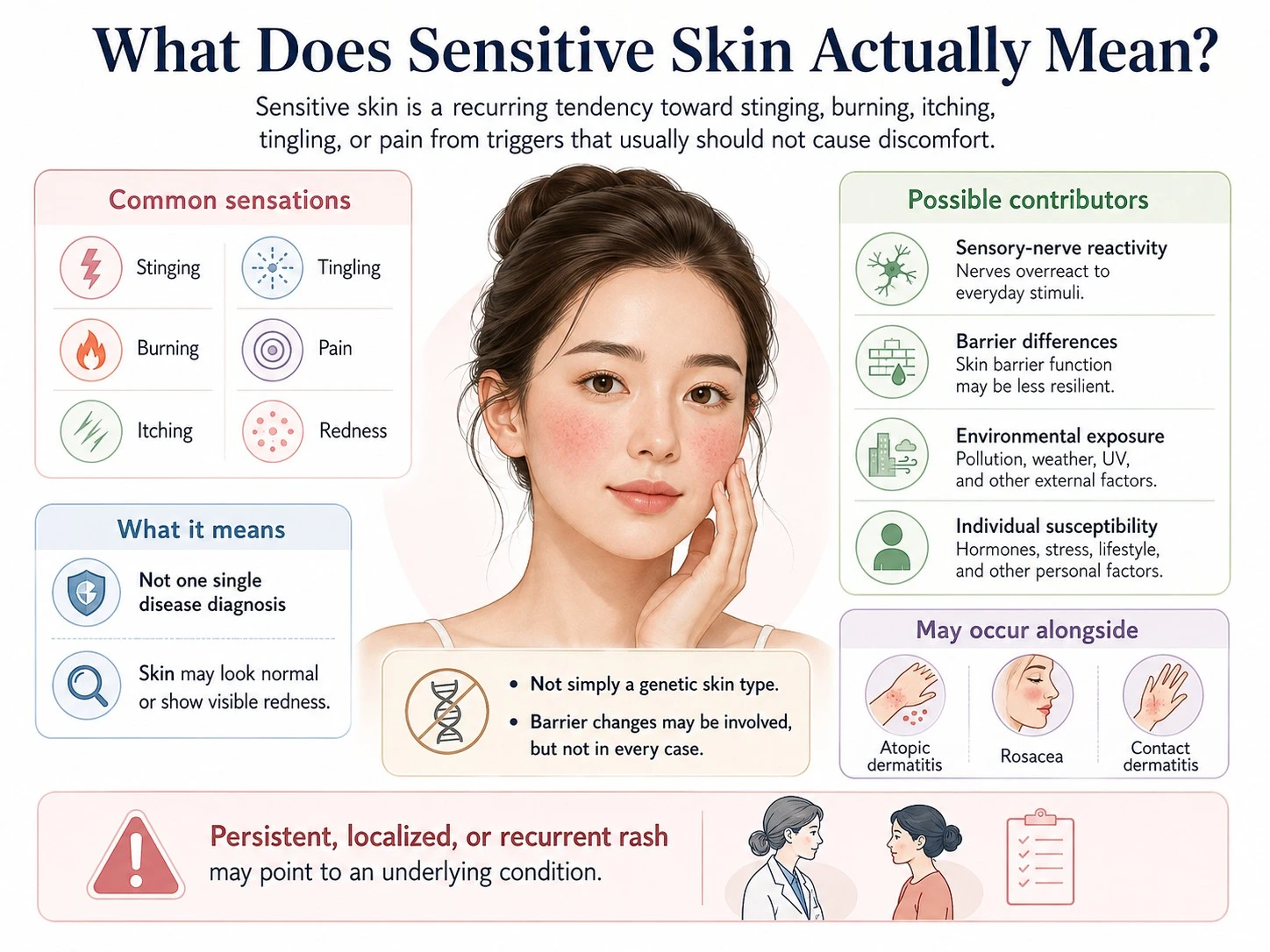
Sensitive skin has a consensus research definition, but it is not one single disease diagnosis. The definition focuses on unpleasant sensations such as stinging, burning, itching, tingling, or pain triggered by things that normally should not cause those sensations. The skin can look normal or show visible redness at the same time.[1][3]
It is also too simple to describe sensitive skin as purely a genetic skin type. Research points to a combination of sensory-nerve reactivity, barrier differences, environmental exposure, and individual susceptibility. Barrier changes can be involved, but not every person with sensitive skin has the same underlying mechanism.[1][2]
Sensitive skin can also occur alongside conditions such as atopic dermatitis, rosacea, or contact dermatitis.[3] If the reaction is persistent, highly localized, or accompanied by a recurring rash, the underlying condition matters more than the general label “sensitive.”
What Does Sensitized Skin Mean?
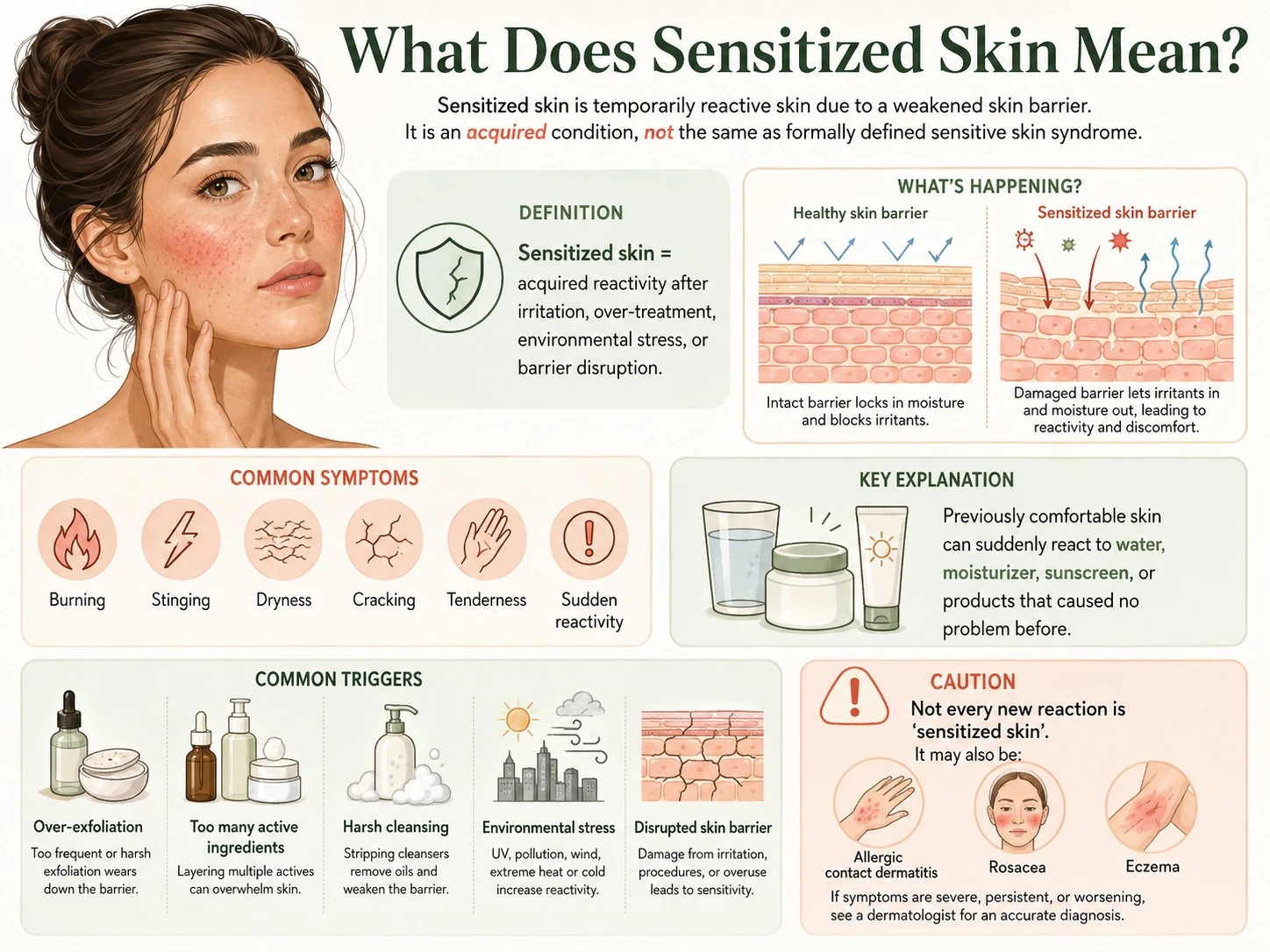
Unlike sensitive skin syndrome, “sensitized skin” does not have the same consensus dermatologic definition. In this article, the term is used as practical skincare shorthand for acquired reactivity that appears after irritation, over-treatment, environmental stress, or disruption of the protective outer barrier.
Irritant exposure can damage the skin barrier and trigger inflammation, leading to burning, stinging, dryness, cracking, or tenderness.[4] That is why someone with previously comfortable skin can suddenly react to water, moisturizer, sunscreen, or products that caused no problem before. Our Skin Barrier guide explains the broader signs of barrier disruption.
Do not use “sensitized” to explain every new reaction. A specific ingredient can cause allergic contact dermatitis, and conditions such as rosacea or eczema can also begin or flare after a period of apparently normal skin.[3][5]
What Can Make Skin Suddenly Sensitized?

New sensitivity is often caused by cumulative irritation rather than one dramatic event. Several individually tolerable steps can become too much when they are combined.
- Too much exfoliation: Frequent acids, peels, scrubs, or exfoliating cleansers can create dryness, burning, and barrier stress. If this pattern fits, see Over-Exfoliated Skin.
- Too many active products at once: Retinoids, exfoliating acids, acne treatments, and other strong actives can become irritating when introduced together or increased too quickly.
- Harsh cleansing: Repeated washing, very hot water, strong surfactants, cleansing brushes, or scrubbing can strip and irritate the surface. A gentler starting point is covered in How to Choose a Cleanser.
- A new skincare or cosmetic product: Fragrance, preservatives, active ingredients, or the complete formula can irritate the skin or trigger an allergic reaction in susceptible users.[5]
- Weather and environment: Cold, heat, low humidity, wind, and other environmental exposures can aggravate reactive skin.[1]
The timing matters. If symptoms started soon after a routine change, removing the newest or most irritating steps gives you more useful information than adding several “soothing” products at once.
How to Care for Sensitive vs Sensitized Skin
Both situations benefit from gentle cleansing, non-irritating moisturization, sun protection, and careful product introduction.[3][7] The strategy is still different: sensitive skin needs a sustainable baseline routine, while sensitized skin needs a temporary reduction in irritation before you rebuild the routine.
| Routine Decision | Sensitive Skin | Sensitized Skin |
|---|---|---|
| Cleanser | Use a mild cleanser that consistently leaves the skin comfortable | Reduce unnecessary cleansing and avoid products that leave the skin tight or stingy |
| Moisturizer | Choose a fragrance-free formula you tolerate and use it consistently | Prioritize a simple moisturizer that reduces tightness without adding more active ingredients |
| Active ingredients | Introduce one at a time and use only what your skin tolerates | Pause unnecessary exfoliants and strong actives until baseline comfort returns |
| New products | Test cautiously before full-face use | Avoid adding multiple new products while trying to identify the trigger |
| Sunscreen | Use a daily sunscreen formula that does not repeatedly sting | Keep sun protection, but change formula if the current product is actively irritating compromised skin |
| Long-term goal | Reduce predictable triggers and keep the routine stable | Recover first, then rebuild slowly |
For a complete low-irritation morning and evening structure, use the Skincare Routine for Sensitive Skin. When trying a new formula, our skincare patch-testing guide can reduce the chance of applying an obviously irritating product to the whole face, although home testing cannot diagnose a true allergy.[6]
When to Restart Active Ingredients After Sensitization
Do not restart an active simply because a fixed number of days has passed. A better checkpoint is skin behavior: basic cleansing, moisturizer, and water should no longer cause persistent stinging, and the unusual tightness, tenderness, flaking, or redness should be clearly settling.
Reintroduce one active at a time at a lower frequency than before. If the same burning or peeling quickly returns, stop and reassess rather than trying to “push through” the reaction.
When Skin Sensitivity May Be Something Else

“Sensitive” and “sensitized” are useful skincare descriptions, but neither should replace a diagnosis when the pattern looks like a skin disease or allergy.
- Itchy, swollen, or recurrent rash after a specific product: This can suggest allergic contact dermatitis rather than simple irritation. Formal dermatology patch testing may be needed to identify the allergen.[5][6]
- Burning and redness after repeated exposure to harsh products: Irritant contact dermatitis is possible, especially when the barrier has been repeatedly damaged.[4]
- Persistent central facial redness, flushing, visible vessels, or acne-like bumps: Rosacea should be considered rather than repeatedly changing “sensitive skin” products.[3]
- Dry, itchy, scaly patches that keep returning: Eczema or another form of dermatitis may need targeted treatment.[3]
Seek medical care for severe swelling, blistering, oozing, eye involvement, a rapidly worsening rash, or reactions that do not improve after removing suspected triggers.[7] If your main symptom is burning or stinging from skincare, Why Does Skincare Burn? explains when discomfort is a sign to stop.
Common Mistakes When Skin Becomes Reactive
- Assuming sensitive skin is always genetic and sensitized skin is always temporary.
- Calling every new rash “barrier damage” without considering allergy, eczema, or rosacea.
- Adding several calming serums, masks, oils, and actives while trying to identify the cause.
- Continuing acids or retinoids through persistent burning because irritation is mistaken for efficacy.
- Using scrubs or cleansing brushes to remove new flaking.
- Switching products every few days before the skin has time to settle.
- Choosing “natural,” “clean,” or “hypoallergenic” products as if those labels guarantee tolerance.
- Ignoring a recurring itchy rash that needs formal allergy evaluation.
Final Thoughts
Sensitive and sensitized skin can feel almost identical, but the history is often different. Sensitive skin is a recurring reactivity pattern, while “sensitized skin” is most useful as a description of newly acquired reactivity after irritation or barrier stress. Neither label should be used to explain persistent rashes or redness without considering an underlying condition.
If your skin suddenly becomes reactive, simplify first: remove likely irritants, use a gentle cleanser and moisturizer, keep sun protection comfortable, and rebuild the routine one product at a time. If the problem keeps returning despite a simple routine, the next step is identifying the cause rather than adding more skincare.
FAQs About Sensitive vs Sensitized Skin
Can sensitive skin also become sensitized?
Yes. Someone with an existing sensitive-skin tendency can still develop an additional episode of irritation or barrier damage. In that situation, the skin may be more reactive than its usual baseline until the new trigger is removed and the irritation settles.
Can sensitized skin go back to normal?
Often, acquired reactivity caused by irritation can improve after the trigger is removed and the skin is allowed to recover. If sensitivity remains persistent or repeatedly returns, reconsider whether an underlying sensitive-skin pattern, dermatitis, rosacea, or allergy is involved.
How long does sensitized skin take to recover?
There is no reliable fixed timeline because recovery depends on the cause, severity, ongoing exposures, and baseline skin condition. Use reduced stinging, tightness, redness, and flaking as practical signs of improvement rather than expecting recovery on a specific day.
Is sensitive skin a skin type?
It is more accurate to treat sensitive skin as a reactivity syndrome or characteristic rather than the same kind of category as oily, dry, or combination skin.[1][3] A person can therefore have oily-sensitive, dry-sensitive, or combination-sensitive skin.
Should you exfoliate sensitized skin?
Avoid unnecessary exfoliation while the skin is actively burning, tight, tender, or peeling. Once the skin is comfortable again, exfoliation can be reintroduced only if you need it and at a frequency your skin tolerates.
Are ceramides good for sensitive or sensitized skin?
Ceramides are normal components of the skin barrier and can be useful in moisturizers designed to support barrier function. The complete formula still matters because a product containing ceramides can also contain something your skin does not tolerate. See our Ceramides for Skin guide for their role in barrier care.
Sources
[1] Misery L, et al. Definition of Sensitive Skin: An Expert Position Paper from the Special Interest Group on Sensitive Skin of the International Forum for the Study of Itch
[2] Fluhr JW, et al. Epidermal Barrier Function in Dry, Flaky and Sensitive Skin: A Narrative Review
[3] DermNet. Sensitive Skin
[4] DermNet. Irritant Contact Dermatitis
[5] American Academy of Dermatology. Contact Dermatitis: Causes
[6] American Academy of Dermatology. How to Test Skin Care Products
[7] American Academy of Dermatology. Contact Dermatitis Tips for Managing


