


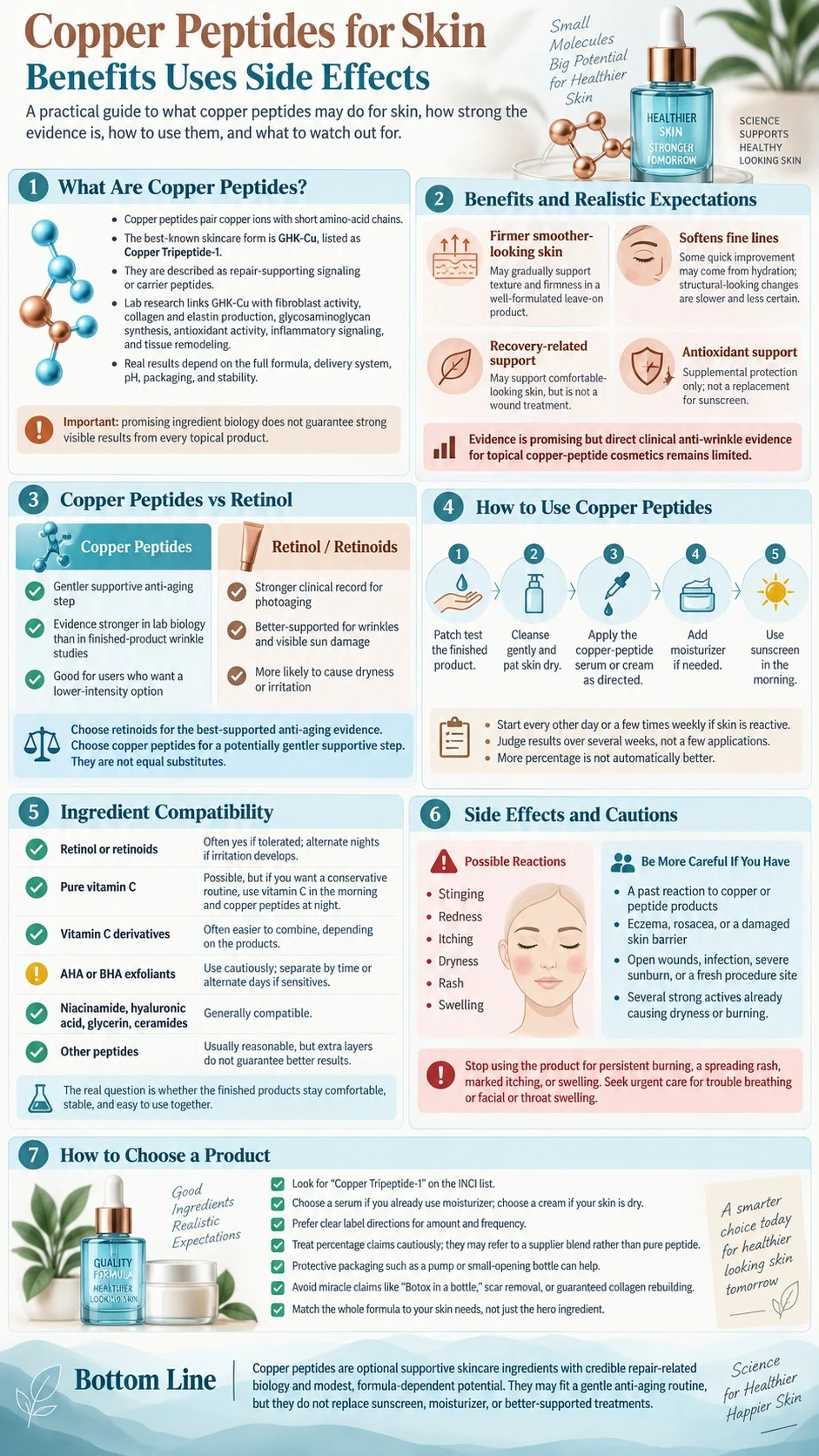
Copper peptides have become popular because the science sounds compelling: a naturally occurring peptide binds an essential mineral and participates in repair-related processes. The leap from that biology to guaranteed younger-looking skin, however, is too large. This guide covers topical cosmetics; injectable or “research use” peptide products are different and outside its scope.
What Are Copper Peptides and How Do They Work?
Peptides are short chains of amino acids, the building blocks used to make proteins. Copper peptides are complexes in which a peptide binds a copper ion. The most studied example in skin research is glycyl-L-histidyl-L-lysine copper, shortened to GHK-Cu. On an ingredient list, it commonly appears as Copper Tripeptide-1.
GHK occurs naturally in the body and readily binds copper. Laboratory and animal research links GHK-Cu with fibroblast activity, collagen and elastin production, glycosaminoglycan synthesis, antioxidant activity, inflammatory signaling, and tissue remodeling.[2] These findings explain why copper peptides are described as carrier or signaling peptides. For a broader map of peptide types, see peptides for skin.
That mechanism does not guarantee a visible result from every bottle. Peptides are water-loving molecules, and their passage through the outer skin can be limited. They can also be sensitive to the surrounding formula. A current review found that published information on topical GHK-Cu permeability, effectiveness, and physicochemical behavior remains insufficient, even though metal complexation improves GHK permeability compared with the uncomplexed peptide.[1] The vehicle, pH, delivery system, storage, packaging, and supporting ingredients can all affect performance.
“Copper peptide” is a category description, not proof of a standardized dose or outcome. Products with the same INCI ingredient can differ in amount, stability, delivery, and skin feel.
Copper Peptide Benefits: Evidence and Realistic Results
Copper peptides are most defensible as supportive cosmetic ingredients. Their repair-related biology is plausible, but many consumer claims depend on laboratory studies, animal models, older small trials, or complete formulas that contain other active and moisturizing ingredients.
| Potential benefit | What supports the claim | Realistic expectation |
|---|---|---|
| Supports firmer, smoother-looking skin | GHK-Cu has been associated with fibroblast activity and synthesis of collagen, elastin, and glycosaminoglycans in experimental research.[2] | A well-formulated leave-on product may produce gradual, modest changes in texture or firmness. It cannot lift loose skin like a procedure. |
| Softens the look of fine lines | Improved hydration from the formula can smooth fine lines quickly, while peptide-related remodeling would take longer. Direct clinical evidence specific to topical GHK-Cu is sparse.[1] | Expect subtle improvement, if any, over consistent use. Immediate plumping may come from humectants rather than the peptide itself. |
| Supports recovery-related skin processes | GHK-Cu has been studied in tissue-remodeling and wound-healing contexts and has anti-inflammatory and antioxidant activity in experimental systems.[2] | A cosmetic may support comfortable-looking skin, but it is not a wound treatment and should not be used on open injuries. |
| Helps defend against oxidative stress | Antioxidant and protective effects appear in preclinical research.[2] | Treat this as supplemental support, not a substitute for broad-spectrum sunscreen. |
| Improves post-procedure appearance | One small controlled study of 13 people after carbon-dioxide laser resurfacing found higher patient satisfaction but no objective advantage for redness, wrinkles, or overall skin quality.[4] | Do not assume a retail serum will speed healing. Follow the procedure provider’s aftercare plan. |
The strongest reason for caution is the gap between mechanism and clinical outcome. A 2024 review described a surprising absence of clinical studies directly testing topical GHK-Cu for wrinkles, despite its widespread cosmetic use.[1] Finished products also combine peptides with moisturizers and other actives, so an improvement cannot automatically be assigned to GHK-Cu alone.
The honest conclusion is promising, formula-dependent, and not yet proven to the same standard as better-established photoaging treatments. Copper peptides suit someone who wants a gentle-feeling supportive product and accepts uncertainty. They are a poor substitute for sunscreen, moisturizer, or a treatment with stronger human evidence.
Copper Peptides vs Retinol: Which Is Better for Aging Skin?
Retinoids have the stronger clinical record for photoaging. A systematic review found that topical tretinoin improved wrinkles, mottled pigmentation, sallowness, and lentigines, although irritation is common and prescription tretinoin is not the same as over-the-counter retinol.[5] Copper peptides have interesting repair biology and may be easier for some people to tolerate, but their direct anti-wrinkle evidence is much thinner.
Choose a retinoid when your priority is the best-supported topical option for visible photoaging and you can manage dryness or irritation. Choose copper peptides for a lower-intensity supportive step or when retinoids are hard to tolerate. They are not equivalent substitutes, but a routine can include both if skin tolerates them. The retinol guide explains how to start gradually and manage predictable side effects.
Daily sun protection still has the larger role in preventing additional sun-related damage. No peptide serum can compensate for inconsistent sunscreen use.
How to Use Copper Peptides in Your Skincare Routine
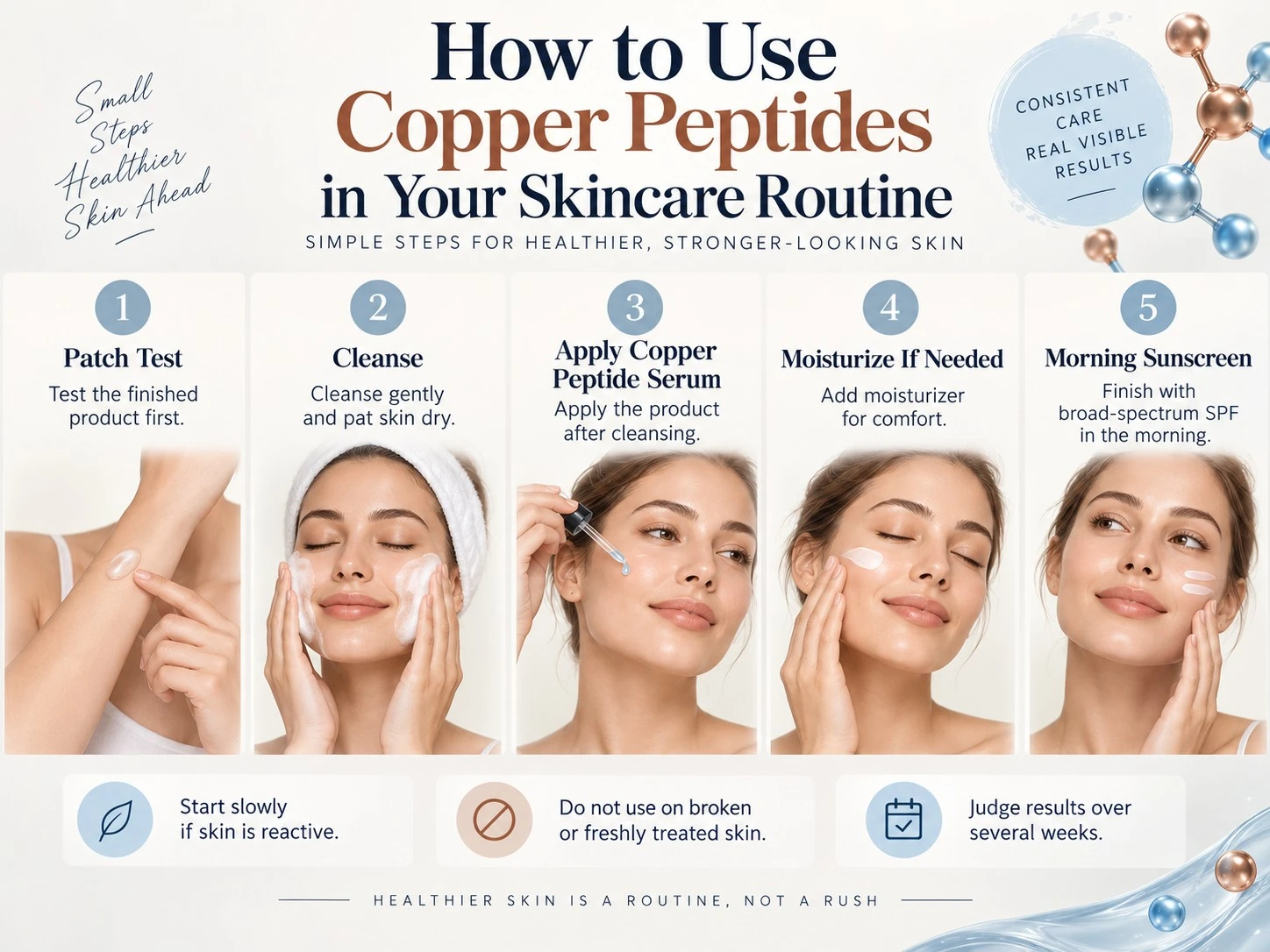
Follow the directions on the finished product because formulas differ. If the label permits daily leave-on use, this simple sequence keeps the routine easy to evaluate:
- Patch test the finished product. Test the complete formula rather than assuming the featured peptide predicts tolerance.
- Cleanse gently and pat skin dry. Do not apply a cosmetic copper-peptide product over broken, raw, or freshly treated skin.
- Apply the copper-peptide product. Use the label-recommended amount. A watery serum normally goes before creams and oils; a copper-peptide cream can serve as the moisturizer step.
- Add moisturizer if needed. Choose a texture that prevents tightness without making the routine uncomfortable or prone to pilling.
- Use sunscreen in the morning. Copper peptides do not provide an SPF or replace broad-spectrum sun protection.
If your skin is reactive, start every other day or a few times per week, then increase only while the product remains comfortable. Many formulas can be used daily when their instructions allow it.
Do not chase a universal “effective percentage.” Ingredient lists do not disclose the amount, and brands may describe the concentration of a supplier blend rather than the concentration of pure Copper Tripeptide-1. More is not automatically better. Consistent use of a stable, comfortable formula is more useful than a dramatic percentage claim you cannot interpret.
Judge the product over several weeks, not a few applications. Hydration and surface smoothness can change quickly because of the formula base; structural-looking changes are slower and less certain. Use consistent lighting for comparison and avoid adding other new products during the test.
Can You Use Copper Peptides With Other Ingredients?
Most compatibility rules online are more absolute than the evidence allows. The practical question is whether the finished products remain stable, comfortable, and usable together—not whether two ingredient names are forbidden in theory.
| Ingredient | Can they share a routine? | Practical approach |
|---|---|---|
| Retinol or prescription retinoids | Often, if both products are tolerated and their directions do not conflict. | Introduce each product separately. If the routine becomes dry or irritated, alternate nights instead of layering. |
| Pure L-ascorbic acid vitamin C | There is not enough direct human evidence to promise that every separate-product pairing is optimal. Low-pH vitamin C and a metal-peptide complex also create reasonable formulation questions. | Follow each label. For a conservative routine, use vitamin C in the morning and copper peptides at night. |
| Vitamin C derivatives | Often easier to formulate at less acidic pH, but compatibility still depends on the finished products. | Use together only if directions allow and the layers remain comfortable. |
| AHA or BHA exfoliants | No universal prohibition, but acids can add stinging, dryness, or barrier stress. | Separate by time or alternate days if skin is sensitive. |
| Niacinamide, hyaluronic acid, glycerin, and ceramides | Generally compatible in ordinary cosmetic routines. | Layer from thinner to thicker, or use a formula that already combines them. |
| Other peptides | Usually reasonable, but more products do not guarantee better results. | Avoid redundant layers if they pill or make it hard to identify irritation. |
The safest interpretation of the vitamin C debate is neither “they cancel each other out” nor “every combination is proven.” Topical GHK literature notes formulation, stability, and permeability challenges but does not establish a universal danger from applying two separate cosmetics.[1] If you use an acidic vitamin C serum, separating it from copper peptides is a simple precaution.
When combining treatment steps, add only one new product at a time. The two-serum layering guide can help you troubleshoot order, pilling, and cumulative irritation without inventing rigid waiting times.
Side Effects and Who Should Be Careful
Copper Tripeptide-1 and related peptide ingredients were considered safe in cosmetics under the practices and concentrations assessed by the Cosmetic Ingredient Review Expert Panel.[3] That conclusion applies to cosmetic use as assessed, not to swallowing or injecting peptide products, applying raw materials, or using a serum as medical wound care.
Possible reactions include stinging, redness, itching, dryness, rash, or swelling. The peptide may not be the cause; fragrance, preservatives, solvents, or another active can also trigger irritation or allergy. A blue or blue-green color can come from the copper complex and does not by itself signal a problem.
Use extra care if you have:
- a known allergy or previous reaction to a product containing copper or peptides;
- eczema, rosacea, or a currently damaged and highly reactive skin barrier;
- an open wound, infection, severe sunburn, or fresh procedure site;
- a clinician-managed condition affecting copper metabolism; or
- several strong active products already causing dryness or burning.
Patch testing cannot guarantee that the face will never react, but it can catch some problems before full application. The ZICAIL patch-test guide explains the process. Professional guidance recommends applying a product to a small test spot twice daily for seven to ten days, using the same contact time intended in normal use.[6]
Stop using the product if you develop persistent burning, marked itching, a spreading rash, or swelling. Seek urgent medical care for trouble breathing, facial or throat swelling, or other signs of a severe allergic reaction. For milder irritation, pause the new product and simplify the routine; if symptoms persist or worsen, contact a healthcare professional.
How to Choose a Copper Peptide Product
Start with the INCI list. Look for Copper Tripeptide-1 rather than relying on “copper complex,” “peptide technology,” or a blue color. The complete formula determines feel, hydration, stability, and tolerance.
Use these checks:
- Choose the right format. A serum suits someone who already has a moisturizer; a cream may be simpler for dry skin.
- Prefer clear directions. The label should explain amount, frequency, and routine placement rather than leaving you to build rules from social media.
- Treat percentages cautiously. A large number may refer to a diluted supplier solution or a multi-ingredient complex. The ingredient list alone cannot confirm a pure-peptide percentage.
- Look for protective packaging. A pump or small-opening bottle can reduce repeated air and finger contact, although packaging alone does not prove stability.
- Avoid miracle claims. “Botox in a bottle,” scar removal, wound healing, or guaranteed collagen rebuilding goes beyond what a normal cosmetic serum can establish.
- Match the whole formula to your skin. Fragrance-free may matter more than the peptide percentage if you are sensitive; added humectants and emollients may matter more if you are dry.
If you are comparing labels, how to read a skincare ingredient list explains what ingredient order can and cannot reveal. Price does not prove delivery quality, and a low list position does not prove a peptide is ineffective because peptides may be used at small amounts.
FAQs About Copper Peptides for Skin
How long do copper peptides take to work?
A moisturizing formula may make skin feel smoother within days, but that is not proof of peptide-driven remodeling. If a copper-peptide product produces a visible change in texture or fine lines, expect it to take several weeks or longer. Direct clinical data are too limited to promise a universal timeline.
Do copper peptides cause purging?
True “purging” is not expected because copper peptides do not exfoliate skin or speed cell turnover in the same established way as retinoids or hydroxy acids. New bumps are more likely to reflect irritation, a pore-clogging part of the formula, or coincidence. Stop and reassess if breakouts persist.
Can you use copper peptides after microneedling or laser treatment?
Only if the professional who performed the procedure approves the exact product and timing. Freshly treated skin has different barrier and infection risks, and a retail cosmetic is not automatically sterile or designed for post-procedure use. A small post-laser study did not find an objective healing advantage for a GHK-Cu regimen.[4]
Should you use copper peptides in the morning or at night?
Either can work if the product directions allow it. Morning use must be followed by sunscreen; night use can make ingredient separation easier if you apply low-pH vitamin C in the morning. Consistency and tolerance matter more than the clock.
Sources
[1] Mortazavi SM, et al. Topically applied GHK as an anti-wrinkle peptide: Advantages, problems and prospective
[2] Dou Y, et al. The potential of GHK as an anti-aging peptide
[3] Cosmetic Ingredient Review. Safety Assessment of Tripeptide-1, Hexapeptide-12, Their Metal Salts and Fatty Acyl Derivatives, and Palmitoyl Tetrapeptide-7 as Used in Cosmetics
[4] Miller TR, et al. Effects of topical copper tripeptide complex on CO2 laser-resurfaced skin
[5] Sitohang IBS, et al. Topical tretinoin for treating photoaging: A systematic review of randomized controlled trials
[6] American Academy of Dermatology Association. How to test skin care products


