


What Is the Real Difference Between SPF 30 and SPF 50?
SPF measures protection against UVB rays, the rays most closely linked to sunburn. It does not measure total sun protection by itself. That means SPF 30 and SPF 50 are both strong options, but neither number tells the full story unless the sunscreen is also broad-spectrum.
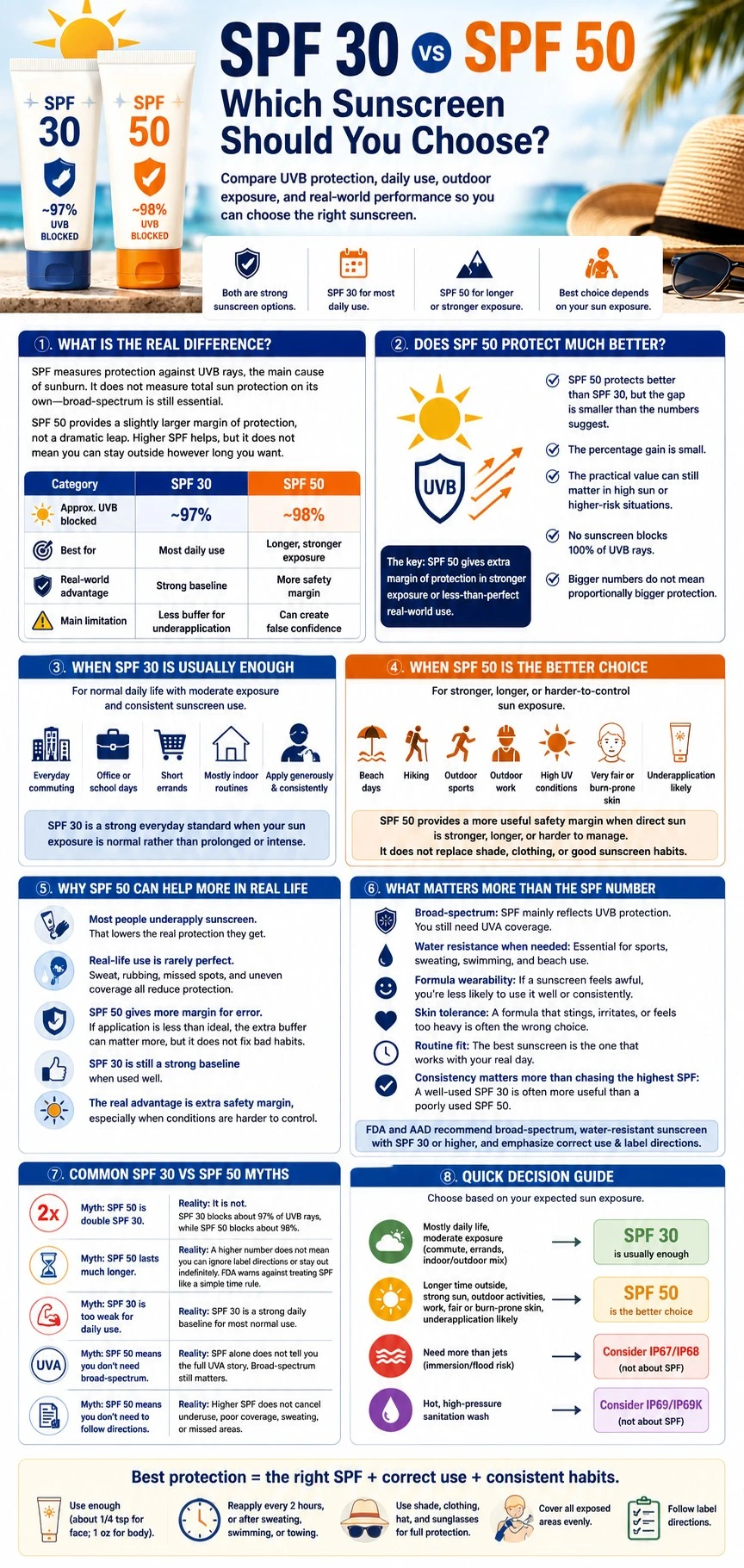
The main difference is that SPF 50 gives a slightly larger margin of protection, not a dramatic leap. FDA explains SPF as a measure tied to the amount of UV exposure required to cause sunburn on protected skin compared with unprotected skin, so it is not a simple “time in the sun” rule.[1] A higher SPF helps, but it does not mean you can stay outside however long you want.
Category | SPF 30 | SPF 50 |
|---|---|---|
Approx. UVB blocked | ~97% | ~98% |
Best for | Most daily use | Longer, stronger exposure |
Real-world advantage | Strong baseline | More safety margin |
Main limitation | Less buffer for underapplication | Can create false confidence |
Does SPF 50 Protect Much Better Than SPF 30?
SPF 50 protects better than SPF 30, but the gap is smaller than the numbers suggest. The main difference is not dramatic filtration on paper. It is the extra margin of protection SPF 50 can provide in stronger exposure or less-than-perfect real-world use.
- The percentage gain is small.
- The practical value can still matter in high sun or higher-risk situations.
- No sunscreen blocks 100% of UVB rays.
- Bigger numbers do not mean proportionally bigger protection.
When SPF 30 Is Usually Enough

SPF 30 is usually enough for normal daily life when sun exposure is moderate and sunscreen use is consistent. It is a strong baseline, not a weak option.
- Everyday commuting
- Office or school days
- Short errands
- Mostly indoor routines with normal incidental exposure
- Days when you can apply sunscreen generously and use it consistently
SPF 30 is a strong everyday standard when your sun exposure is normal rather than prolonged or intense.
When SPF 50 Is the Better Choice

SPF 50 is the better choice when sun exposure will be stronger, longer, or harder to control. This is where the extra margin of protection becomes more useful.
- Beach days
- Hiking
- Outdoor sports
- Outdoor work
- High UV conditions
- Very fair or burn-prone skin
- Times when underapplication is likely
SPF 50 gives a more useful safety margin when direct sun is stronger, longer, or harder to manage. It does not replace shade, clothing, or good sunscreen habits.
Why SPF 50 Can Help More in Real Life Than the Numbers Suggest
The jump from SPF 30 to SPF 50 looks small on paper, but real life is not lab testing. Most people do not apply sunscreen perfectly, evenly, or generously enough. That is where SPF 50 can help more than the 97% vs 98% headline suggests. FDA and other consumer guidance make clear that real protection depends on more than the number on the bottle.[2]
- Most people underapply sunscreen. That lowers the real protection they get.
- Real-life use is rarely perfect. Sweat, rubbing, missed spots, and uneven coverage all reduce protection.
- SPF 50 gives more margin for error: If application is less than ideal, the extra buffer can matter more, but it does not fix bad sunscreen habits.
- That does not mean SPF 30 is weak. SPF 30 is still a strong everyday baseline when used well.
- The real advantage is not magic. It is extra safety margin, especially when conditions are harder to control.
What Matters More Than the SPF Number Alone
SPF matters, but it is not enough by itself. A higher number does not guarantee better real-world protection if the sunscreen is the wrong fit for your skin, your routine, or the day you are actually having. AAD recommends broad-spectrum, water-resistant sunscreen with SPF 30 or higher[3], and FDA guidance also emphasizes real use, label directions, and full protection habits rather than overtrusting SPF alone.[2]
- Broad-spectrum: SPF mainly reflects UVB protection. You still need UVA coverage.
- Water resistance when needed: This matters most for sports, sweating, swimming, and beach use.
- Formula wearability: If a sunscreen feels awful, you are less likely to use it well or consistently.
- Skin tolerance: A formula that stings, irritates, or feels too heavy is often the wrong choice, even if the SPF number looks great.
- Routine fit: The best sunscreen is the one that works with your real day, not just the highest number on the shelf.
- Consistency matters more than chasing the highest SPF: A well-used SPF 30 is often more useful than a poorly used SPF 50.
If you want the full decision guide beyond SPF numbers, read our article on how to choose the right sunscreen.
Common SPF 30 vs SPF 50 Myths
A lot of confusion around SPF 30 vs SPF 50 comes from simple myths that sound practical but lead to bad decisions.
- Myth: SPF 50 is double SPF 30.
Reality: It is not. SPF 30 blocks about 97% of UVB rays, while SPF 50 blocks about 98%. - Myth: SPF 50 lasts much longer.
Reality: A higher number does not mean you can ignore label directions or stay out indefinitely. FDA explicitly warns against treating SPF like a simple time rule.[1] - Myth: SPF 30 is too weak for daily use.
Reality: SPF 30 is a strong daily baseline for most normal use. - Myth: SPF 50 means you do not need broad-spectrum.
Reality: SPF alone does not tell you the full UVA story. Broad-spectrum still matters. - Myth: SPF 50 means you do not need to follow label directions.
Reality: Higher SPF does not cancel underuse, poor coverage, sweating, or missed areas.


