


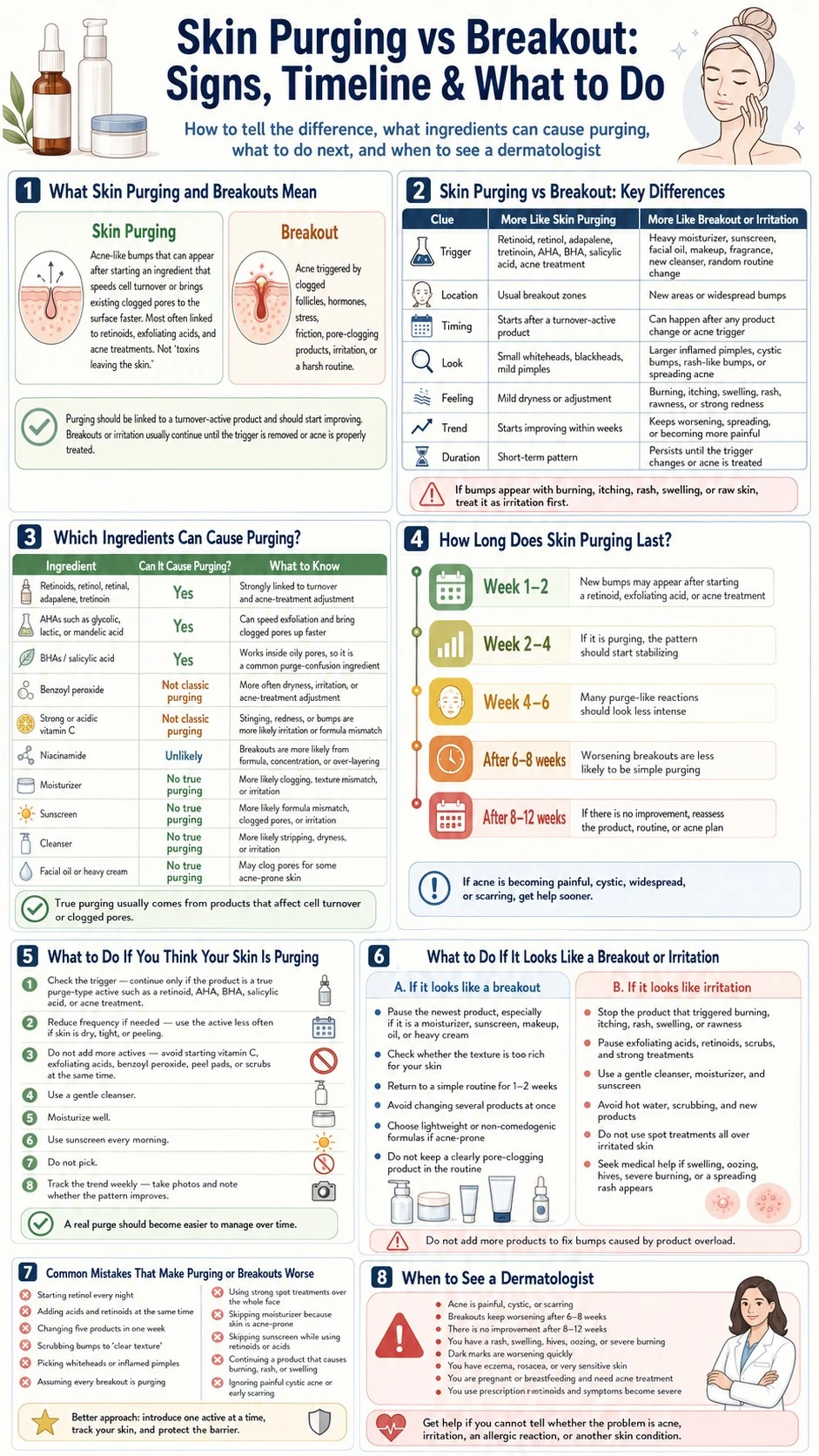
What Skin Purging and Breakouts Mean
Skin purging is a common skincare term, not a precise medical diagnosis. It describes acne-like bumps that can appear after starting an ingredient that affects cell turnover or helps bring existing clogged pores to the surface faster. [2]
Purging is most often discussed with retinoids, exfoliating acids, and acne treatments. It is not “toxins leaving the skin.” It also does not mean every new pimple is a good sign.
A breakout is different. Acne forms when hair follicles become clogged with oil and dead skin cells, leading to whiteheads, blackheads, pimples, or deeper inflamed bumps. [3] Triggers can include hormones, stress, friction, pore-clogging products, irritation, or an overly harsh routine.
The practical difference is this: purging should be linked to a turnover-active product and should start improving. A breakout or irritation tends to continue until the trigger is removed or the acne is properly treated.
Skin Purging vs Breakout: Key Differences
Use this table as a decision guide. One clue is not enough; the pattern matters.
| Clue | More Like Skin Purging | More Like Breakout or Irritation |
|---|---|---|
| Trigger | Retinoid, retinol, adapalene, tretinoin, AHA, BHA, salicylic acid, acne treatment | Heavy moisturizer, sunscreen, facial oil, makeup, fragrance, new cleanser, random routine change |
| Location | Usual breakout zones | New areas or widespread bumps |
| Timing | Starts after a turnover-active product | Can happen after any product change or acne trigger |
| Look | Small whiteheads, blackheads, mild pimples | Larger inflamed pimples, cystic bumps, rash-like bumps, or spreading acne |
| Feeling | Mild dryness or adjustment | Burning, itching, swelling, rash, rawness, or strong redness |
| Trend | Starts improving within weeks | Keeps worsening, spreading, or becoming more painful |
| Duration | Short-term pattern | Persists until the trigger changes or acne is treated |
If bumps appear with burning, itching, rash, swelling, or raw skin, treat it as irritation first. Do not force your skin through a product that is causing a strong reaction.
Which Ingredients Can Cause Purging?
True purging usually comes from products that affect cell turnover or clogged pores. Plain moisturizers, sunscreens, cleansers, and oils are more likely to cause formula mismatch, pore clogging, irritation, or over-layering.
| Ingredient or Product Type | Can It Cause Purging? | What to Know |
|---|---|---|
| Retinoids, retinol, retinal, adapalene, tretinoin | Yes | Strongly linked to turnover and acne-treatment adjustment. [4][5] |
| AHAs such as glycolic, lactic, or mandelic acid | Yes | Can speed exfoliation and bring clogged pores up faster. |
| BHAs / salicylic acid | Yes | Works inside oily pores, so it is a common purge-confusion ingredient. |
| Benzoyl peroxide | Not classic purging | More often dryness, irritation, or acne-treatment adjustment. |
| Strong or acidic vitamin C | Not classic purging | Stinging, redness, or bumps are more likely irritation or formula mismatch. |
| Niacinamide | Unlikely | Breakouts are more likely from formula, concentration, or over-layering. |
| Moisturizer | No true purging | More likely clogging, texture mismatch, or irritation. |
| Sunscreen | No true purging | More likely formula mismatch, clogged pores, or irritation. |
| Cleanser | No true purging | More likely stripping, dryness, or irritation. |
| Facial oil or heavy cream | No true purging | May clog pores for some acne-prone skin. |
The key question is whether the new product can speed turnover or help clear clogged pores.
How Long Does Skin Purging Last?
Purging should have a beginning, a rough adjustment period, and then a clear trend toward calmer skin.
A practical timeline:
- Week 1–2: new bumps may appear after starting a retinoid, exfoliating acid, or acne treatment.
- Week 2–4: if it is purging, the pattern should start stabilizing.
- Week 4–6: many purge-like reactions should look less intense.
- After 6–8 weeks: worsening breakouts are less likely to be simple purging.
- After 8–12 weeks: if there is no improvement, reassess the product, routine, or acne plan.
Acne treatments can take time to show full results, but that does not mean every worsening breakout should be tolerated for months. [4] If the acne is becoming painful, cystic, widespread, or scarring, get help sooner.
What to Do If You Think Your Skin Is Purging

If the pattern fits purging, you may not need to stop the product immediately. Reduce skin stress while giving the active enough time to work.
Use these steps:
- Check the trigger. Continue only if the product is a true purge-type active, such as a retinoid, AHA, BHA, salicylic acid, or acne treatment.
- Reduce frequency if needed. If your skin is dry, tight, or peeling, use the active less often instead of pushing through every night.
- Do not add more actives. Avoid starting vitamin C, exfoliating acids, benzoyl peroxide, peel pads, or scrubs at the same time.
- Use a gentle cleanser. Avoid harsh foaming cleansers, exfoliating cleansers, and cleansing brushes while your skin adjusts.
- Moisturize well. A simple moisturizer can reduce dryness and help you tolerate acne or turnover-active products better.
- Use sunscreen every morning. Retinoids and acids can make the routine less forgiving if you skip sun protection.
- Do not pick. Picking increases the risk of scabs, irritation, scars, and post-acne marks.
- Track the trend weekly. Take photos in the same light, note where bumps appear, and watch whether the pattern improves.
A real purge should become easier to manage over time. If your skin keeps getting worse, reassess the product.
What to Do If It Looks Like a Breakout or Irritation

If the pattern does not fit purging, do not keep using the product just because you hope the reaction means it is “working.”
If it looks like a breakout:
- Pause the newest product, especially if it is a moisturizer, sunscreen, makeup, oil, or heavy cream.
- Check whether the texture is too rich for your skin.
- Return to a simple routine for one to two weeks.
- Avoid changing several products at once.
- Choose lightweight or non-comedogenic formulas if you are acne-prone.
- Give real acne treatments enough time, but do not keep a clearly pore-clogging product in the routine.
If it looks like irritation:
- Stop the product that triggered burning, itching, rash, swelling, or rawness.
- Pause exfoliating acids, retinoids, scrubs, and strong treatments.
- Use a gentle cleanser, moisturizer, and sunscreen.
- Avoid hot water, scrubbing, and new products.
- Do not use spot treatments all over irritated skin.
- Seek medical help if swelling, oozing, hives, severe burning, or spreading rash appears.
Do not add more products to fix bumps that were caused by product overload.
Common Mistakes That Make Purging or Breakouts Worse
Purging and breakout problems often get worse when the routine becomes too crowded.
Avoid these mistakes:
- Starting retinol every night.
- Adding acids and retinoids at the same time.
- Changing five products in one week.
- Scrubbing bumps to “clear texture.”
- Picking whiteheads or inflamed pimples.
- Assuming every breakout is purging.
- Using strong spot treatments over the whole face.
- Skipping moisturizer because your skin is acne-prone.
- Skipping sunscreen while using retinoids or acids.
- Continuing a product that causes burning, rash, or swelling.
- Ignoring painful cystic acne or early scarring.
A better approach is simple: introduce one active at a time, track your skin, and protect the barrier.
When to See a Dermatologist
Some acne and product reactions need professional support, especially if the skin is painful, inflamed, or scarring.
See a dermatologist if:
- Acne is painful, cystic, or scarring.
- Breakouts keep worsening after 6–8 weeks.
- There is no improvement after 8–12 weeks.
- You have a rash, swelling, hives, oozing, or severe burning.
- Dark marks are worsening quickly.
- You have eczema, rosacea, or very sensitive skin.
- You are pregnant or breastfeeding and need acne treatment.
- You use prescription retinoids and symptoms become severe.
Get help if you cannot tell whether the problem is acne, irritation, an allergic reaction, or another skin condition.
Final Thoughts
Skin purging is linked to turnover-active ingredients and should improve with time. A breakout or irritation is more likely if bumps appear in new areas, keep worsening, or come with burning, itching, rash, swelling, or strong redness.
Judge by the trigger, location, timeline, and how your skin feels. Continue only when the pattern fits purging and your skin is tolerating the product. Stop and simplify if the reaction looks like irritation or a true breakout.
FAQs About Skin Purging vs Breakouts
How do I know if my skin is purging or breaking out?
Look at the trigger, location, timeline, and irritation signs. Purging is more likely after starting a retinoid, AHA, BHA, salicylic acid, or acne treatment. It usually appears in your normal breakout areas and should improve within weeks. A breakout is more likely if bumps appear in new areas, keep spreading, or follow a heavy or irritating product.
What does skin purging look like?
Skin purging often looks like small whiteheads, blackheads, or mild pimples in areas where you already tend to break out. It may happen after starting a turnover-active product. It should not look like a spreading rash, severe swelling, raw skin, or painful cystic acne.
How long does skin purging last?
Purging often improves within several weeks. If the pattern is still getting worse after 6–8 weeks, it is less likely to be simple purging. If there is no improvement after 8–12 weeks, reassess the product or speak with a dermatologist.
Should I stop the product if my skin is purging?
You do not always need to stop if the pattern clearly fits purging and irritation is mild. Reduce frequency, moisturize well, and avoid adding other actives. Stop the product if you get severe burning, rash, swelling, raw skin, or worsening painful acne.
Can moisturizer or sunscreen cause purging?
No, moisturizers and sunscreens do not usually cause true purging because they do not speed skin cell turnover or clear clogged pores in the same way retinoids or acids can. If they cause bumps, the issue is more likely pore clogging, irritation, or formula mismatch.
Can niacinamide cause purging?
Niacinamide is unlikely to cause true purging. If you break out after starting niacinamide, check the formula base, concentration, fragrance, and whether you are layering too many niacinamide products. Irritation or product mismatch is more likely than purging.
Is burning or itching part of purging?
Mild dryness or light adjustment can happen with retinoids or acids. Burning, itching, rash, swelling, rawness, or strong redness is more likely irritation or an allergic-type reaction. Do not treat those symptoms as normal purging.
Can purging cause cystic acne?
True purging usually looks like smaller bumps or pimples in normal breakout areas. Painful cystic acne, deep lumps, or acne that is spreading and worsening should not be ignored. Reassess the product and consider seeing a dermatologist.
Sources
[1] Banner Health. How to Tell If Your Skin Is Breaking Out or Purging
[2] MedicalNewsToday. Skin Purging: Pictures, Causes, and Treatments
[3] Mayo Clinic. Acne: Symptoms and Causes
[4] American Academy of Dermatology. Acne: Diagnosis and Treatment
[5] Health.com. 6 Things Dermatologists Wish Everyone Knew Before Using Retinol


