

Azelaic acid and niacinamide overlap, but they are not interchangeable. Azelaic acid is a dicarboxylic acid with anti-inflammatory, antimicrobial, pore-normalizing, and pigment-regulating activity. [1] Niacinamide, a form of vitamin B3, mainly supports barrier function, moderates visible oiliness and redness, and can gradually improve uneven tone. [4]
The right choice depends on the problem you most want to solve. If several concerns overlap, you may not need to choose only one.
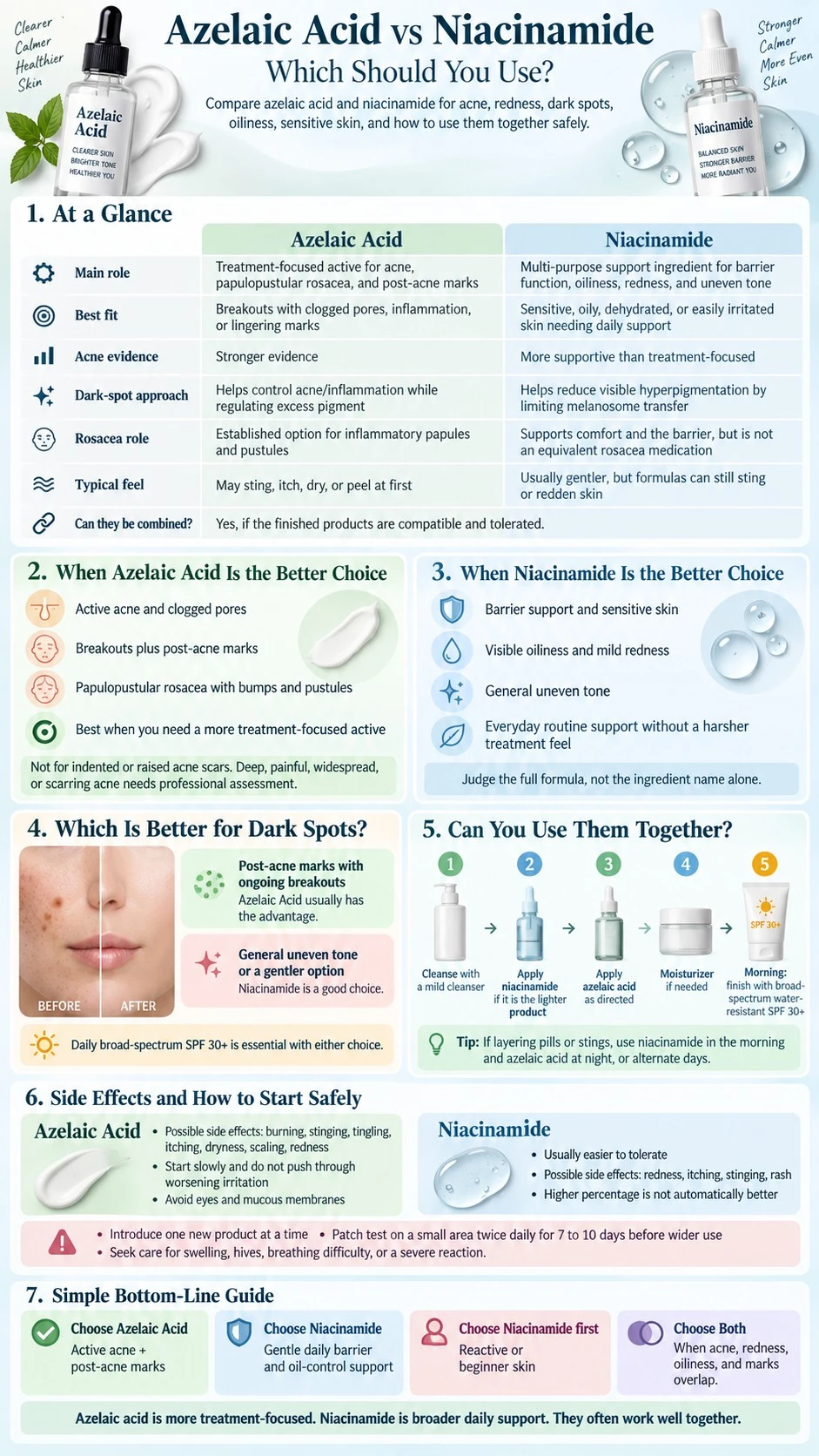
Azelaic Acid vs Niacinamide at a Glance
| Comparison | Azelaic Acid | Niacinamide |
|---|---|---|
| Main role | Treatment-focused active for acne, papulopustular rosacea, and post-inflammatory marks | Multi-purpose support ingredient for barrier function, oiliness, redness, and uneven tone |
| Best fit | Breakouts with clogged pores, inflammation, or lingering marks | Sensitive, oily, dehydrated, or easily irritated skin needing daily support |
| Acne evidence | Stronger; included in acne treatment guidance and supported by moderate-quality evidence | More limited as a stand-alone acne treatment; better viewed as supportive care |
| Dark-spot approach | Helps control the breakout or inflammation that creates marks while regulating excess pigment | Can reduce visible hyperpigmentation by limiting melanosome transfer |
| Rosacea role | Established option for inflammatory papules and pustules | May support comfort and the barrier, but is not an equivalent rosacea medication |
| Typical feel | Can sting, itch, dry, or peel, especially at first | Usually gentle, but strong or complex formulas can still sting or redden skin |
| Can they be combined? | Yes, if the finished products are compatible and your skin tolerates the routine | Yes; often used as the lower-irritation supporting step |
The most important evidence gap is acne. A systematic review found moderate-quality evidence for azelaic acid but low- to very-low-quality evidence for several other topicals, including nicotinamide; no nicotinamide studies in that review measured the main participant-rated acne outcome. [3] Niacinamide may still help an oily or redness-prone routine, but it should not be presented as equally proven for clearing acne.
For a deeper look at each ingredient, read the ZICAIL guides to azelaic acid and niacinamide.
When Azelaic Acid Is the Better Choice
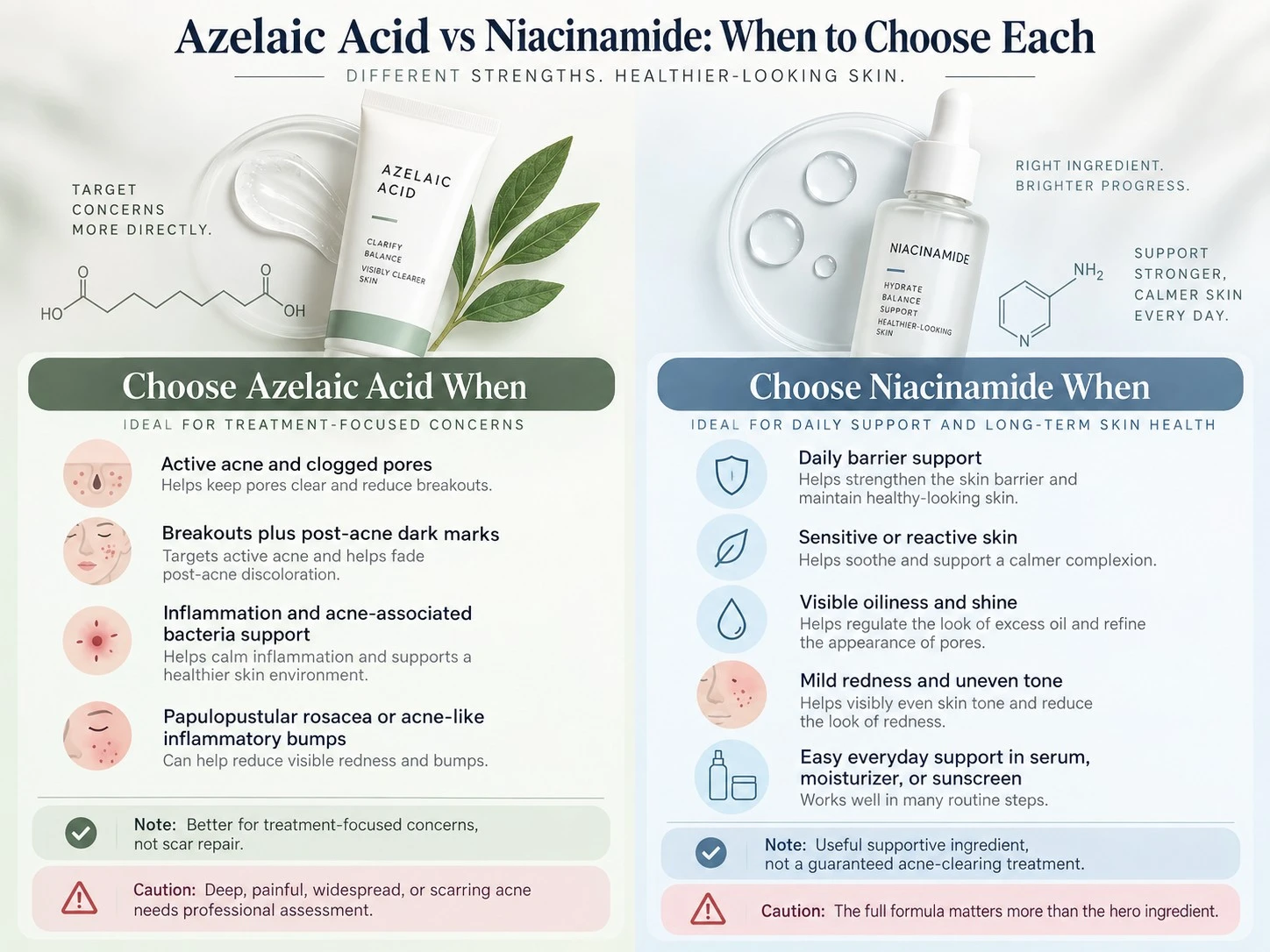
Azelaic acid is usually the more logical choice when your primary concern is a skin condition rather than general cosmetic support.
Active Acne and Clogged Pores
Azelaic acid helps open and keep pores clear, acts against acne-associated bacteria, and reduces inflammation. The American Academy of Dermatology also notes that it can treat the dark spots that remain after acne clears. [2]
This combination makes it particularly useful when you have both new breakouts and flat brown or gray post-acne marks. It will not rebuild indented or raised scars, however. If you are unsure whether you are dealing with discoloration or a textural scar, see Acne Scars vs Dark Spots.
Deep, painful, widespread, or scarring acne needs professional assessment. Repeatedly adding cosmetic actives can delay a treatment plan that addresses the severity and causes of the acne.
Rosacea-Related Bumps and Redness
Prescription 15% azelaic acid gel is indicated in the United States for inflammatory papules and pustules of mild to moderate rosacea. Its label also makes an important distinction: effectiveness for redness without papules or pustules has not been established. [5]
Choose azelaic acid when a clinician has identified papulopustular rosacea or when acne-like inflammatory bumps are the main feature. Persistent flushing, visible vessels, eye symptoms, or unexplained facial redness may need a different diagnosis and treatment. Niacinamide can support a gentle routine, but it should not replace medical evaluation.
When Niacinamide Is the Better Choice
Niacinamide is often the better first move when the goal is to make an everyday routine more supportive without adding a treatment-focused active.
Barrier Support and Sensitive Skin
Topical niacinamide is generally well tolerated and has evidence across several cosmetic uses, including barrier support, visible redness, pigmentation, and signs of skin aging. [4] That makes it practical for skin that feels dry, tight, or reactive, especially when a moisturizer or serum delivers it in a simple formula.
Sensitive skin can still react to a niacinamide product. Fragrance, solvents, preservatives, multiple actives, or a high-concentration formula may be the real source of burning or redness. Judge the finished product, not the featured ingredient alone.
Oiliness and General Uneven Tone
Niacinamide suits people whose concerns are shine, the appearance of pores, mild redness, and uneven tone rather than persistent inflammatory acne. It can improve how oily skin looks without acting like an exfoliating acid, and improved barrier function may make the rest of a routine easier to tolerate.
It does not permanently shrink pores or guarantee acne clearance. Think of it as a versatile support ingredient: useful in a moisturizer, sunscreen, or serum, but not automatically the central treatment for every concern.
Which Is Better for Dark Spots?
For post-acne hyperpigmentation with ongoing breakouts, azelaic acid usually has the advantage because it can address both the acne and the pigment left behind. This may reduce the cycle in which each new lesion creates another mark. [2]
Niacinamide is a reasonable choice for general uneven tone or when you need a gentler, easier-to-layer product. Clinical studies have found reduced hyperpigmentation with topical niacinamide, and laboratory work suggests that it limits the transfer of pigment-containing melanosomes into surrounding skin cells. [6]
Neither ingredient can identify the cause of a dark patch. Melasma, sun spots, post-inflammatory hyperpigmentation, and raised or indented acne scars require different expectations. Review ZICAIL’s Hyperpigmentation Guide if the pattern is unclear, and seek dermatology advice for a new, changing, or unusual spot.
Daily sun protection matters whichever active you choose. Use a broad-spectrum, water-resistant sunscreen with SPF 30 or higher; UV exposure can keep discoloration visible and undermine progress. [7]
Can You Use Azelaic Acid and Niacinamide Together?
Yes. There is no standard ingredient conflict that requires azelaic acid and niacinamide to be separated. The limiting factor is usually the tolerance and texture of the two finished formulas, not a harmful chemical interaction.
Using both can make sense when acne, redness, oiliness, barrier weakness, and post-acne marks overlap. Niacinamide supports the routine, while azelaic acid does more of the treatment-focused work. More layers are not automatically more effective, however.
A Simple Routine
- Cleanse with a mild, non-scrubbing cleanser and pat the skin dry.
- Apply a thin niacinamide serum if it is the lighter product. If your niacinamide is in a moisturizer, save it for the moisturizing step.
- Apply azelaic acid according to the exact product label or prescription directions.
- Finish with moisturizer when needed.
- In the morning, apply broad-spectrum, water-resistant SPF 30 or higher.
Texture can change the order. A thin azelaic gel may go before a thicker niacinamide cream, so follow product directions and generally move from lighter to richer textures. If layering pills or stings, use niacinamide in the morning and azelaic acid at night, or alternate days. The ZICAIL guide to using two serums together explains how to simplify crowded routines.
Side Effects and How to Start Safely
Introduce only one new product at a time. The American Academy of Dermatology recommends testing a skincare product on a small area twice daily for seven to ten days before wider use, following the product’s normal contact time. [8]
Azelaic Acid Side Effects
Burning, stinging, tingling, itching, dryness, scaling, and redness can occur, especially during the first weeks. Prescription labeling also advises avoiding the eyes and mucous membranes and stopping for persistent severe irritation or hypersensitivity. Rare reports of hypopigmentation mean that clearly lighter patches should be assessed, particularly on darker complexions. [5]
Start at the frequency stated on the product, but do not push through worsening burning, tenderness, or peeling. Reduce other exfoliants and astringents, add a bland moisturizer, and seek medical advice if the reaction is severe or does not settle.
Niacinamide Side Effects
Niacinamide is usually easier to tolerate, yet redness, itching, stinging, or a rash can still occur. [4] A stronger percentage is not automatically more effective, and published results from a specific 2% or 5% formula do not prove that every higher-strength serum will work better. [6]
Begin with a simple formula and moderate frequency, especially if your routine already contains retinoids, exfoliating acids, or benzoyl peroxide. Stop and seek care for swelling, hives, trouble breathing, or a severe reaction.
FAQs About Azelaic Acid vs Niacinamide
Can You Use Azelaic Acid and Niacinamide Every Day?
Many products are intended for daily use, and some prescription azelaic acid products are labeled for twice-daily application. Follow the exact label. Begin one product at a time and use a lower frequency if dryness, stinging, or redness persists.
Which Ingredient Is Better for Sensitive Skin?
Niacinamide is usually the gentler first choice for barrier support, but the formula matters more than the ingredient name alone. Azelaic acid can also suit sensitive or rosacea-prone skin, although initial stinging and dryness are more common. Patch test and avoid adding several actives at once.
Which One Helps Post-Acne Dark Spots More?
Azelaic acid is usually more useful when dark spots occur alongside active acne because it addresses both problems. Niacinamide can also gradually improve hyperpigmentation and may be easier to use when the skin is dry or reactive. Sunscreen and breakout control remain essential.
Do Azelaic Acid or Niacinamide Cause Purging?
Neither ingredient should automatically be blamed for “purging.” Azelaic acid can change follicular cell buildup, but new bumps accompanied by burning, itching, or peeling may reflect irritation. Niacinamide is not an exfoliant and should not cause a true purge. Stop or reduce the new product if the pattern is widespread, uncomfortable, or keeps worsening.
Sources
[1] King S, et al. A Systematic Review to Evaluate the Efficacy of Azelaic Acid in the Management of Acne, Rosacea, Melasma and Skin Aging
[2] American Academy of Dermatology. Acne: Diagnosis and Treatment
[4] Ong RR, Goh CF. Niacinamide: A Review on Dermal Delivery Strategies and Clinical Evidence
[5] DailyMed. Azelaic Acid Gel, 15%: Prescribing Information
[6] Hakozaki T, et al. The Effect of Niacinamide on Reducing Cutaneous Pigmentation and Suppression of Melanosome Transfer
[7] American Academy of Dermatology. How to Apply Sunscreen
[8] American Academy of Dermatology. How to Test Skin Care Products


