

What to Decide Before Starting a Sunscreen Formula
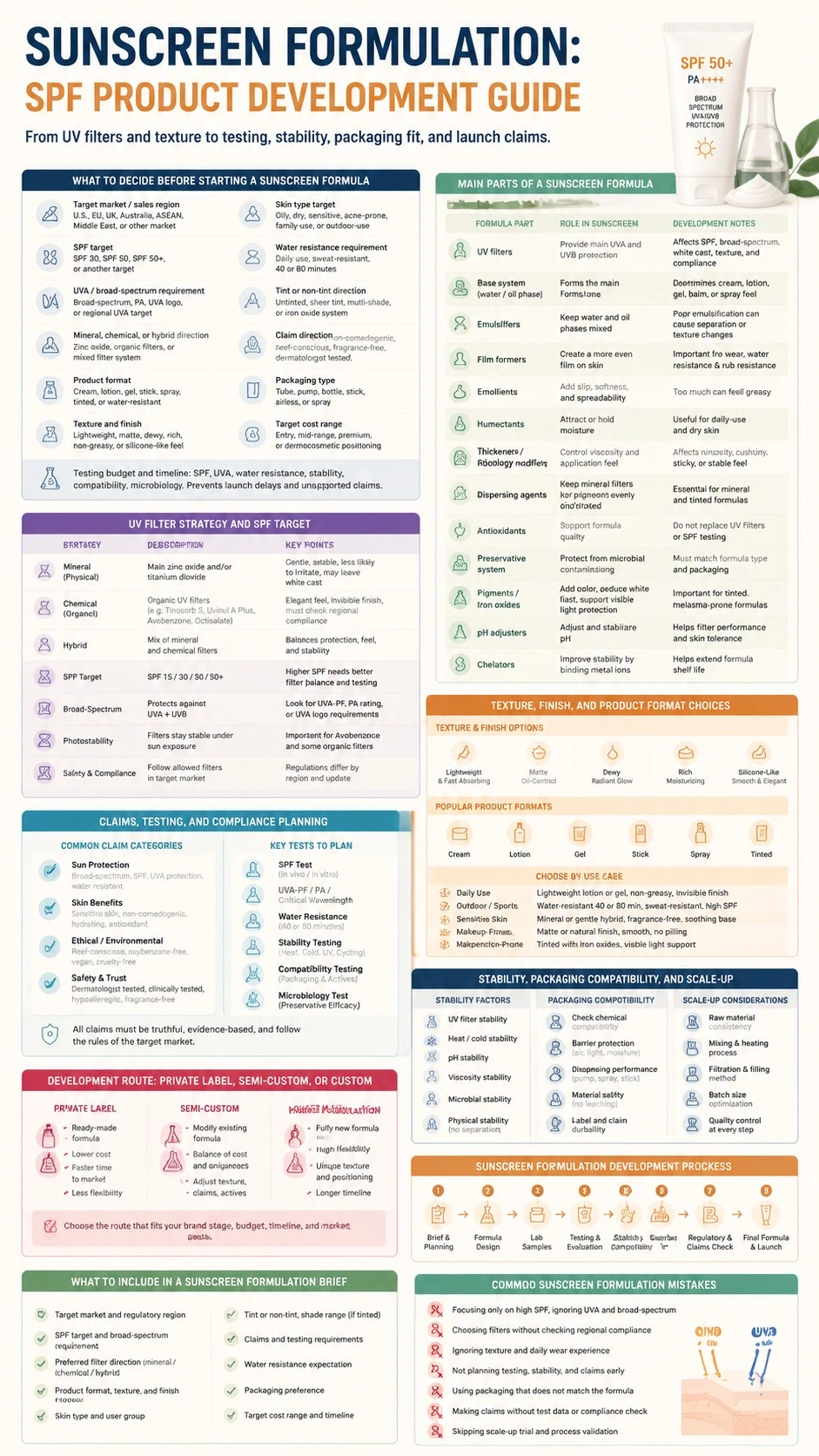
A good sunscreen brief should not start and end with “I want SPF 50.” Before sampling, the product team should define where the product will be sold, how it will be used, what claims it needs, what texture the target customer expects, and what testing budget is realistic. These decisions shape the formula, timeline, cost, packaging, and launch path.
| Decision | What to Define | Why It Matters |
|---|---|---|
| Target market / sales region | U.S., EU, UK, Australia, ASEAN, Middle East, or other market | Sunscreen filters, labels, and claims can vary by region |
| SPF target | SPF 30, SPF 50, SPF 50+, or another target | Affects filter system, testing, texture, and cost |
| UVA / broad-spectrum requirement | Broad-spectrum, PA, UVA logo, or regional UVA target | Helps avoid a formula that protects mainly against UVB |
| Mineral, chemical, or hybrid direction | Zinc oxide, organic filters, or mixed filter system | Impacts white cast, feel, claim direction, and compliance |
| Product format | Cream, lotion, gel, stick, spray, tinted, or water-resistant product | Changes texture, packaging, stability, and use experience |
| Texture and finish | Lightweight, matte, dewy, rich, non-greasy, or silicone-like feel | Strongly affects repeat purchase and daily use |
| Skin type target | Oily, dry, sensitive, acne-prone, family-use, or outdoor-use | Guides base system, fragrance direction, and comfort testing |
| Water resistance requirement | Daily use, sweat-resistant positioning, 40 or 80 minutes | Requires early testing and claim planning |
| Tint or non-tint direction | Untinted, sheer tint, multi-shade, or iron oxide system | Affects pigments, shade matching, white cast, and visible light claims |
| Claim direction | Sensitive skin, non-comedogenic, reef-conscious, fragrance-free, dermatologist tested | Claims must match evidence and target market rules |
| Packaging type | Tube, pump, bottle, stick, airless, or spray | Formula must remain stable and usable in the chosen pack |
| Target cost range | Entry, mid-range, premium, or dermocosmetic positioning | Controls filter choices, texture system, actives, and packaging |
| Testing budget and timeline | SPF, UVA, water resistance, stability, compatibility, microbiology | Prevents launch delays and unsupported claims |
For early cost planning, read How Much Does It Cost to Launch a Sunscreen Brand?
Main Parts of a Sunscreen Formula
A sunscreen formula is a full performance system, not a simple mix of UV filters. Each part affects protection, skin feel, spreadability, stability, cost, production, and consumer experience. Buyers do not need to know exact percentages, but they should understand what each part does before approving samples.
| Formula Part | Role in Sunscreen | Development Notes |
|---|---|---|
| UV filters | Provide the main UVA and UVB protection | Filter choice affects SPF, broad-spectrum performance, white cast, texture, and regional compliance |
| Water / oil phase or base system | Forms the main structure of the product | Determines whether the sunscreen feels like a cream, lotion, gel, balm, or spray |
| Emulsifiers | Help water and oil phases stay mixed | Poor emulsification can lead to separation, instability, or texture changes |
| Film formers | Help the sunscreen form a more even layer on skin | Important for wear, water resistance, rub resistance, and even coverage |
| Emollients | Add slip, softness, and spreadability | Can make sunscreen feel elegant, but too much can feel greasy |
| Humectants | Help attract or hold moisture | Useful for daily-use and dry-skin formulas, but must fit the texture goal |
| Thickeners / rheology modifiers | Control viscosity, flow, and application feel | Affect whether the product feels runny, cushiony, sticky, or stable |
| Dispersing agents | Help keep mineral filters or pigments evenly distributed | Important for mineral and tinted sunscreen formulas |
| Antioxidants | Support formula quality and marketing direction | They do not replace UV filters or SPF testing |
| Preservative system | Helps protect the formula from microbial contamination | Must match the formula type, packaging, and target market requirements |
| Pigments / iron oxides for tinted products | Add color and may support visible light protection | Important for tinted formulas, shade matching, and pigmentation-prone positioning |
| Fragrance or fragrance-free direction | Affects sensory profile and skin comfort | Fragrance-free is often preferred for sensitive-skin or dermocosmetic positioning |
For deeper ingredient evaluation, use Sunscreen Ingredient Guide: Safe, Harmful & What to Choose. For the basic protection mechanism, see How Does Sunscreen Work? SPF, UVA, UVB, and Filters.
UV Filter Strategy and SPF Target
UV filter strategy affects SPF efficiency, UVA coverage, white cast, texture, cost, testing route, and market compliance. The SPF number matters, but it is not the only sign of a strong formula. A good SPF 30 or SPF 50 product also needs stable filters, balanced UVA protection, acceptable skin feel, and supportable claims.
Sales region should be confirmed before filter strategy is finalized. Different markets allow different sunscreen active ingredients and use different sunscreen rules. Filter options and formulation approaches also continue to change. For example, the FDA added bemotrizinol to the U.S. OTC sunscreen monograph in 2026, while EU sunscreen products follow cosmetic product rules and UVA logo expectations. [3][4][6]
| Strategy | Best Fit | Main Trade-Off |
|---|---|---|
| Mineral sunscreen | Sensitive-skin concepts, mineral-led positioning, family-use formulas | Can create white cast, thicker texture, or higher pigment load challenges |
| Chemical sunscreen | Lightweight daily SPF, clear finish, elegant skin feel | Filter availability and claim wording depend strongly on the sales region |
| Hybrid sunscreen | Balanced SPF efficiency, texture, and reduced white cast | More complex filter compatibility and stability planning |
| Tinted mineral / hybrid sunscreen | White cast control, tone-evening, pigmentation-prone positioning | Needs shade matching, pigment dispersion, and possible visible light support planning |
| High-SPF daily sunscreen | SPF 50 / SPF 50+ market positioning | Can increase filter load, texture challenges, testing cost, and formula complexity |
| Water-resistant sunscreen | Beach, outdoor sport, sweat, or active-use positioning | Requires film-forming strategy, water-resistance testing, and stronger claim control |
The practical decision is not “mineral or chemical is better.” It is which filter system can deliver the target SPF, UVA performance, texture, claims, cost, and region-specific compliance.
For related context, read Mineral vs Chemical Sunscreen: Which Should You Use?, What Is Broad Spectrum Sunscreen and Why It Matters, and SPF 30 vs SPF 50: Which Sunscreen Should You Choose.
Texture, Finish, and Product Format Choices
Texture affects how much sunscreen people apply, whether they reapply, how it layers with skincare or makeup, and whether they buy it again. Product format also affects formulation structure, packaging, filling, stability, and claim direction. The same SPF target can feel very different as a cream, gel, lotion, stick, spray, tinted product, or water-resistant formula.
| Format or Texture | Common Positioning | Formulation Impact |
|---|---|---|
| Cream sunscreen | Moisturizing daily SPF, dry skin, family-use concepts | Needs richer emollient balance, stable viscosity, and good spreadability |
| Gel sunscreen | Lightweight SPF, oily skin, humid climates, fresh finish | Requires clean sensory feel without tackiness, drying, or pilling |
| Lotion sunscreen | Everyday face and body SPF, broad market use | Must balance spread, absorption, cost, and packaging flexibility |
| Stick sunscreen | Portable reapplication, outdoor use, targeted areas | Needs solid structure, glide, payoff, and heat stability |
| Spray sunscreen | Body SPF, fast application, active lifestyle | Requires spray compatibility, even delivery, and strict claim control |
| Tinted sunscreen | White cast control, tone-evening, light coverage | Needs pigment dispersion, shade matching, and transfer control |
| Water-resistant sunscreen | Beach, sport, sweat, swimming, outdoor activity | Needs film formers, water-resistance testing, and a durable skin feel |
| Mineral-led / reef-conscious concept | Mineral positioning, reef-conscious claims, sensitive-skin direction | Needs careful claim wording, white cast control, and texture refinement |
A good format decision starts with use case, not trend. A premium facial sunscreen may need elegant dry-down and makeup compatibility. A beach sunscreen needs durability and reapplication comfort. A family body sunscreen needs cost control, spreadability, and stable packaging.
For related reading, see Gel vs Cream Sunscreen: Which One Is Better for You?, Tinted vs Untinted Sunscreen: Which Should You Use?, and Water-Resistant vs Waterproof Sunscreen: The Truth.
Claims, Testing, and Compliance Planning
Claims should be planned before sampling, not added after the formula is finished. Sunscreen claims depend on formula design, test methods, evidence, wording, and sales region. A claim that sounds simple in marketing can require specific testing, specific label language, or a different formulation route.
| Claim or Target | What It Requires | Buyer Risk If Ignored |
|---|---|---|
| SPF 30 / SPF 50 | SPF testing using the required or accepted route for the target market | Product may not support the planned SPF label |
| Broad spectrum | UVA and UVB performance evidence | Formula may focus too much on UVB and miss UVA expectations |
| UVA / PA / UVA logo | Region-specific UVA testing and label rules | Product may not be suitable for EU, Asian, or multi-market positioning |
| Water resistant 40 / 80 minutes | Water-resistance testing and matching label wording | “Waterproof” or unsupported water claims can create compliance risk |
| Sensitive skin | Gentle formula direction and supportable wording | Claim can feel weak or risky if fragrance, irritation, or testing is not considered |
| Non-comedogenic | Formula design and suitable testing or evidence | Acne-prone positioning may lack support |
| Fragrance-free | No added fragrance and careful raw material review | “Fragrance-free” may be challenged if masking fragrance or aroma materials are present |
| Tinted / visible light support | Pigment system, often iron oxides, and careful claim wording | A tint alone may not support visible light claims |
| Reef-safe / reef-conscious | Careful ingredient selection and cautious wording | “Reef safe” can be too absolute and difficult to prove |
| Dermatologist tested | Actual dermatologist testing or evaluation route | Claim becomes weak if used as pure marketing language |
| Suitable for babies / kids | Market-specific rules, safety review, and gentle formula design | Higher-risk claim if testing, age wording, or regional rules are unclear |
Development caution: Do not approve sunscreen claims before confirming the testing route, claim wording, sales region, and evidence. A formula that is acceptable for one market may not be label-ready for another. This is especially important for SPF level, broad-spectrum claims, UVA labels, water resistance, sensitive-skin positioning, and reef-conscious language.
For related buyer decisions, read What SPF Means in Sunscreen and Which Number to Choose and What Is Reef Safe Sunscreen? Ingredients and Labels.
Stability, Packaging Compatibility, and Scale-Up
A sunscreen sample that feels good in the lab is not automatically ready for launch. Formulation development also needs stability checks, packaging compatibility, and scale-up review. Packaging is not a formula ingredient, but it affects whether the formula can be filled, shipped, stored, dispensed, and used consistently.
Key checks usually include:
Heat, cold, and light stability: The formula should stay consistent under realistic storage and transport conditions.
UV filter dispersion and settling risk: Filters and pigments need to remain evenly distributed, especially in mineral or tinted formulas.
Emulsion separation: Creams, lotions, and fluid emulsions should not split, oil out, or form visible layers.
Viscosity change after storage: A sunscreen that becomes too thick, too thin, grainy, or stringy may create filling and use problems.
pH drift, where relevant: Some formulas need pH monitoring to support stability, skin comfort, and preservative performance.
Preservative effectiveness: The preservation system must fit the formula type, packaging, and expected use pattern.
Packaging compatibility: Tubes, pumps, bottles, sticks, and sprays can all affect formula flow, dispensing, and long-term stability.
Leakage, staining, clogging, or transfer risk: These issues can damage customer experience even when the formula feels good at first.
Pilot batch performance: A formula that works in a small lab sample still needs to behave well in a larger batch.
Production batch consistency: Texture, shade, viscosity, scent, and fill weight should remain consistent across batches.
Filling, sealing, and transport stress: The formula and packaging must survive production handling and shipping.
For packaging decisions, read Sunscreen Packaging Guide: Tubes, Bottles, Pumps & More.
Development Route: Private Label, Semi-Custom, or Custom
Not every sunscreen project needs a formula built from zero. The right development route depends on launch timeline, differentiation needs, testing budget, cost target, and how much control the brand wants over texture, claims, packaging, and user experience.
Private label: The fastest route. It uses an existing or pre-developed base formula, so sampling and launch planning are easier. The trade-off is lower uniqueness and less control over the final formula.
Semi-custom: A practical middle route. It adjusts texture, fragrance, tint, actives, packaging, or claim direction on a proven base. This can reduce risk while still giving the product a stronger brand fit.
Custom formulation: The strongest route for differentiation. It gives more control over filter strategy, skin feel, finish, claims, and positioning, but it usually needs more sampling, testing, cost planning, and development time.
The best route is not always the most customized one. Private label can work well for a fast launch, while custom formulation makes more sense when the brand needs a clear product advantage.
For deeper comparison, read Private Label vs Custom Sunscreen: Which Is Better?
Sunscreen Formulation Development Process
A mature sunscreen project should start with a clear brief, not random sample selection. Clear goals help control reformulation, testing delays, claim changes, packaging mistakes, and cost drift.
Define market, user, SPF target, and price position. Confirm where the product will be sold, who it is for, and what price tier it needs to support.
Confirm filter strategy and claim direction. Decide whether the product should be mineral, chemical, hybrid, tinted, water-resistant, daily-use, or outdoor-focused.
Build the formulation brief. Include SPF target, texture, finish, claims, packaging direction, cost range, benchmarks, and launch timeline.
Develop lab samples. The first samples should test the main product direction, not every possible variation.
Review texture, finish, scent, shade, and application feel. Check whether the formula matches the intended user experience.
Check packaging direction early. A formula that feels good may still fail in the wrong tube, pump, bottle, stick, or spray format.
Run stability and compatibility checks. Confirm the formula can remain stable and usable under realistic storage and handling conditions.
Arrange SPF, UVA, or water-resistance testing where needed. Testing should match the claim and sales region.
Confirm packaging, artwork, and claim wording. Label claims should match the evidence and regulatory direction.
Produce a pilot batch if needed. This helps check whether the formula performs well beyond lab scale.
Move to bulk production and QC release. Final production should include batch consistency, appearance, odor, texture, filling, and release checks.
For broader planning, read How to Start a Sunscreen Brand: Formula, Testing & Launch and How to Choose a Sunscreen Manufacturer for Your Brand.
What to Include in a Sunscreen Formulation Brief
A sunscreen formulation brief does not need to read like a chemist’s formula. It needs to clearly define the product you want to build. The more precise the brief, the easier it is for the manufacturer to develop samples, control cost, avoid unsupported claims, and reduce reformulation.
Use this checklist before starting sample development:
Target market and sales region: Define where the sunscreen will be sold because ingredient rules, labels, and claims vary by market.
SPF target: State whether you need SPF 30, SPF 50, SPF 50+, or another target.
UVA / broad-spectrum target: Clarify whether you need broad-spectrum, PA, UVA logo, or another regional UVA requirement.
Mineral, chemical, or hybrid direction: Choose the filter direction before texture and claim planning.
Product format: Define cream, gel, lotion, stick, spray, tinted, or water-resistant format.
Texture and finish: Describe the target feel, such as lightweight, matte, dewy, rich, non-greasy, or fast-absorbing.
Skin type target: Specify oily, dry, sensitive, acne-prone, family-use, or outdoor-use positioning.
Water resistance requirement: State whether water resistance is needed and whether 40 or 80 minutes is the target.
Tint or non-tint direction: Clarify untinted, sheer tint, multi-shade, or iron oxide direction.
Fragrance or fragrance-free direction: Define fragrance expectations early, especially for sensitive-skin positioning.
Packaging type: Include tube, bottle, pump, stick, spray, or airless packaging direction.
Target cost range: Give a realistic cost range so the formula and packaging match the business model.
Claims to include: List desired claims, such as broad spectrum, sensitive skin, non-comedogenic, or reef-conscious.
Claims to avoid: Exclude claims that may create regulatory, testing, or market risk.
Testing expectation: Confirm expected SPF, UVA, water resistance, stability, compatibility, or microbiology testing.
Benchmark samples: Share products that match the desired texture, finish, price, or positioning.
Target launch timeline: Give a realistic schedule for sampling, testing, packaging, and production.
Before contacting a supplier, read Questions to Ask a Sunscreen Manufacturer Before You Start.
Common Sunscreen Formulation Mistakes
Starting with SPF number only: SPF is important, but it is not the full product strategy. Define texture, claims, market region, cost, and user experience before sampling.
Ignoring sales-region regulations: A formula that works for one region may not be label-ready for another. Confirm the target market before choosing filters and claims.
Asking for too many claims in one product: More claims can mean more testing, higher cost, and longer development. Prioritize the claims that support your strongest market position.
Choosing texture before confirming claim direction: A lightweight texture can be harder to achieve if the product also needs high SPF, water resistance, mineral positioning, or rich moisturization.
Treating water resistance as a simple add-on: Water resistance affects film formers, skin feel, testing, and claim wording. It should be planned from the start.
Ignoring packaging compatibility: A good sample can still fail in the wrong tube, pump, bottle, stick, or spray format. Packaging fit should be checked early.
Approving shade or finish too early: Tint, white cast, dry-down, and transfer can change after stability testing or packaging review. Final approval should wait for compatibility checks.
Not budgeting for SPF, UVA, stability, or compatibility testing: Testing is part of sunscreen development, not an optional final step.
Copying competitor claims without evidence: Similar wording does not mean the same test support. Claims should match your formula and documentation.
Choosing the cheapest base without considering repeat purchase: Low cost can help launch, but poor feel, pilling, white cast, or weak reapplication comfort can hurt repeat sales.
Final Takeaway: What Makes a Good Sunscreen Formulation?
A good sunscreen formulation balances protection, texture, claims, testing, stability, packaging compatibility, cost, and market compliance. The best formula is not simply the highest SPF. A launch-ready sunscreen must be testable, stable, pleasant to use, scalable in production, and realistic for the target price point. Strong formulation planning also reduces claim risk, sample revisions, packaging problems, and delays before launch.


