


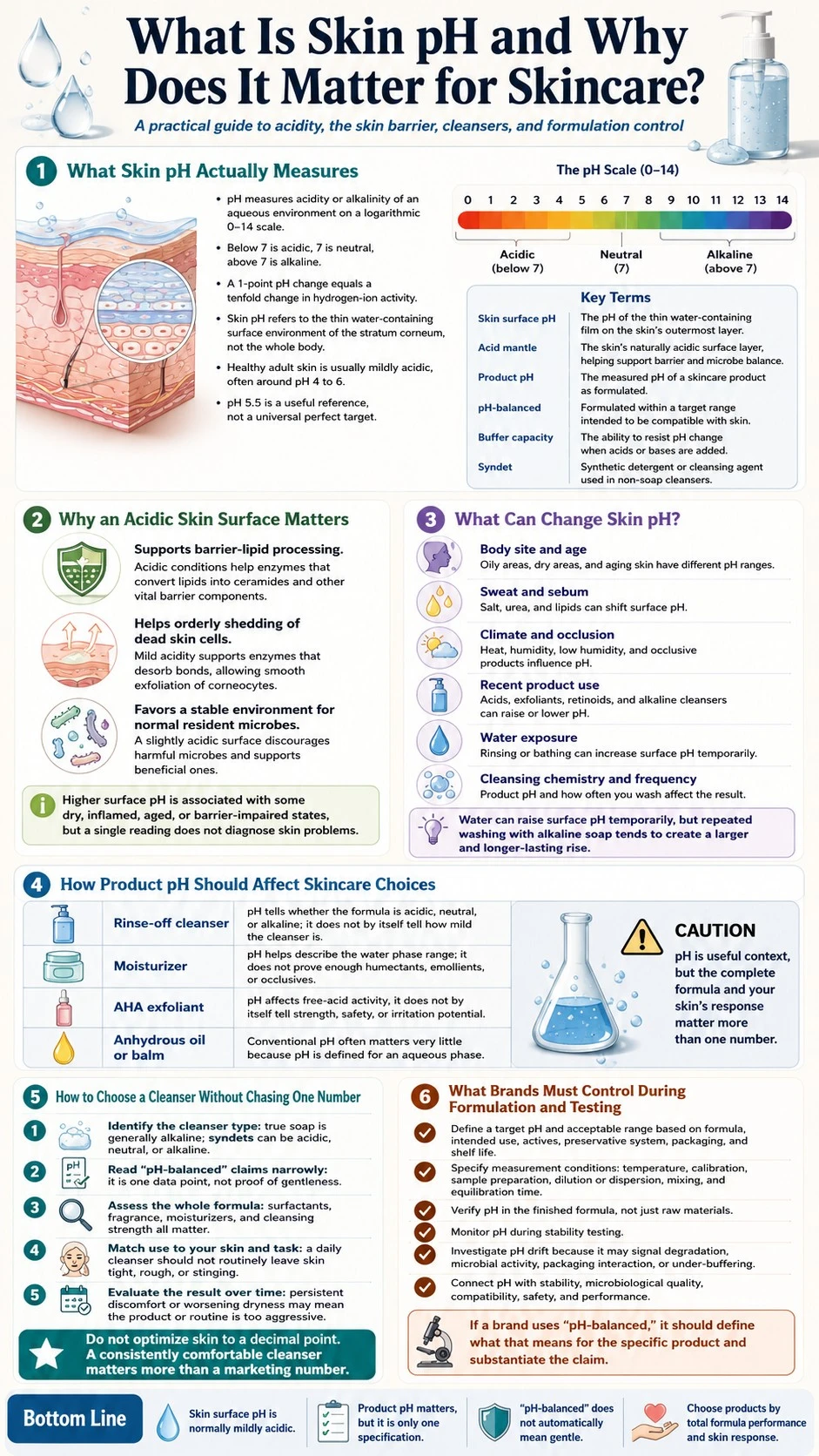
Skin pH is easy to reduce to a marketing number—usually 5.5—but real skin is more complicated. The surface is mildly acidic, its pH varies by body site and circumstances, and a single reading does not diagnose “imbalanced” skin.
The useful question is not whether every product matches one exact number. It is whether cleansing, leave-on products, and active treatments work with the skin barrier without causing avoidable dryness or irritation.
What Does Skin pH Actually Measure?
pH describes how acidic or alkaline an aqueous environment is on a logarithmic scale from 0 to 14. A value below 7 is acidic, 7 is neutral, and a value above 7 is alkaline. Because the scale is logarithmic, a change of one pH unit represents a tenfold change in hydrogen-ion activity; pH 5 is not merely a little more acidic than pH 6.
Skin pH refers to the thin, water-containing environment at the surface of the stratum corneum, not the pH of blood or the entire body. In a multicenter study of 330 people, forearm pH averaged 4.93 after participants avoided showering and cosmetics for 24 hours, and the researchers estimated a natural average of about 4.7. Published values still span a wider range, so 5.5 should be treated as a convenient reference—not a universal biological set point.[1]
This acidic surface is often called the acid mantle. It is dynamic rather than a permanent coating: sweat, sebum, free fatty acids, components of natural moisturizing factor, and normal cellular processes all contribute to it.
| Term | Practical definition | Why it matters |
|---|---|---|
| Skin surface pH | The measured acidity or alkalinity at the outer skin surface | It varies with body site, age, environment, recent washing, and measurement conditions |
| Acid mantle | The mildly acidic chemical environment at the stratum corneum surface | It participates in barrier function, shedding, and microbial ecology |
| Product pH | The pH of a product’s water phase under a stated test method | It can affect ingredient performance, preservation, texture, and skin interaction |
| pH-balanced | A marketing or formulation claim that needs a defined target range | It does not, by itself, establish mildness or suitability for every skin type |
| Buffer capacity | A formula’s resistance to pH change when acid or base is introduced | Two products with the same measured pH may behave differently during use and storage |
| Syndet | A cleanser based on synthetic detergents rather than traditional soap chemistry | Syndets can be formulated across acidic, neutral, or alkaline ranges |
Why Does an Acidic Skin Surface Matter?
The stratum corneum is not inert. Enzymes inside it help process barrier lipids, organize the spaces between skin cells, and release surface cells in a controlled way. Many of these processes are pH-sensitive. A mildly acidic environment therefore helps maintain the “brick-and-mortar” structure of the skin barrier, which limits water loss and entry of irritants.
Skin pH also influences microbial ecology. Normal skin microbes are adapted to the surface environment, while pH can affect how organisms grow or adhere. That does not mean acidic skincare sterilizes the skin, and it does not justify trying to eliminate the microbiome. The goal is a stable barrier ecosystem, not a germ-free surface.[1]
Higher surface pH is observed in some dry, inflamed, aged, or barrier-impaired skin states. Association is not the same as cause, however. A pH change may contribute to dysfunction, result from it, or do both. Persistent burning, cracking, itching, or rash deserves proper assessment rather than a self-diagnosis of “pH imbalance.”
What Can Change Skin pH?
Skin pH moves throughout the day. Body site, sweat, sebum, age, climate, occlusion, recent product use, and even the time allowed before measurement can affect the result. Water alone can raise surface pH temporarily, after which healthy skin usually re-acidifies.
Cleansing chemistry and frequency matter more than one isolated wash. In a study of 48 healthy volunteers, an alkaline soap raised hand-skin pH more than an acidic cleanser and recovery was slower; repeated washing produced a larger effect. Nurses who washed frequently with alkaline soap also had higher pH during their work shift than before it.[2]
This is why “destroyed acid mantle” is often an overstatement. Skin has recovery mechanisms. The more practical concern is repeated exposure combined with harsh surfactants, hot water, long contact time, vigorous rubbing, or inadequate moisturization—especially when the barrier is already vulnerable.
How Should Product pH Affect Your Skincare Choices?
Product pH is useful context, but its meaning changes with product type.
| Product type | What pH can tell you | What pH cannot tell you |
|---|---|---|
| Rinse-off cleanser | Whether the formula is acidic, neutral, or alkaline under the manufacturer’s test method | How mild the surfactant system is, how much residue it leaves, or how your skin will tolerate repeated use |
| Moisturizer | Whether the water phase sits within the formula’s intended range | Whether it has enough humectants, emollients, or occlusives for your skin |
| AHA exfoliant | Whether the acid is in an environment where some fraction remains available in its free-acid form | The true strength, safety, or irritation potential without concentration, acid type, directions, and the full formula |
| Anhydrous oil or balm | Often very little, because conventional pH is defined for an aqueous phase | Whether the product is stable, non-irritating, or suitable for acne-prone skin |
Exfoliating acids are the clearest example of why “match skin pH” is the wrong rule. A glycolic- or lactic-acid product may be intentionally formulated below typical skin-surface pH. Its performance depends on acid type, concentration, pH, and other ingredients. Follow the directions rather than trying to neutralize the formula with another product. The FDA also advises sun-protection precautions because alpha hydroxy acids can increase sun sensitivity.[4]
For leave-on products, judge the whole routine. Several individually tolerable formulas can still become irritating when strong skincare active ingredients are stacked too quickly. If your skin is reactive, introduce one change at a time and use a simple sensitive-skin routine as the baseline.
How to Choose a Cleanser Without Chasing One Number
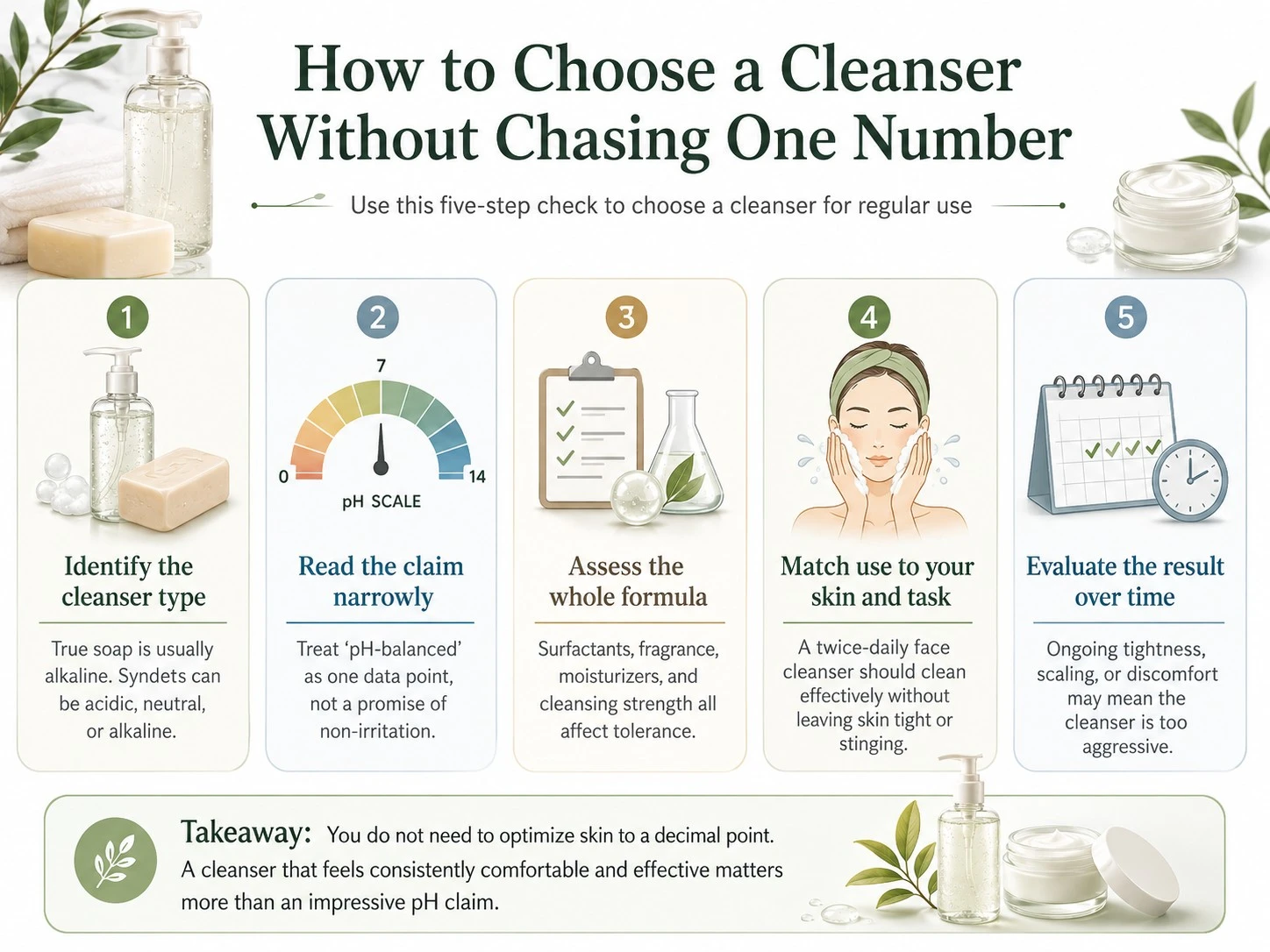
Use this five-step check to choose a cleanser for regular use:
- Identify the cleanser type. Traditional true soap is generally alkaline, while syndets can be acidic, neutral, or alkaline. A liquid texture or bar format alone does not settle the question.
- Read the claim narrowly. Treat “pH-balanced” as one data point, not a promise of non-irritation. In a study of 250 marketed cleansers, measured pH ranged from 3.59 to 10.83, and products labeled “balanced” did not share one consistent measured range.[5]
- Assess the whole formula. Surfactant system, fragrance, moisturizers, cleansing strength, and other ingredients influence tolerance. Clinical testing has shown that a cleanser at “skin pH” is not automatically milder than a neutral cleanser.[3]
- Match use to your skin and task. A face cleanser for twice-daily use should remove what is necessary without routinely leaving skin tight, rough, or stinging.
- Evaluate the result over time. Persistent post-wash discomfort, worsening scaling, or the need to compensate with increasingly heavy moisturizer suggests the product or cleansing routine may be too aggressive.
No consumer needs to optimize skin to a decimal point. A cleanser that is consistently comfortable and effective is more useful than an impressive pH claim attached to a harsh formula.
What Brands Must Control During Formulation and Testing
For formulators, pH is a specification—not a slogan. The development team should define a target and acceptable range based on the formula, intended use, active ingredients, preservative system, packaging, and expected shelf life.
Measurement conditions must also be specified. Temperature, meter calibration, sample preparation, dilution or dispersion, mixing, and equilibration time can all change the reported result. A supplier’s ingredient pH does not predict the pH of the finished product, and a value from universal indicator paper is not a substitute for a calibrated meter when releasing a batch.
Product pH can influence:
- the ionization and skin availability of some active ingredients;
- preservative performance and microbiological risk control;
- viscosity, color, odor, and emulsion behavior;
- compatibility among raw materials and with packaging components;
- comfort, especially in products used around the eyes or on compromised skin.
The target should be verified in the finished formula, then monitored during cosmetic stability testing. Any drift needs investigation because it may signal ingredient degradation, microbial activity, packaging interaction, or an under-buffered formula. A complete skincare product testing plan should connect pH with stability, microbiological quality, compatibility, safety, and performance—not treat it as a stand-alone pass/fail number.
If a brand uses “pH-balanced,” it should define what that means for the specific product, substantiate the claim, and maintain the associated batch specification. The most defensible claim is one grounded in the actual formula and its intended user, not a generic appeal to pH 5.5.
Final Thoughts
Healthy skin is usually mildly acidic, and that environment supports important barrier and microbial functions. But skin does not require every product to have the same pH, nor can one number predict whether a formula is gentle.
Use pH as part of the picture. For consumers, comfort, frequency, cleansing chemistry, active strength, and the whole routine matter. For brands, a controlled test method, justified specification, stability monitoring, and claim substantiation turn pH from marketing shorthand into meaningful product quality.
FAQs About Skin pH
Can You Test Your Skin pH at Home With pH Strips?
Not reliably. Test strips are designed for liquids and have limited resolution; skin moisture, pressure, contact time, recent washing, and residue can distort the color. Research measurements use calibrated skin-compatible electrodes under controlled conditions. A home strip result should not guide treatment or diagnose a skin condition.
Does “pH-Balanced” Always Mean pH 5.5?
No. The phrase does not communicate one universal measured value, and brands may use it for different target ranges. Look for a disclosed number or range if pH is important to you, then consider the complete formula and how your skin responds.
Do You Need a Toner to Restore Skin pH After Cleansing?
Usually not. Healthy skin can re-acidify after washing, and a well-formulated gentle cleanser should not require a separate “pH-restoring” step. Choose a toner only if its ingredients serve a clear purpose in your routine and your skin tolerates it.
Is Bar Soap Always Bad for Skin pH?
Traditional true soap is inherently alkaline and can raise surface pH, especially with frequent use. But bar format does not always mean true soap: syndet bars use different chemistry and can be formulated at lower pH. The ingredient system, usage pattern, and your skin’s response still matter.
Is Water Hardness the Same as Water pH?
No. Hardness mainly describes dissolved calcium and magnesium, while pH describes acidity or alkalinity. Hard water may affect cleanser lather and residue, but a hard-water number does not tell you the water’s pH.
Sources
[1] H. Lambers et al. Natural Skin Surface pH Is on Average Below 5, Which Is Beneficial for Its Resident Flora
[2] H. M. D. R. Gunathilake et al. The pH of Commercially Available Rinse-Off Products in Sri Lanka and Their Effect on Skin pH
[3] S. Hawkins et al. Role of pH in Skin Cleansing
[4] U.S. Food and Drug Administration. Alpha Hydroxy Acids
[5] J. A. Fleischer et al. Not All Marketed Skin Cleansers’ pH Is Optimal for Atopic Dermatitis


