


What Is a Patch Test?
An at-home patch test means applying a small amount of a new skincare product to a small area of skin before using it more widely. The goal is to see whether that product causes visible irritation or an allergic-type reaction on a limited area.
A patch test is a safety check, not a medical diagnosis. It does not prove that you are allergic to a specific ingredient, and it cannot guarantee that a product will never clog pores, trigger acne, or irritate you later.
It is most useful before you apply a new leave-on product, active ingredient, fragranced product, or eye-area product to your full face, neck, eyelids, or acne-prone areas. If the test area reacts, do not push through.
At-Home Patch Test vs Dermatologist Patch Testing
At-home skincare patch testing and professional patch testing serve different purposes.
| Type | Who Does It | Main Purpose | What It Can Tell You |
|---|---|---|---|
| At-home skincare patch test | You | Check whether one product irritates your skin | Whether that product causes a visible reaction on a small test area |
| Dermatologist patch testing | Dermatologist or allergist | Diagnose possible contact allergy | Which ingredients or allergens may be causing dermatitis |
An at-home patch test checks one product’s tolerance on your skin. Professional patch testing is a medical test used to investigate allergic contact dermatitis or repeated reactions. It may involve substances such as cosmetics, fragrances, preservatives, hair dyes, soaps, shampoos, metals, topical medications, or other allergens, with delayed reactions checked later. [3][4]
If you keep reacting to different products, an at-home test is not enough to identify the cause. A dermatologist can help find the ingredient or allergen involved.
Where Should You Patch Test Skincare?
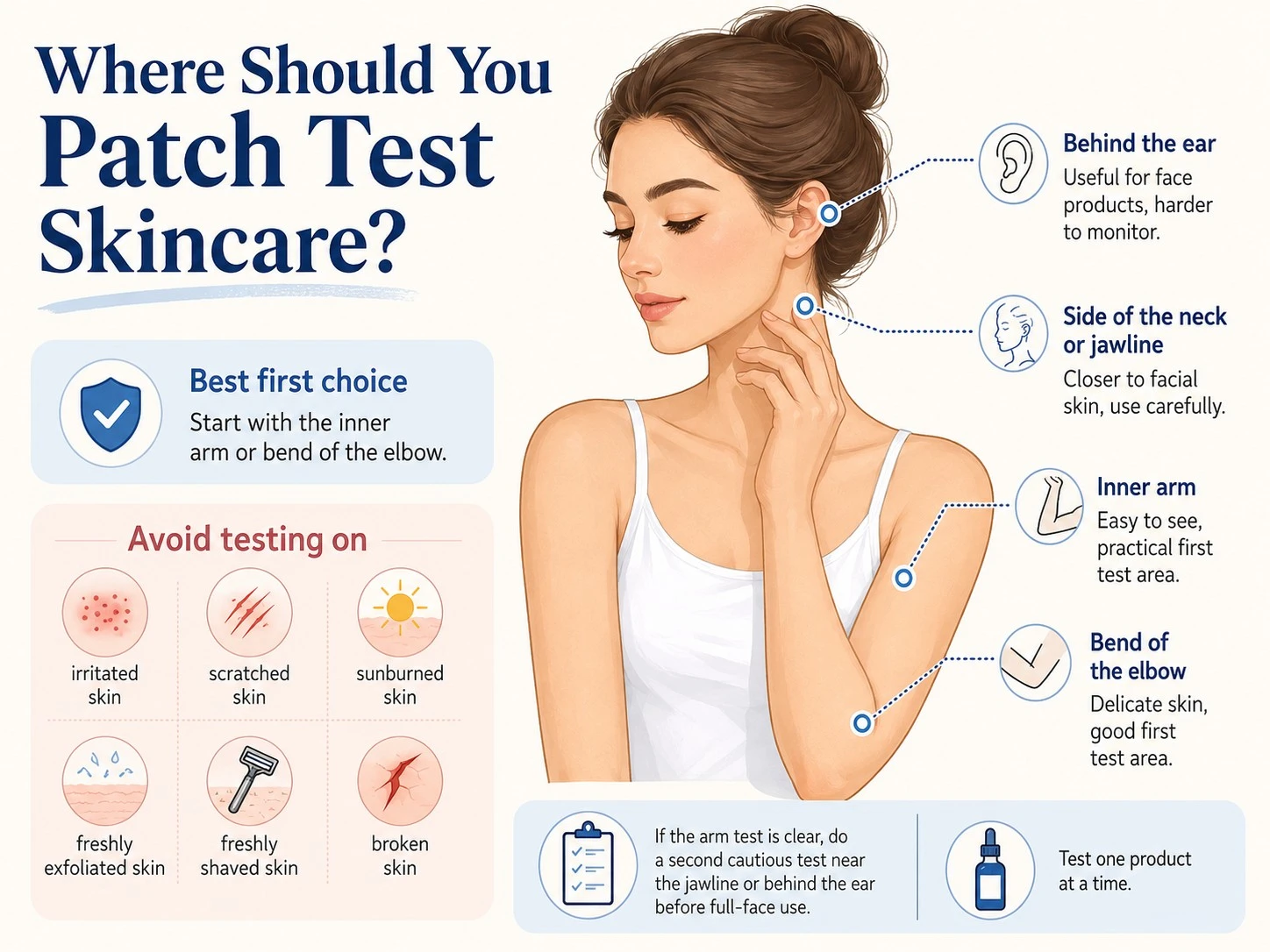
Choose a small area that is easy to check and unlikely to be rubbed, washed, or scratched during the day. Do not test on irritated, scratched, sunburned, freshly exfoliated, freshly shaved, or broken skin.
Good patch test areas include:
- Inner arm: A practical general test area that is easy to see.
- Bend of the elbow: Useful because the skin is slightly more delicate.
- Behind the ear: Helpful for face products, but harder to monitor clearly.
- Side of the neck or jawline: Closer to facial skin, but use carefully and avoid this area if your face is already irritated.
For a first test, the inner arm or bend of the elbow is usually the easiest choice. Use a small area where the product is less likely to be rubbed or washed away, such as the underside of the arm or bend of the elbow. [1]
If the product is meant for the face and the arm test is clear, you can do a second cautious test near the jawline or behind the ear before full-face use. Keep the process simple: if you test several products at once, you may not know which one caused a reaction.
How to Patch Test a New Skincare Product Step by Step
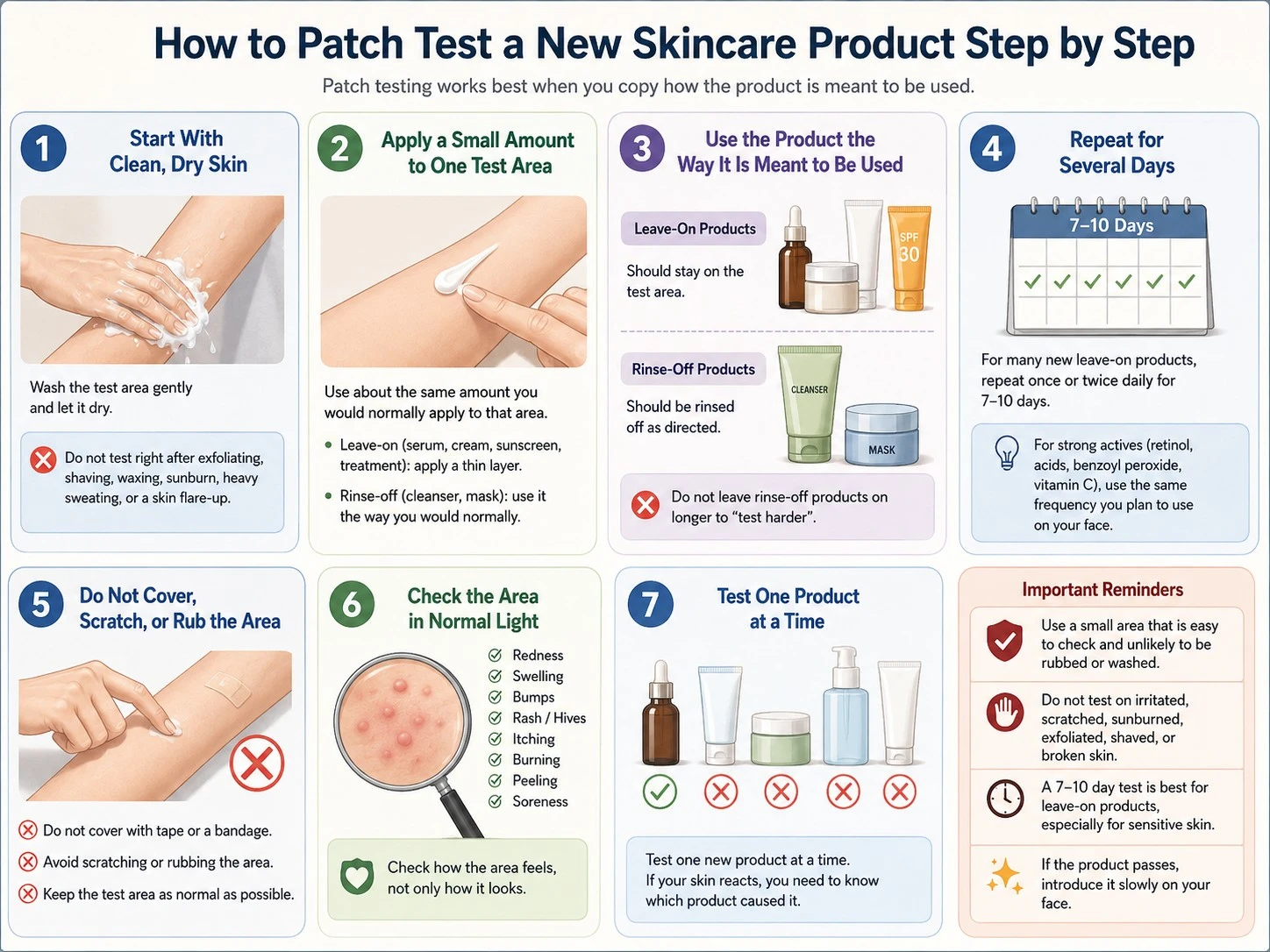
Patch testing works best when you copy how the product is meant to be used. Do not use a tiny amount that tells you nothing, and do not leave a wash-off product on longer than directed.
1. Start With Clean, Dry Skin
Wash the test area gently and let it dry. Do not test right after exfoliating, shaving, waxing, sunburn, heavy sweating, or a skin flare-up, because irritated skin is more reactive.
2. Apply a Small Amount to One Test Area
Use about the same amount you would normally apply to that area of skin. A tiny invisible dot may not give you useful information. For a leave-on serum, cream, sunscreen, or treatment, apply a thin layer. For a cleanser or mask, use it the way you would during normal use.
3. Use the Product the Way It Is Meant to Be Used
Leave-on products should stay on the test area. This includes moisturizers, serums, sunscreens, toners, essences, retinol, vitamin C, and acne treatments.
Rinse-off products should be rinsed off. This includes cleansers, wash-off masks, and exfoliating masks. Do not leave them on longer to “test harder.” That can create irritation that would not happen during normal use.
4. Repeat for Several Days
For many new leave-on skincare products, repeat the test once or twice daily for 7–10 days. [1] This gives your skin time to show delayed irritation or repeated-use sensitivity.
If you are testing a strong active, such as retinol, exfoliating acids, benzoyl peroxide, or low-pH vitamin C, use the same frequency you plan to use on your face. Do not test a retinoid twice daily if you would only use it two nights a week.
5. Do Not Cover, Scratch, or Rub the Area
Keep the test area as normal as possible. Do not cover it with tape or a bandage unless a healthcare professional tells you to, because covering can trap product, heat, and sweat. Avoid scratching the area, which can make redness and bumps harder to judge.
6. Check the Area in Normal Light
Look for redness, swelling, bumps, rash, hives, itching, burning, peeling, or soreness. Check how the area feels, not only how it looks.
A product can be wrong for your skin even if the reaction is more sensation than visible redness.
7. Test One Product at a Time
Test one new product at a time. If your skin reacts, you need to know which product caused it.
How Long Should You Patch Test Skincare?
The right patch test window depends on your skin and the product. A 24-hour test can catch fast irritation, but it can miss delayed reactions.
| Timeframe | What It Can Catch | Best Use |
|---|---|---|
| 24 hours | Fast burning, stinging, redness, or swelling | A quick first check, but not enough for reactive skin |
| 48–96 hours | Some delayed irritation or allergic-type reactions | Better for cautious users |
| 7–10 days | Repeated-use irritation and delayed reactions | Best for leave-on skincare and sensitive skin |
For most new leave-on skincare products, 7–10 days is the better home test window, especially for sensitive, acne-prone, eczema-prone, rosacea-prone, or active-treated skin. [1][2]
A shorter test is still better than no test, but do not assume a product is safe for full-face use just because nothing happened after one night. If the product passes, introduce it slowly, especially if it is a strong active.
What Reaction Means You Should Stop?
Stop the patch test and rinse the area if you see a clear reaction. Do not keep testing the same product on the same irritated spot.
Stop if you notice:
- Burning that does not fade quickly.
- Strong stinging.
- Itching.
- Redness that spreads or gets stronger.
- Swelling.
- Rash.
- Hives.
- Blisters.
- Pain.
- New bumps in the test area.
- Peeling that feels sore, raw, or cracked.
Some active products can cause mild tingling for a short time. That is not the same as strong burning, swelling, hives, or a painful rash.
If a reaction is severe, spreading, blistering, close to the eyes or lips, or does not improve, contact a dermatologist. If you have trouble breathing, facial swelling, or symptoms beyond the skin, seek urgent medical help.
Do not try to “build tolerance” to a product that clearly causes a strong reaction.
What Products Should You Patch Test First?
Products that stay on the skin, contain active ingredients, include fragrance, or touch delicate areas deserve the most caution.
| Product Type | Patch Test Priority | Why |
|---|---|---|
| Retinoids / retinol | High | Can cause dryness, peeling, and irritation |
| AHAs / BHAs / exfoliating acids | High | Can sting or over-exfoliate |
| Vitamin C serum | Medium to high | Low-pH formulas can irritate some skin |
| Benzoyl peroxide | High | Can dry or irritate skin |
| Sunscreen | High for sensitive skin | Can contain filters, fragrance, or preservatives that irritate |
| Fragranced skincare | High | Fragrance is a common irritation or allergy concern |
| Essential oils / botanical-heavy products | High | Natural does not mean non-irritating |
| Moisturizer | Medium | Usually gentler, but still worth testing for sensitive skin |
| Cleanser | Medium | Rinse-off, but fragrance and surfactants can still irritate |
| Eye cream | High | Eye-area skin is delicate |
| Hairline or face-contact products | Medium to high | Can affect the forehead, temples, jawline, or neck |
Fragrance, preservatives, hair dyes, cosmetics, soaps, shampoos, and topical medications are common categories involved in professional patch testing for allergic contact dermatitis. [3][4] This does not mean every fragranced or active product is bad; it means these products deserve a more careful start if your skin reacts easily.
How to Patch Test Different Skincare Products
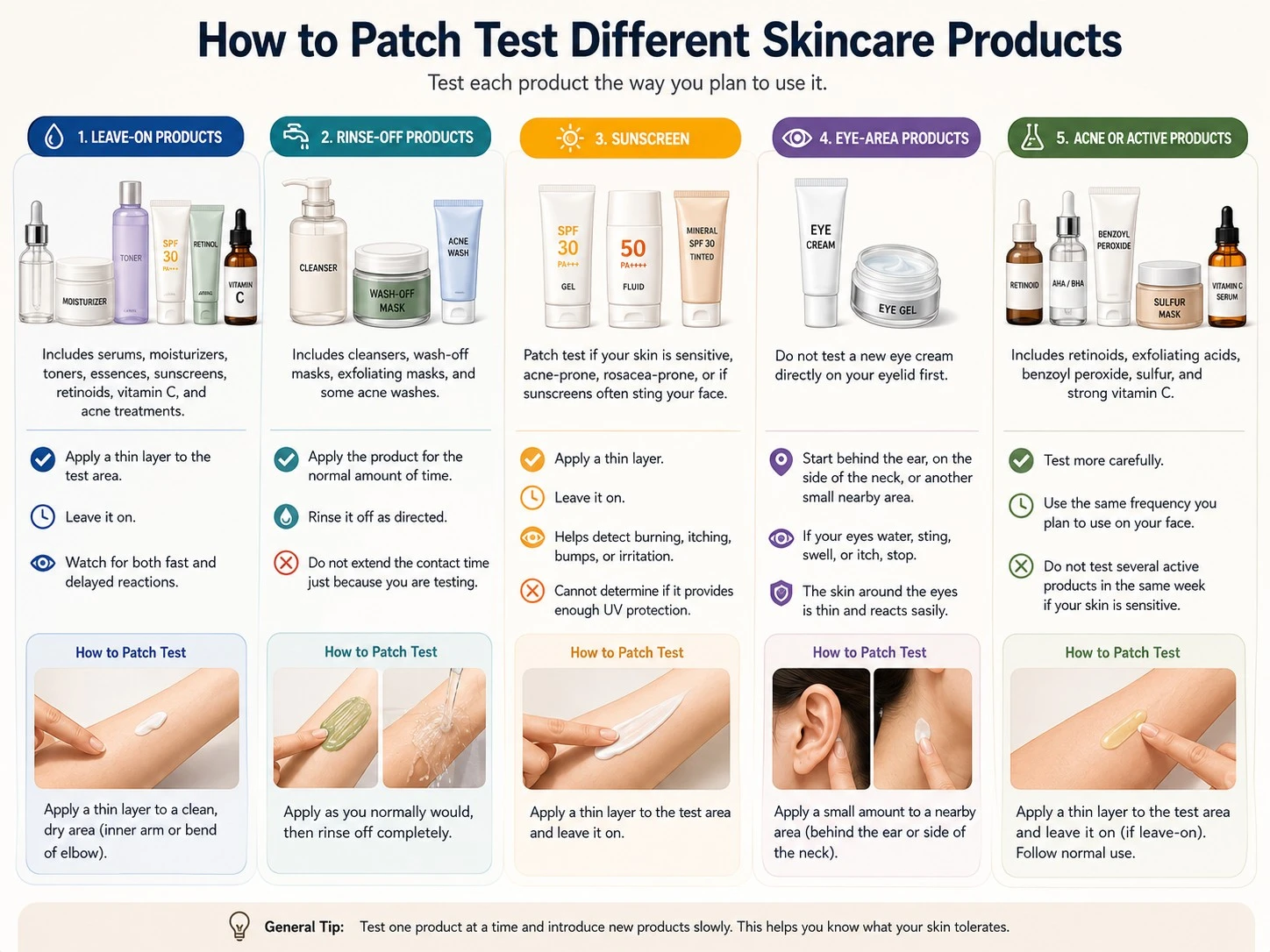
Test each product the way you plan to use it.
Leave-On Products
This includes serums, moisturizers, toners, essences, sunscreens, retinol, vitamin C, and acne treatments. Apply a thin layer to the test area, leave it on, and watch for both fast and delayed reactions.
Rinse-Off Products
This includes cleansers, wash-off masks, exfoliating masks, and some acne washes. Apply the product for the normal amount of time, then rinse it off. Do not extend the contact time just because you are testing.
Sunscreen
Patch test sunscreen if your skin is sensitive, acne-prone, rosacea-prone, or if sunscreens often sting your face. A patch test can help you notice burning, itching, bumps, or irritation, but it cannot tell you whether the sunscreen gives enough UV protection.
Eye-Area Products
Do not test a new eye cream directly on your eyelid first. Start behind the ear, on the side of the neck, or another small nearby area.
If your eyes water, sting, swell, or itch after using an eye-area product, stop. The skin around the eyes is thin and reacts easily.
Acne or Active Products
Products with retinoids, exfoliating acids, benzoyl peroxide, sulfur, or strong vitamin C should be tested more carefully. Do not test several active products in the same week if your skin is sensitive.
What a Patch Test Can and Cannot Tell You
A patch test is useful, but it has limits. Passing a patch test does not mean a product is guaranteed to work well on your whole face.
| A Patch Test Can Help You Notice | A Patch Test Cannot Guarantee |
|---|---|
| Immediate irritation | That the product will never irritate later |
| Delayed redness or itching | That it will not clog pores after weeks |
| Burning, swelling, rash, or hives | That it will work for acne, dark spots, wrinkles, or dryness |
| Whether one product seems risky | That it is safe for the eyelids or full face |
| Whether to avoid full-face use | A diagnosis of a specific allergy |
Patch testing should be paired with slow product introduction. After a product passes, do not add three new products to your face at once. Use one new product first, give your skin time, then decide whether to keep, stop, or adjust it.
For acne-prone skin, patch testing is better at finding irritation than predicting clogged pores or breakouts that appear after repeated use.
What to Do If You React During a Patch Test
If your skin reacts during a patch test, stop using the product. Do not apply more to “confirm” the reaction.
Use these steps:
- Stop the product.
- Rinse the area with cool water or a gentle cleanser.
- Apply a plain, fragrance-free moisturizer if the skin feels dry or tight.
- Avoid exfoliating acids, retinoids, fragrance, benzoyl peroxide, or strong actives over the reaction.
- Take a photo if the reaction is visible or significant.
- Contact a dermatologist if the reaction spreads, blisters, is painful, or does not improve.
Do not use the same product on your face after a failed patch test. If you need to know which ingredient caused the reaction, bring the product or ingredient list to a dermatologist. A failed patch test may have prevented a full-face reaction.
When Should You See a Dermatologist for Patch Testing?
At-home patch testing is useful for one product at a time. It is not enough when reactions keep happening or the cause is unclear.
See a dermatologist if:
- You keep reacting to different skincare products.
- You have repeated rash on the face, eyelids, neck, hands, or lips.
- Reactions appear days after using products.
- You suspect fragrance, preservatives, sunscreen filters, hair dye, metals, or topical medications.
- You have eczema, rosacea, or sensitive skin that keeps flaring.
- A reaction is painful, swollen, blistering, or spreading.
- You need to identify a specific allergen.
Professional patch testing can help identify allergens linked with contact dermatitis, especially when you react to many products but cannot tell which ingredient is responsible. [3] Do not keep guessing for months if your skin repeatedly flares.
Patch Testing Tips for Sensitive or Acne-Prone Skin
For sensitive or acne-prone skin, use these tips:
- Test one product at a time.
- Keep your normal routine stable while testing.
- Avoid starting retinol, exfoliating acids, and benzoyl peroxide in the same week.
- If your skin barrier feels damaged, repair it before testing strong actives.
- If you are acne-prone, remember that patch testing does not always predict clogged pores.
- If you are sensitive, avoid testing directly on the face first.
- Do not test right after exfoliation, shaving, waxing, sunburn, or a flare-up.
- Stop quickly if the test area burns, swells, itches, or forms a rash.
For reactive skin, slow testing is often the fastest way to avoid a setback.
Where to Go Next
Use this guide as your skincare patch test starting point, then go deeper based on your skin needs.
- For product layering, read our Skincare Routine Order.
- If your barrier feels damaged, read our Skin Barrier Guide.
- If you are acne-prone, read Skincare Routine for Acne-Prone Skin.
- If you are unsure about your skin type, start with What Is My Skin Type?
Final Thoughts
Patch testing is a small step that can prevent a bigger skin problem. Test new skincare products on a small area before full-face use, especially if they contain actives, fragrance, sunscreen filters, or ingredients your skin has not used before.
Give leave-on products enough time, stop if you see clear signs of reaction, and see a dermatologist if reactions are repeated, severe, or hard to explain.
FAQs About Patch Testing Skincare Products
How do you patch test skincare products?
Apply a small amount of the product to a small test area, such as the inner arm or bend of the elbow. Use it the way it is meant to be used. Leave on leave-on products, rinse off wash-off products, and repeat for several days while watching for irritation.
Where is the best place to patch test skincare?
The inner arm and bend of the elbow are good first choices because they are easy to see and less likely to be rubbed or washed. Behind the ear or side of the neck can be useful for face products, but avoid irritated or broken skin.
How long should I patch test skincare?
A 24-hour test can catch fast irritation, but 48–96 hours is better for delayed reactions. For many leave-on skincare products, 7–10 days is safer, especially if your skin is sensitive or has reacted before. [1]
Can I patch test skincare on my face?
You can, but it is not the best first choice for sensitive skin. Start on the inner arm or bend of the elbow. If that is clear, you can test a small area near the jawline or behind the ear before full-face use.
What does a failed patch test look like?
A failed patch test may show redness, itching, burning, swelling, rash, hives, bumps, blisters, pain, or sore peeling. If the reaction is strong, spreading, or near the eyes or lips, stop and contact a dermatologist.
Can a product still break me out after passing a patch test?
Yes. A patch test is better at finding irritation than predicting clogged pores. A product can pass a small-area test and still cause breakouts after repeated full-face use, especially if it is heavy, occlusive, or not right for acne-prone skin.
Should I patch test cleanser or wash-off products?
Yes, especially if your skin is sensitive or reactive. Apply the cleanser or wash-off product for the normal amount of time, then rinse it off. Do not leave it on longer than directed.
When do I need professional patch testing?
Consider professional patch testing if you keep reacting to different products, have repeated rashes, react days after using products, or suspect contact dermatitis. A dermatologist or allergist can test for specific allergens such as fragrance, preservatives, metals, hair dye ingredients, or topical medications. [3][4]
Sources
[1] American Academy of Dermatology Association. How to test skin care products
[2] Healthline. How to Perform a Self Skin Patch Test and Products to Avoid
[3] Cleveland Clinic. Patch Testing for Skin Allergies: Procedure & Results
[4] U.S. Food & Drug Administration. Allergens in Cosmetics


